The month of July exceeded its rainfall target despite forecasts of a below-normal month under a strengthening El Niño. The reason could be that climate change is amplifying monsoon complexity: West Pacific warming, Western Disturbances and evolving ocean conditions increasingly interact with El Niño, producing more erratic rainfall patterns.
These are among the key takeaways of a new analysis by Climate Trends. Other highlights include:
* Back-to-back monsoon systems erased much of India's rainfall deficit within a month, bringing it down from 40% to 16%.
* While 60% of the country's state area recorded normal to excess rainfall, East & Northeast India (-30%) and South India (-26%) remained significantly deficient.
* India's monsoon is entering a new climate regime: The priority is no longer just forecasting seasonal rainfall, but anticipating extreme rainfall episodes and their impacts.
July unfolded differently from initial forecasts of a below-normal season. Instead, July turned unexpectedly wet, exposing how climate change and changing ocean-atmosphere interactions are making India's monsoon harder to predict, said the Climate Trends report.
Between July 1 and July 26, India received 238.2 mm of rainfall against the normal 233.9 mm, despite the India Meteorological Department (IMD) forecasting below-normal July rainfall, at less than 94% of the Long Period Average (LPA) of 280.4mm.
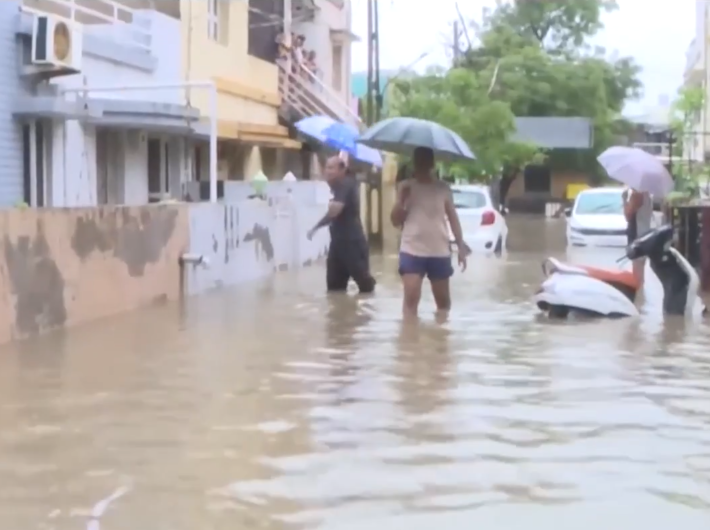
Heavy to extremely heavy rainfall has battered several parts of the country, particularly Maharashtra, Gujarat, Assam, Odisha, Jammu & Kashmir and Himachal Pradesh. Series of heavy rainfall events eliminated the daunting nationwide rainfall deficit of 40% as on June 30 to 16% as on July 29.
As of July 29, 15 states recorded normal rainfall and four states reported excess to large excess rainfall, covering 60% of the state area of the country. Meanwhile, 17 states recorded deficient rainfall, accounting for 36% of the country's state area.
Monsoon 2026, which began under the shadow of a brewing Super El Niño in the Pacific, has surprised meteorologists. The season has reinforced that the influence of global warming on the monsoon is now as significant as that of El Niño, and the two can no longer be assessed in isolation.
According to the National Oceanic and Atmospheric Administration, there is an 81 per cent chance of a very strong El Niño between October and December. There is a 1-in-5 chance of El Niño remaining weaker than very strong.
While extreme weather events were not ruled out during the active phases of monsoon, these consistent spells of rain have once again indicated that climate change plays a clear amplifying role.
“Clearly, none of the climate models captured these phenomena,” Dr K J Ramesh, former director general, IMD, was quoted as saying. “Two important factors are driving rainfall across India at present. Warming of the West Pacific (to the west of the Philippines) is the saviour of the monsoon 2026 by offsetting the monsoon rainfall suppressing potential posed by El Niño in July 2026. So far, three cyclonic circulations (two depressions and one low pressure) have been pushed through Myanmar. West Pacific cyclone remnants are entering the North Bay of Bengal and re-intensifying, making the monsoon 2026 vigorous with widespread heavy rainfall surrounding their track over the Indian Peninsula.
“On the other hand, increased Western Disturbances during the monsoon season have led to greater moisture loading from the Arabian Sea, bringing heavy rains to Maharashtra and Gujarat. These western disturbances are travelling up to Tibet, bringing rains over the eastern Himalayas, eventually triggering floods over Assam. Climate change is reshaping the characteristics of the monsoon, which models are failing to take into account,” he said.
“It is quite surprising how the monsoon is performing in an El Niño year. Just two weeks back, heavy rains had battered Maharashtra. There was a brief break, and the monsoon recovered quite quickly and is again in the active phase; in fact, it is vigorous,” said Dr Akshay Deoras, research scientist, National Centre for Atmospheric Science, University of Reading, UK.
“Monsoon has the power to run on its own, and this is what we have been witnessing this July,” said Dr Akhil Srivastava, scientist-D, National Weather Forecasting Centre (NWFC), IMD.
Monsoon 2026 is no longer just an anomaly; it is another reminder that India's monsoon is entering a new climate regime, the Climate Trends report noted. Traditional drivers such as El Niño remain important, but they are increasingly interacting with warmer oceans, changing atmospheric circulation and climate change in ways that existing models struggle to capture. The challenge ahead is not simply forecasting how much rain will fall, but understanding where, when and how intensely it will fall in a rapidly warming world.