
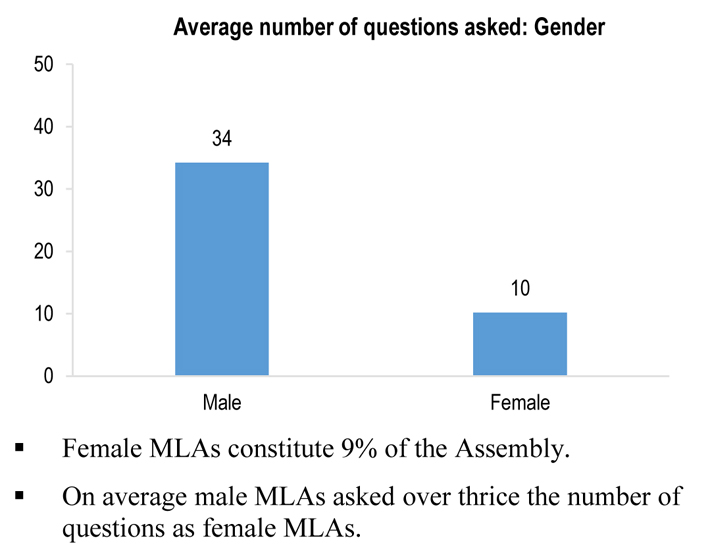
Of the MLAs, 13% completed secondary school (10th standard), while 15% completed intermediate (12th standard)
GN Bureau | January 13, 2017

A staggering 58 percent of MLAs did not ask any question, showed data compiled by PRS legislative research on the participation of members of Uttar Pradesh legislative assembly (2012-2017).
On average, each MLA asked 32 questions. Three MLAs asked more than 500 questions each.
The polls in Uttar Pradesh will staggered across seven phases for its 403-member assembly. The first phase will be on February 11 and
the last phase will be on March 8. The results will be announced on March 11.
Out of the current MLAs, 62% are between the age of 45 years and 65 years, while just 2% are below the age of 35 years.
Read: UP assembly vital statistics
Of the 404 MLAs, 13% completed secondary school (10th standard), while 15% completed intermediate (12th standard). Additionally, 31% have a graduate degree and 36% obtained a post graduate degree.
Incidentally, several MLAs declared more than one profession. 76% of MLAs declared that they were associated with agriculture, 33% MLAs with business and 9% with law. Some of the other professions MLAs are associated with are teaching, healthcare, journalism and social work.
On average MLAs with college degrees asked 70% more questions than MLAs without college degrees.
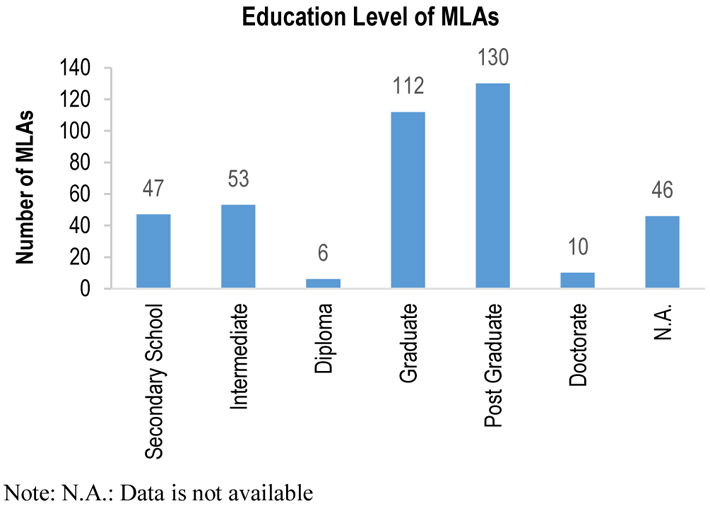
Female MLAs constitute 9% of the Assembly. On average, male MLAs asked over thrice the number of questions as female MLAs.
The 16th Legislative Assembly met for a total of 126 days. Of this, data is publically available for 107 sitting days (until 2015).
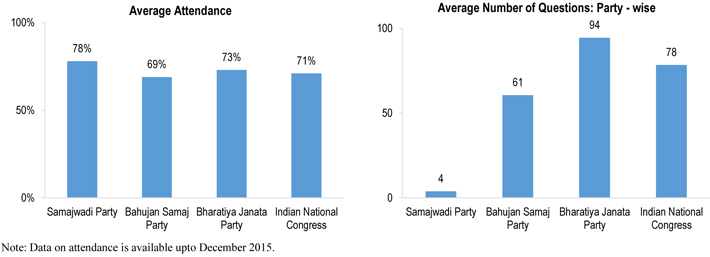
The average attendance of Samajwadi Party (SP) MLAs is the highest with 78% and that of the Bahujan Samaj Party MLAs is the lowest on average with 70%. MLAs from the ruling SP asked fewer questions on average (about 4 per MLA) compared to MLAs from the opposition parties (about 70 per MLA). This differs from the trend in Parliament where there is little difference between the numbers of questions asked by MPs from the ruling or opposition parties.
Read: Will Modi go UP or down? Here’s why all eyes are on Uttar Pradesh polls
Digital payments have become a reflex for urban India, but the confidence earned in paying has not yet carried over to borrowing. That is the central finding of `How Urban India Pays Report 2026`, released by Pahlé India Foundation in collaboration with Amazon Pay. Based on a survey of 5,149 consu
Commerce and industry minister Piyush Goyal has called upon businesses in India and the United Kingdom to translate the opportunities created by the India-UK Comprehensive Economic and Trade Agreement (CETA) into expanded trade, investment, partnerships and job creation. Addressing the Bu
The Gandhian movement in India, after Gandhi’s death, failed, says Ramachandra Guha, and blames Vinoba Bhave for it. But the movement found new, fertile grounds around the world and succeeded in bringing about a change in South Africa, the US and elsewhere. It is high time it returned home. Of cour
Tavleen Singh, noted journalist and political commentator, has turned to fiction, with her debut novel ‘The Actor’ (HaperCollins India). Set in the near future, it has a superstar, Amit Singh, turning to politics, when the political landscape is dominated by prime minister Guru Gaynendraj
The union cabinet, chaired by prime minister Narendra Modi, on Tuesday approved the setting up of a Special Purpose Vehicle (SPV), called Integrated Transport & Logistics Authority (ITLA), to strengthen research, planning, appraisal, monitoring and impact assessment within the broad domains of Transp
Foundational Literacy and Numeracy (FLN) are often described as the building blocks of education. Yet, their significance goes well beyond a child’s ability to read a sentence, write a response or solve a basic mathematical problem. These foundational skills shape how children understand the world,










