
2-day strike hits banking services

The employees unions demanded immediate revision in wages and opposed banking sector reforms

GN Bureau | February 11, 2014
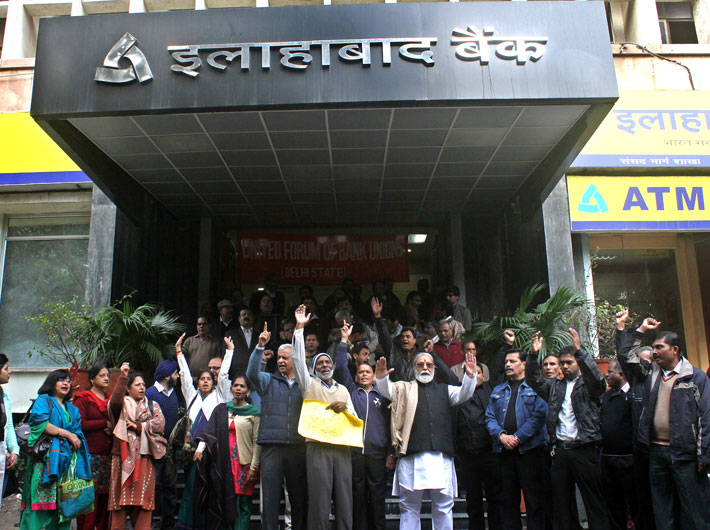


A second strike of bank employees in less than two months, has hit the banking activities across country.
The strike has been called by the United Forum of Bank Unions (UFBU), a conglomeration of nine public sector bank employees’ and officers’ unions representing one million bank workers, demanding immediate revision in wages. The unions are demanding a 30 percent hike in their salaries. While the government is offering 10 percent, which would itself cost nearly Rs 3,000 crore to the banks.

On Monday speaking at the foundation stone of Indian Overseas Bank in New Delhi, finance minister P Chidambaram said, "It cannot be that all profits are used to declare dividend and to provide enhanced wages and allowances to bank employees. A significant part of retained earnings must be used to infuse additional capital, otherwise banks will not find the amount of capital that is required over the next 5-20 years.”

The fact that strike has been called immediately after Sunday, the banking operations such as cheque clearances and cash transactions at all the branches will be affected for three days. The impact could also be seen in rural areas where people still depend on branches for all their financial transactions.

"All over the country, about 10 crore cheques worth Rs 7,40,000 crore could not be cleared. Government transactions, foreign exchange transactions and money market operations were also affected. In many places, ATMs did not function or dried up," said Vishwas Utagi, vice-president, All India Bank Employees Association (AIBEA), one of the employees unions on strike. The unions blamed Indian Banking Association (IBA), the management body, and the government for forcing them to take this path.

Earlier in December the bank employees went on for a daylong strike after the IBA offered a five percent hike in the wages of the bank employees. “It was a meagre hike offered by the IBA which was not acceptable to all the banking unions. There has been so much price rise in the last three years,” J P Sharma, vice president of AIBEA, had said.

The wages have been due for revision since November 1, 2012 for bank employees. In the last 14 months, there have been eight rounds of discussion between unions and IBA. The next round of discussion will take place on February 13 in Mumbai.

Comments


Other News

Ethanol blending: The two sides of a story

India`s crude oil consumption is estimated to be around 88.5% imported from abroad. This one single figure is also responsible for why ethanol has become both an economic strategy and fuel policy at the same time. In an economy like India, which depends so heavily on foreign oil, any increase in internat

Food inflation: Not a macroeconomic statistic but a developmental indicator

India`s retail inflation shows a reassuring picture at first glance. According to the latest data, Consumer Price Index (CPI) inflation edged up to 4.38% in June 2026 from 3.93% in May 2026, but continued to remain within the Reserve Bank of India`s (RBI) target band of 4% (+/- 2%). However, beneath this

Skin in the game or masterful market timing?

When a company founder opens their personal chequebook to buy shares in their own business, stock markets usually applaud. To the average retail investor, it feels like the ultimate vote of confidence, a sign that the people running the show have real skin in the game and believe brighter days are ahead.

India’s freedom struggle was shaped by wider Asian political thought

As we mark 80th anniversary of independence, ‘Asianism and the Fall of Empire’ (HarperCollins India) by historian Mithi Mukherjee offers a new perspective on Ind

What is colonialism? A relook at modern history

The Chromatic World Order: The Fiction That Rules Our World  By Sajid Mohamed Aakar Books  

Monsoon session of parliament adjourns sine die

The Monsoon Session, 2026 of Parliament which commenced on July 20 was adjourned sine die on Thursday. The session provided 19 sittings spread over a period of 25 days.   During the session 11 Bills were introduced in Lok Sabha and 2 Bills were introduced in Rajya Sabha. 12 B

Upcoming Conferences


-->

Archives

Current Issue

Opinion

Facebook Twitter Google Plus Linkedin Subscribe Newsletter

Twitter






