For a more sustainable solution, food policy must move beyond reacting to price volatility and towards building resilience ahead of shortages
India's retail inflation shows a reassuring picture at first glance. According to the latest data, Consumer Price Index (CPI) inflation edged up to 4.38% in June 2026 from 3.93% in May 2026, but continued to remain within the Reserve Bank of India's (RBI) target band of 4% (+/- 2%). However, beneath this calm aggregate figure lies a growing concern: food inflation, measured by the Consumer Food Price Index (CFPI), came in at 5.32%, with rural food inflation climbing to 5.45%. This widening gap between headline and food inflation for several consecutive months highlights a structural inflation challenge.
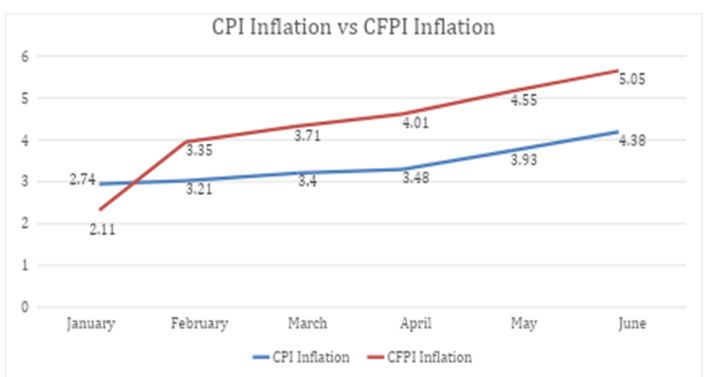
Under the revised CPI series (2024=100), food and beverages carry a weight of 36.75% of the inflation basket. Although this weight has narrowed from 45.86% under the earlier 2012 series, food remains the single largest component of household basket. It is also the most volatile: Over the past few years, food inflation has swung between sharp spikes and outright deflation, while overall inflation has remained contained. Because food occupies such a large CPI weight, its swings will remain a key driver of overall inflation.
Nothing illustrates India's food inflation problem more visibly than the TOP (tomato, onion, potato) basket: tomato prices surged 31.92% year on year, with ginger prices climbing by 50.41%. At the same time, potato prices fell by 20.34%, and peas fell by 9.67% over the same period. This is not a uniform rise: some items accelerate sharply even as others decline, reflecting an extreme volatility that challenges both farmers and consumers. Highly perishable commodities continue to move through fragmented value chains, where limited storage, cold-chain capacity and market integration leave little room to absorb supply shocks.
The deeper problem is that India's plate is changing faster than its agricultural infrastructure.
As household incomes grow and urbanisation accelerates, consumption has shifted away from cereals toward milk, fruits, vegetables, eggs, meat and processed foods. Yet the country's storage system remains overwhelmingly shaped by the procurement needs of rice and wheat. The Food Corporation of India and state agencies operate around 918 lakh tonnes (nearly 92 million tonnes) of foodgrain storage capacity. Cold storage for fruits, vegetables and dairy is far more limited and unevenly distributed, with nearly 60% of capacity concentrated in just four states: Uttar Pradesh, West Bengal, Gujarat, and Punjab. The result is a growing mismatch between what Indians consume and what the storage infrastructure can support, driving post-harvest losses and higher food prices.
Weather undoubtedly matters, and the RBI has repeatedly flagged monsoon variability as a top inflation threat. But weather alone doesn't fully explain why relatively small price shocks in India are transmitted so quickly and disproportionately into retail inflation. Extreme weather has raised production risk across crops: heatwaves lower yields of horticultural produce, untimely rainfall damages standing crops, floods impede transportation, and droughts reduce irrigation. The deeper issue is the fragility of these supply chains — fragmented markets, insufficient storage and limited resilience to shocks — which turns modest dips in output into outsized post-harvest losses and price spikes at the till.
Government responses remain overwhelmingly reactive. Every time food prices rise, governments typically resort to export restrictions, stock limits, temporary import relaxations or direct market interventions. Such measures may offer short-term relief, but they do not solve the underlying structural problems. Moreover, the uncertain policy environment they generate can discourage private investment in agricultural marketing, storage and processing, making the system less resilient.
Global experience offers a different playbook: the Netherlands has boosted farm productivity through investment in technology, logistics and greenhouse farming; Brazil has scaled output through research, irrigation and large-scale scientific farming; and Vietnam has built up its domestic food supply chains to become a major agricultural exporter. All three focused on productive capacity and supply chain resilience over market intervention, achieving greater price stability as a result.
India already possesses many of the underlying strengths needed to build a more resilient food system: it is among the world's largest producers of milk, rice, wheat, fruits and vegetables, and has rapidly expanded its digital connectivity and logistics. The challenge is not policy but gaps in integration across the agricultural value chain.
Food inflation, then, should be seen not only as a macroeconomic statistic but also as a development challenge. High and volatile food prices erode household purchasing power, particularly for low-income households, and undermine nutrition security. These problems cannot be solved by monetary policy alone: interest rates might cool demand, but they cannot fix fragmented supply chains, expand cold storage, improve logistics or protect crops from extreme weather.
For a more sustainable solution, food policy must move beyond reacting to price volatility and towards building resilience ahead of shortages. This requires scaling up investment in irrigation, climate-resilient seeds, modern warehousing, refrigerated logistics and food processing, alongside market reforms, better crop forecasting, and expanded agricultural research and extension services.
India's food inflation story is ultimately one about agricultural competitiveness, not just weather or any single month's price print. Price stability cannot be engineered after the harvest is in; it has to be built into the food system itself. As climate risk intensifies and India's consumption patterns evolve, the country needs to move decisively from short-term price management toward structural reforms that make its food supply chains resilient by design. Absent that shift, food inflation will remain not an occasional disruption, but a recurring feature of the Indian economy.
Khushbu Bura Gohain is Research Assistant, and Samriddhi Prakash is Associate - Strategy & Research, at Pahle India Foundation.