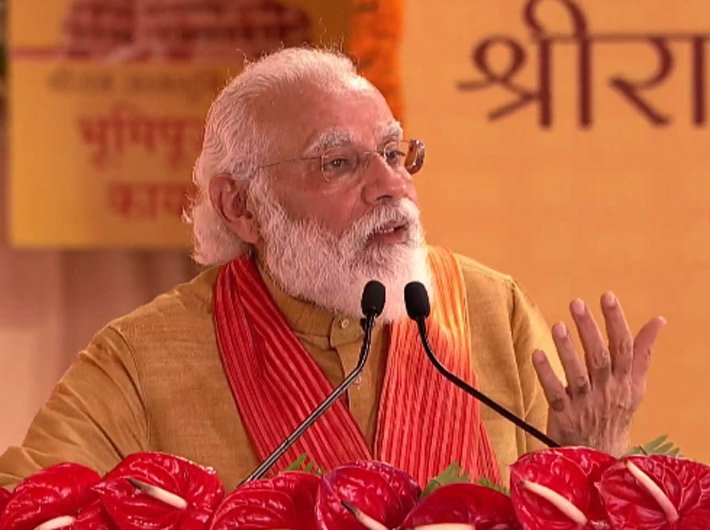
PM performs Bhoomi Pujan, says Lord Ram is the common thread of unity in diversity in the country
History was created as prime minister Narendra Modi participated in the foundation-stone-laying ceremony for the new Ram Temple in Ayodhya on Wednesday, ending centuries of controversy.
Modi performed Bhoomi Pujan at 'Shree Ram Janmabhoomi Mandir', in the presence of a very limited number of invitees, given the social-distancing norms in place due to the Covid-19 pandemic. He was accompanied by Uttar Pradesh governor Anandiben Patel, chief minister Yogi Adityanath, and RSS chief Mohan Bhagawat.
Speaking on the occasion, the PM congratulated fellow citizens and Ram Bhakts all across the world. Terming the moment as historic, he said India was starting a glorious chapter today, when people all across the country are excited and emotional to have finally achieved what they had been waiting for centuries, several of whom are scarcely able to believe that they are witnessing this day in their lifetime. He highlighted that Ram Janmabhoomi has become liberated from the cycle of breaking down and building up again, and a grand temple for Ramlalla will be constructed in place of tents now.
He said that just as 15th August is representative of sacrifices by people all across the country towards the freedom struggle, this day marks the immense dedication and continuous struggle across generations for the Ram Mandir. He recalled and paid obeisance to those whose struggles have resulted in the dream of Ram Mandir coming true.
Shree Ram – the foundation of our culture
The PM observed that while several attempts were made to wipe out his existence, Shree Ram continues to be the foundation of our culture. He said that Ram Mandir will be a modern symbol of our culture, eternal faith, national spirit and collective will power which will inspire generations to come. The construction of the temple will also open up several opportunities across sectors and will change the economy of the region.
He noted that this day stands testimony to the truth of the faith and resolution of crores of Ram Bhakts. He praised the dignity and restraint with which citizens responded, keeping the feelings of everyone in mind, when the judgment was passed by the supreme court last year, and similar dignity and restraint is visible today too.
He recalled how people from all walks of life including the poor, dalits, and tribals had been instrumental in several feats such as victory of Shree Ram, Shree Krishna lifting Govardhan, Chatrapati Shivaji establishing Swaraj, Gandhiji leading independence movement and so on. Similarly, the construction of Ram Mandir has started with the help and contribution of common citizens, he said.
Recounting the character traits of Shree Ram, Modi remarked that he always stuck to truth, and established social harmony as the cornerstone of his rule. He loved his subjects equally, but had a special kindness for the poor and the needy. There is no aspect of life where Shree Ram doesn’t serve as an inspiration, and his impact is visible in several aspects of culture, philosophy, faith and tradition of the country.
Shree Ram – the thread of unity in diversity
Modi said that Shree Ram has acted as a guiding light for people, through Valmiki Ramayan in ancient times, through Tulsidas, Kabir and Guru Nanak in medieval times and was also present in the bhajans of Mahatma Gandhi as the power source of ahimsa and satyagraha. Lord Buddha is also associated with Shree Ram, and the city of Ayodhya has been a centre of faith of Jains since centuries, he said. Recounting the different Ramayans written in various languages, he noted that Shree Ram is the common thread of unity in diversity in the country.
The PM noted that Shree Ram is revered in several countries. He listed out the Ramayans popular in countries such as Indonesia, the country with the maximum Muslim population, Cambodia, Laos, Malaysia, Thailand, Sri Lanka, Nepal, and said that references to Shree Ram are also found in Iran and China and Ram Kathas are popular in several countries. He said that people in all these countries must be feeling glad today, with the start of construction of Ram Mandir.
Inspiration for entire humanity
He expressed hope that the temple will serve as an inspiration for the entire humanity for eras to come. He noted that it is important that the message of Shree Ram, Ram Mandir and of our age old tradition reaches out to the entire world. Keeping this in mind, Ram Circuit is being made in the country.
Ram Rajya
Modi recounted the contours of ‘Ram Rajya’ dreamt by Mahatma Gandhi. He said that the teaching of Shree Ram, which have continued to guide the country, include: no one should be poor or unhappy; men and women should be equally happy; farmers and animal keepers should always be happy; the old, the kids and the doctors should always be protected; it is the duty of all to protect those seeking asylum; homeland is more than heaven; and, the more power a nation has, the greater its capacity to further peace. The PM said that Shree Ram stands for modernity as well as change. The country is progressing, following these ideals of Shree Ram.
Foundation of mutual love and brotherhood
He emphasized that the temple should be constructed on the foundation of mutual love and brotherhood. He said that through ‘sabka saath’ and with ‘sabka vishwas’, we need to achieve ‘sabka vikaas’ and make a self-confident and Aatmanirbhar Bharat. He underlined that the message of Shree Ram, that there should not be any delay and we should move forward, is the message which the country needs to follow.
‘Maryada’ during COVID
Modi ended by recalling the significance of the path of ‘maryada’ of Shree Ram in the backdrop of the COVID situation. He said that the current situation demands the maryada to be ‘do gaz ki doori – mask hai zaroori’ and exhorted everyone to follow the same.