
Coal India violating rights of adivasis, claims Amnesty

The rights of adivasis have been violated by the coal producing companies, said Amnesty India chief Aakar Patel

taru

Taru Bhatia | July 13, 2016 | New Delhi

#coal companies   #adivasis   #Coal India   #Amnesty India   #rights   #parliament  


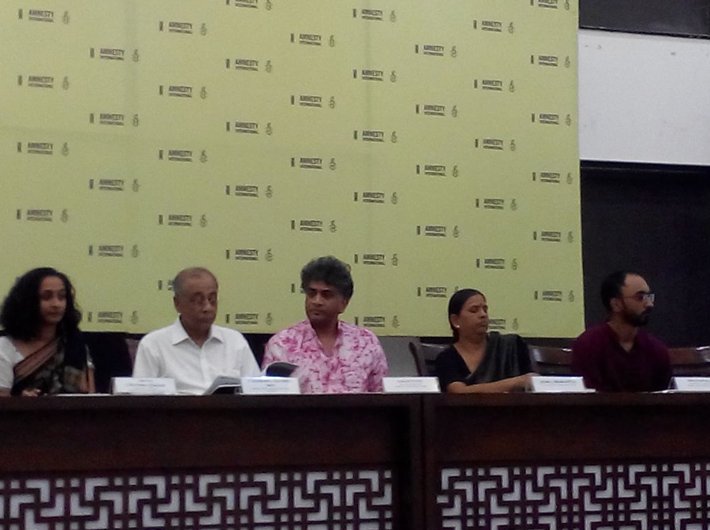
Amnesty International India has released an investigative report on how mining operations by India's largest coal producing state-owned Coal India Limited has violated the rights of adivasis. 

The report – when land is lost, do we eat coal? – released on Wednesday has traced Coal India subsidiaries in Jharkhand, Odisha and Chattisgarh. It highlights how  authorities and the company has failed to consult adivasi communities and forest dwellers before  ‘grabbing’ their land.
 
“We need to question what development we are talking about, if that doesn't include adivasi and poorest of poor,” said V. Kishore Chandra Deo, former union minister for tribal affairs.
 
The report also underlines the environmental impacts of mines, which seriously affects the lives of the indigenous communities. 
 
The report is not about the UPA government or the NDA government, it is about the rights of adivasis that have been violated by the coal producing companies including state owned Coal India Limited, said Aakar Patel, executive director, Amnesty International India. 
 
"The government plans to nearly double coal production by 2020, and Coal India wants to produce a billion tonnes of coal every year. Yet both the company and central and state governments don't seem to care to speak or listen to vulnerable adivasi communities whose lands are acquired and forests destroyed for coal mining," he added.
 
The organisation shared the report with the central and state governments and the Coal India limited, however, neither of them have responded to it yet, Patel said.
 
The report exposes a pattern of human rights violations in open cast mines run by different Coal India subsidiaries that are South Eastern Coalfields Limited's Kusumunda mine in Chattisgarh, central Coalfields Limited's Tetariakhar mine in Jharkhand and Mahanadi Coalfields Limited's Basundhara-west mine in Odisha. 
 
Patel, while releasing the report said, "We are not against mining…but [against] the irresponsible method with which the coal is extracted."
Aruna Chandrashekhar, a senior researcher of the report with Amnesty International India, said adivasis were left out  of decision making and were not spoken to before the coal companies acquired their land for mining. 
 
Indian companies have breached both Indian and international laws by not respecting human rights, including by carrying out due diligence to ensure that government agencies conduct proper consultation with regard to coal mining operations. This responsibility exists over and above compliance with national laws, Chandrashekhar added. 
 
To make matters worse, in recent years, successive governments have sought to dilute requirements for public hearings for certain categories of mines, putting the rights of local communities at further risks, she said. 
 
Sudha Bharadwaj, a human rights lawyer said, "If state owned companies are doing such human rights violations, imagine what private companies must be doing. Just imagine."
 
She added that we need to question whether we need so many power plants and coal mining at policy level. 
Amnesty International India has submitted various recommendations to the central and state governments. The most important of which is to amend the coal bearing act.
 

Comments


Other News

Centre intensifies preparedness as El Niño threat looms

Amid uncertainty in the southwest monsoon due to the potential impact of El Niño, the government is addressing the situation with comprehensive preparedness, a clear strategy, and strong ground-level action. While challenges remain, the entire system has been activated in advance and is working proa

India is crossing a climate threshold

On June 28, Delhi recorded a maximum temperature of 41.3°C, four degrees above the seasonal normal. But the “feels like” temperature, which factors in humidity, showed more than 51°C. What the body experienced was very different from what the thermometer recorded.  India`

The Geography of India’s inflation

India today finds itself in an unusual position. At a time when geopolitical conflicts, trade fragmentation, and supply-chain disruptions are reshaping the global economy, the country`s macroeconomic fundamentals remain relatively upwards. Growth remains among the highest in the world, inflation has larg

How to listen to the great storytellers that the trees are

The Trees of My Country: A Natural History of India in 50 Trees By T. R. Shankar Raman, with illustrations by Manali Patil Aleph Book Company, 284 pages, Rs 1,499  

This tree in Bihar turns out to be the oldest accurately dated banyan

A banyan tree in Munger, Bihar, estimated to be around 700 years old, has been identified as the oldest accurately dated banyan tree, Ficus benghalensis, using radiocarbon dating, a method that relies exclusively on scientific evidence rather than historical records or local lore. Banyan

Corporate Governance 3.0: What the boardroom of 2030 will look like

The phrase "corporate governance" often evokes images of board meetings, compliance checklists, and regulatory filings. For years, governance was viewed primarily as a mechanism to prevent fraud, protect minority shareholders, and ensure regulatory compliance. However, the events of the last deca


Archives

Current Issue

Opinion

Facebook Twitter Google Plus Linkedin Subscribe Newsletter

Twitter







