Rates slashed to 22% for domestic firms, 15% for new domestic manufacturing companies: new reliefs to cost the exchequer Rs 1,45,000 crore
Aiming to dispel the clouds of a slowdown, the government on Friday announced a series of measures including corporate tax breaks to revive economic activities. The stock market, depressed for a while, welcomed the move that would cost the exchequer Rs 1,45,000 crore.
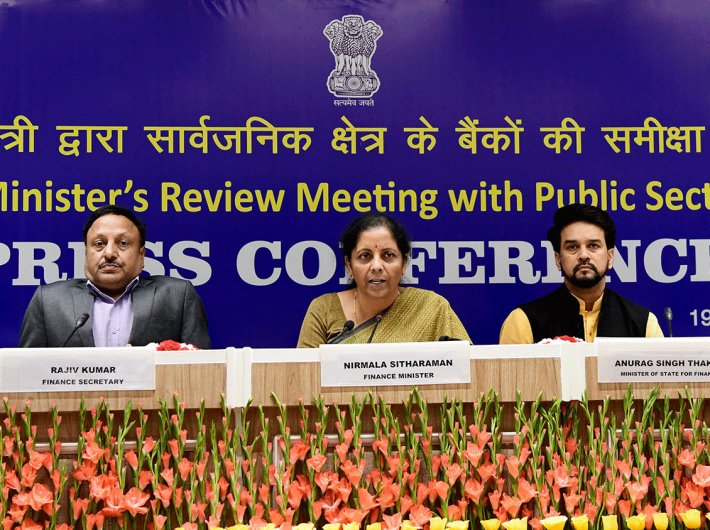
Union minister for finance & corporate affairs Nirmala Sitaraman addressed a press conference in Goa, and announced that the government had brought in the Taxation Laws (Amendment) Ordinance 2019 to make certain amendments in the Income-tax Act 1961 and the Finance (No. 2) Act 2019. The salient features of these amendments are:
a. In order to promote growth and investment, a new provision has been inserted in the Income-tax Act with effect from FY 2019-20 which allows any domestic company an option to pay income-tax at the rate of 22% subject to condition that they will not avail any exemption/incentive. The effective tax rate for these companies shall be 25.17% inclusive of surcharge and cess. Also, such companies shall not be required to pay minimum alternate tax.
b. In order to attract fresh investment in manufacturing and thereby provide boost to ‘Make-in-India’ initiative, another new provision has been inserted in the Income-tax Act with effect from FY 2019-20 which allows any new domestic company incorporated on or after October 1, 2019 making fresh investment in manufacturing, an option to pay income-tax at the rate of 15%. This benefit is available to companies which do not avail any exemption/incentive and commences their production on or before March 31, 2023. The effective tax rate for these companies shall be 17.01% inclusive of surcharge and cess. Also, such companies shall not be required to pay minimum alternate tax.
c. A company which does not opt for the concessional tax regime and avails the tax exemption/incentive shall continue to pay tax at the pre-amended rate. However, these companies can opt for the concessional tax regime after expiry of their tax holiday/exemption period. After the exercise of the option they shall be liable to pay tax at the rate of 22% and option once exercised cannot be subsequently withdrawn. Further, in order to provide relief to companies which continue to avail exemptions/incentives, the rate of Minimum Alternate Tax has been reduced from existing 18.5% to 15%.
d. In order to stabilise the flow of funds into the capital market, it is provided that enhanced surcharge introduced by the Finance (No.2) Act, 2019 shall not apply on capital gains arising on sale of equity share in a company or a unit of an equity oriented fund or a unit of a business trust liable for securities transaction tax, in the hands of an individual, HUF, AOP, BOI and AJP.
e. The enhanced surcharge shall also not apply to capital gains arising on sale of any security including derivatives, in the hands of foreign portfolio investors (FPIs).
f. In order to provide relief to listed companies which have already made a public announcement of buy-back before July 5, 2019, it is provided that tax on buy-back of shares in case of such companies shall not be charged.
g. The government has also decided to expand the scope of CSR 2 percent spending. Now CSR 2% fund can be spent on incubators funded by central or state government or any agency or public sector undertaking of central or state government, and, making contributions to public funded universities, IITs, national laboratories and autonomous bodies (established under the auspices of ICAR, ICMR, CSIR, DAE, DRDO, DST, Ministry of Electronics and Information Technology) engaged in conducting research in science, technology, engineering and medicine aimed at promoting SDGs.
The total revenue foregone for the reduction in corporate tax rate and other relief estimated at Rs. 1,45,000 crore, an official press release said.