
Art students from BHU are on a mission to convert filthy places into art works

Swati Chandra | May 18, 2015 | New Delhi

Nature and its elements have taken the place where there was once filth and heaps of garbage.
Initiating the concept of public art in the holy town of Varanasi, visual arts students from Banaras Hindu University (BHU) led by their professor Suresh K Nair have painted beautiful wall murals on shabby walls across the temple town.
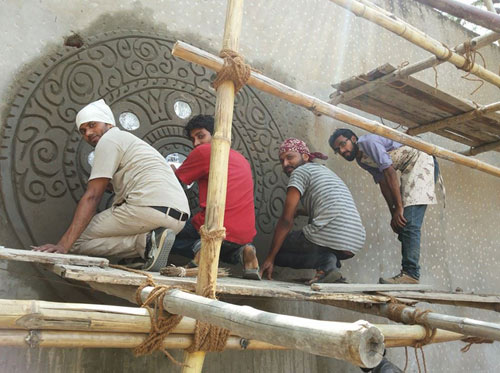
“Public art is permanent and accessible to everyone. People who pass by will see it. It’s a direct mode of conversation between artists and the people. We are using this to create awareness towards environment and cleanliness,” says Nair.
“We have named it the ‘Earth project’. Unlike conventional murals depicting mythological tales and legends, these under the ‘Earth Project’ have a symbolic resemblance to nature and its elements.”
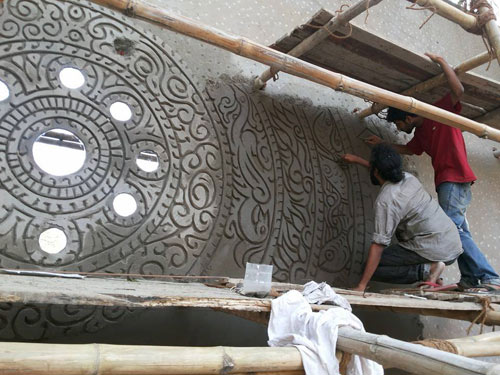
The group started from a private school adjacent to the university campus. A portion of the school ground was muddy and had become a garbage dump. The school administration got in touch with Nair and his team, and they decided to transform the area.
The artists decided to erect a wall and paint murals representing five elements of nature. Symbols like fish, birds, human body and mirror to make it visually appealing and add a sense of playfulness. The green coloured 20 ft x 40 ft wall mural is the first ecology-based work in the country.
The idea behind this was to impart basic awareness and knowledge about nature and increase sensibility towards it among the school students. From then onwards, the team is working towards identifying and transforming filthy serpentine lanes and roads in the old city areas.
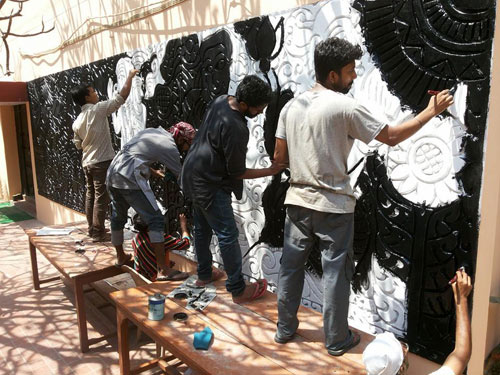
“We are trying to involve locals into this work. If they will participate, they will have a sense of ownership and it will be easier to convince others as well,” Nair informed. Communities, organisations, residents of several colonies have in fact identified their own places and approached the team to prepare wall murals.
Apart from painting, the team is making sure that the area remains clean and keeping dust bins and billboards to maintain the place and art works.
These artist’s have not confined their works to Varanasi only. The team has made a similar wall mural at a government primary school premises in Puducherry. Another mural depicting the story of partition has been erected near Wagah Border.
Success in today’s professional organisation is no longer solely determined by academic qualifications, technical expertise or years of experience. While these attributes do matter, organisations increasingly value individuals who demonstrate the right mindset and behavioural qualities. The ability
Prime minister Narendra Modi interacted with CEOs and Founders of 20 Space Startups at Seva Teerth on Friday. CEOs of leading companies in the space sector working in diverse fields ranging from building rockets and reusable semi-cryogenic launch vehicles, avionics, satelli
In 2012, Anita Dash wasn`t dreaming of building a dairy brand. She wasn`t studying business models or planning market expansion. Like countless mothers across India, her focus was on something much simpler: giving her children a better future. At the time, her most valuable
India`s crude oil consumption is estimated to be around 88.5% imported from abroad. This one single figure is also responsible for why ethanol has become both an economic strategy and fuel policy at the same time. In an economy like India, which depends so heavily on foreign oil, any increase in internat
India`s retail inflation shows a reassuring picture at first glance. According to the latest data, Consumer Price Index (CPI) inflation edged up to 4.38% in June 2026 from 3.93% in May 2026, but continued to remain within the Reserve Bank of India`s (RBI) target band of 4% (+/- 2%). However, beneath this
When a company founder opens their personal chequebook to buy shares in their own business, stock markets usually applaud. To the average retail investor, it feels like the ultimate vote of confidence, a sign that the people running the show have real skin in the game and believe brighter days are ahead.











