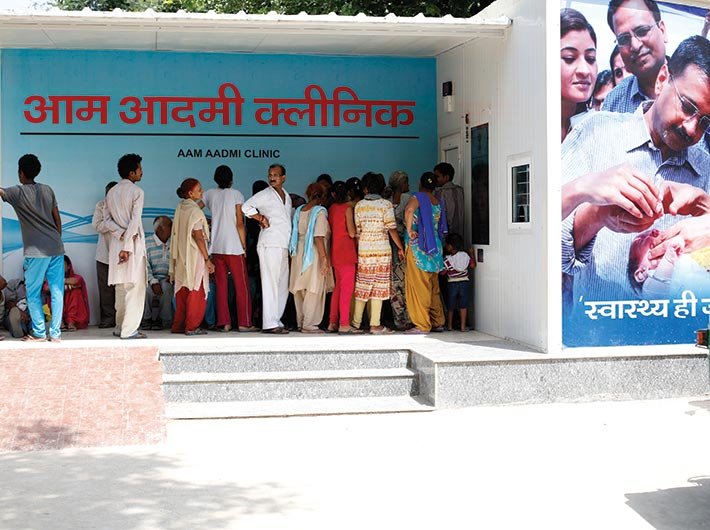
On a sweltering August morning, the porch of the two-room clinic in Rajiv Gandhi JJ colony, Peeragarhi, north-west Delhi, is thinly crowded. Patients eagerly await their turn to see the doctor. From inside the air-conditioned clinic, an official dispenses tokens to patients from a vending machine. By 11 am, the crowd outside the clinic has nearly doubled. Instead of falling in, people huddle to get the cover of the roof from the sun. Meanwhile, more people are coming; some appear to be about to lose their patience as they jostle to stand close to the entrance, clogging the entry-exit point.
This is the scene at the first ‘aam aadmi’ clinic launched by Delhi chief minister Arvind Kejriwal as a model grassroot quality healthcare facility. The venue for the pilot clinic is chosen deliberately. This colony had first come up as a relief camp for migrants from Punjab in the eighties. Even after two decades, its roads are dilapidated and general amenities nearly missing. This place is home to about 4,000 people – mostly from lower middle class background.
As part of his outreach to aam aadmi, Kejriwal has promised to provide a “private hospital-like amenity for free’’ to them. To start with the Delhi government has plans to set up 15 such clinics in each of the assembly constituencies totaling 1,000 across the capital.
The clinic is a major hit with the people who can ill-afford the expensive private hospitals and are left with no option but to visit the crammed and ill-equipped government hospitals for healthcare.
“We do not refuse to treat people who are not from this colony. This is a reason for the overwhelming number of patients,” says Uday Kushwaha, laboratory technician, posted at the clinic.
Middle-aged Kiran Devi suffers from diabetes and had been visiting the local dispensary for blood tests etc. She complains that the dispensary would invariably run out of medicines forcing her to buy the same from the market. Seated comfortably under the roof shade, Kiran Devi, is on her maiden visit to the aam aadmi clinic. “I hope to have a better experience here,’’ she quips.
Auto-rickshaw driver Rajinder Kumar has come with his 22-year-old son Saurabh, who has been running high fever for three days. “The dispensary in our area only has basic medicines. The other day I stood in queue for over an hour only to be handed a tablet of paracetamol,” he says.
Besides providing medical check-up and medicines, the aam aadmi clinic also has facility to conduct some health tests. “Let us see if this facility is any better,” Kumar says, keeping a hawk’s eye on the display board for his turn to see the doctor.
Lalit Sharma tends to his four-year-old daughter while wife Anjali is waiting for the clinic’s laboratory technician. In her late 20s, Anjali is pregnant with their second child. She had been seeing doctors at Bhagwan Mahavir hospital, Pitampura, where doctors had advised her to carry out thalassemia, ultrasound and thyroid function tests. The couple have come to the aam aadmi clinic hoping that the tests would be for free.
Anjali manages to jostle past the unruly crowd and get inside the clinic to speak to technician Kushwaha. She returns with a sullen face. He has apparently told her that her tests require sophisticated machines which are not available in the clinic. The clinic only provides facilities for basic tests like liver function test, lipid profile and blood count.
The Sharmas are apparently not happy at this. They had faced similar problems during Anjali’s first pregnancy. “That time, we were consulting a doctor at Sanjay Gandhi memorial hospital. There, we were given appointment for tests two months after it was advised and finally told that these should be done at a private lab,’’ says Sharma, angrily. This, he claimed, would happen in spite of the hospital having all the facilities.
Notwithstanding their fresh experience, Anjali feels that ‘mohalla clinic’ was a good idea. “Whenever I go to the OPD of a government hospital, it takes hours to see a doctor. I wish this clinic was equipped to handle pregnancy related matters also.’’
Each time she goes for a check-up or test, Anjali has to carry her daughter as there is no one to look after her at home. Once again, Lalit had taken a day off from his work as a commercial vehicle driver to ensure his wife’s tests are done. “This time, my employer has served me an ultimatum. Now that we have no option we have to go to a private laboratory,” he says. The family will surely have to shell out a major chunk of Lalit’s meagre salary of Rs 12,000 for the tests.
To give it a feel of luxury of a private hospital, the clinic is equipped with an air-conditioner where the doctor, the pharmacist, the lab technician and auxiliary nurse midwife (ANM) sit. The white interiors of the clinic make it look like a private nursing home to patients who are relieved to be in after waiting in the sun for long.
Near afternoon, Bhavna Sharma, pharmacist, loses her cool to a patient who flaunts his ‘’VIP connection’’ and demands to see the doctor on priority basis. “Should we follow procedures or give in to nepotism?” she fumes. The patient is a 10-year-old boy with high fever, who is struggling to keep himself under the shade. On request, the pharmacist allows the boy to have a seat inside the ‘air-conditioned’ clinic.
Despite the space crunch and other inadequacies, people have welcomed the aam aadmi clinic which gives them an option to the ill-equipped dispensaries and government hospitals. Sudesh Rani, 60, had met with a horrific accident in 2000, which has left her unable to walk properly. She is happy to see the aam aadmi clinic. She feels it would spare her the pain and trouble of travelling to and walking through the long and cramped corridors of the government hospitals.
The clinic is a hit with diabetic patients. “I have been coming here regularly for the past two months. I get all my medicines here,” says Kiran Devi.
A little past noon, the front porch resembles a battleground as people start getting impatient to see the doctor. Some are late for work and others for tuitions. As the clinic staff stoically adheres to the serial number, some of the patients begin to leave. A girl in her teens, who had come to see doctor for an ear ache, decides to go back else she would get late for her tuition class.
The clinic is, perhaps, first attempt at providing affordable healthcare at grass roots in India. However, given the enormous population base and the relatively small number of proposed clinics across Delhi (1,000), the scheme is unlikely to become a panacea for all the ills ailing our healthcare system.
[email protected]