
Khadi: Not just for sake of appearances

Modi’s promotion of the textile is welcome, now go for a holistic revival with bottoms-up approach

GN Bureau | April 2, 2016

#weavers   #Narendra Modi   #KVIC   #Khadi  


There has been a sudden revival of “nationalism” – at least of one version of it, and yet it is difficult to imagine that not long ago, one of the prime symbols of nationalism was not an animal, not a divisive slogan but a cloth. After independence, khadi was reduced to a formal uniform of the political class, and along with its wearers, khadi too lost its symbolic force. Its charm remained merely skin-deep.

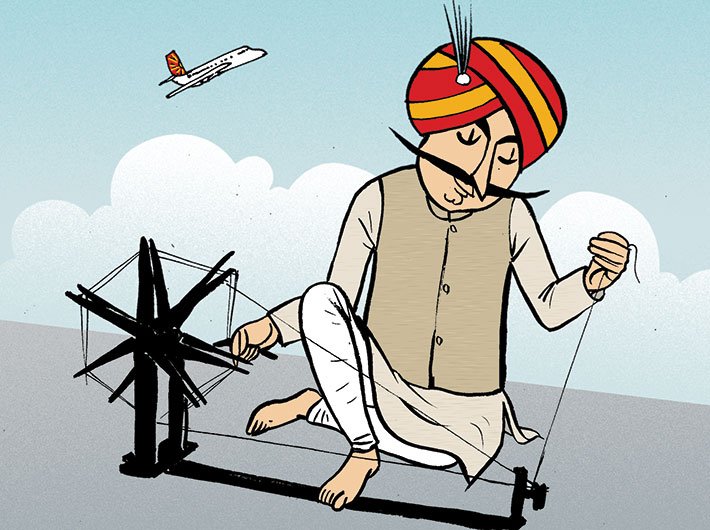
Now, prime minister Narendra Modi has taken up the task of making khadi popular again. He himself has been a sort of brand ambassador for khadi, making his style of kurtas a fashion statement. His championing of khadi goes counter to the trend of even the political class giving up on khadi.

After Modi spoke of the virtues of khadi, Air India has adopted the fabric for its crew, and the government officers too may don khadi soon. For khadi lovers, it’s all good news.

In Gandhi’s days, khadi was a weapon of the swadeshi, against the imported cloth. After independence, its import should be no less. Gandhi promoted khadi because the hand-spun cotton cloth was at the centre of his vision for India’s self-reliant economy. In interior villages, where there are no job opportunities other than the rain-dependent agriculture, khadi-spinning and similar economic activities can give people a means of livelihood. That role of khadi remains as relevant today as ever, and it can help reduce the mass exodus to cities in search of jobs.

What the current push from the prime minister will do for khadi is to increase its demand. It will have to be complemented with a similar push to increase its supply from the grassroots. For that, the government, through the Khadi and Village Industries Commission (KVIC), should do more handholding for the struggling and barely surviving cooperative societies in the field of khadi production – their problems go well beyond the lack of demand for khadi.


Comments


Other News

Beyond toilets: Why open defecation persists in rural India

Despite the awareness campaigns on sanitation across India, open defecation (OD) is practised openly and widely in both rural and urban areas. Research shows that rural respondents are well aware of the negative impacts of OD, yet this awareness does not lead to toilet construction or use. In rural North I

What unpaid nation builders want from policymakers

The Supreme Court recently described homemakers as “nation builders” and fixed a notional monthly income of Rs 30,000 for them in motor accident compensation cases. The judgment was not about wages. It was about compensation. Yet it inadvertently raised a larger economic question: If a homemake

What the US–Iran peace deal means for India

After months of rising tensions, the United States and Iran have reached a memorandum of understanding called the "Islamabad Agreement." This agreement allows for the immediate reopening of the Strait of Hormuz without tolls and provides Iran with relief from sanctions, depending on its complianc

V. M. Tarkunde: A legal luminary par excellence

14 Lawyers: Portraits from The Bar By Raju Ramachandran  Juggernaut, 248 pages, Rs. 799  

The Cost of Obesity

The latest episode of Checks and Balances focuses on the ticking time bomb of obesity in India, and Geetanjali Minhas of Governance Now spoke with a panel of experts. You can watch the episode here: https://youtu.be/mH

US-Iran deal: Path to peace or prelude to deeper regional quagmire?

In the midst of deep mistrust, the US and Iran are reported to have reached a framework deal for ending the West Asian conflict. But whether it will result in any meaningful breakthrough or pave the way for any lasting peace in the region, is in the realm of speculation.   During


Archives

Current Issue

Opinion

Facebook Twitter Google Plus Linkedin Subscribe Newsletter

Twitter







