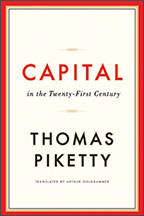
French economist Thomas Picketty’s book 'Capital in the Twenty-First Century' has critical lessons for India
Will India return to the higher economic growth trajectory? Will Modi (if he becomes the PM) and his supposedly decisive administrative style boost the manufacturing sector and create jobs that a mammoth number of youngsters entering the economy will need? Will the so-called Gujarat model or some growth-obsessed variant of it take care of rampant poverty and malnutrition? These are the questions raised in debates during these, most significant elections in recent decades. But we are still not talking about the most important question when it comes to economy, the biggest economic challenge the next government will face.
It is inequality. Simplistically put, it is the vague notion that post-liberalisation the rich have become richer and the poor the poorer. There is an equally simplistic counter-argument to it: the rich may have gotten better at making more money but the poor too have benefitted from it, courtesy trickle-down effect. That is, of course, true to an extent. The overall incidence of poverty has declined, no matter which yardstick we use. Be it the number of mobile phones or be it the access to education and health care, on any parameter, the poor are better off than before.
This debate soon veers towards growth vs development that we had especially last year, thanks to the new works from Amartya Sen and Jean Dreze on one hand and Jagadish Bhagwati and Arvind Panagariya on the other. Inequality goes much beyond that.
Though the topic is not making waves in India, it may do so soon, because it is the main talking point among the commentators in the west of late. Firstly, it was the Occupy movement which drew attention to the ‘one percent’, the wealthiest few who draw far more benefits from economy than the rest of us. And secondly, because the economist who drew people’s attention to the ‘one percent’ syndrome has come out with a book that is making waves.
French economist Thomas Picketty’s Capital in the Twenty-First Century (translated from French and published this month by Harvard University Press) is attracting rave reviews. Paul Krugman calls it “truly superb book”. More: “It’s a work that melds grand historical sweep—when was the last time you heard an economist invoke Jane Austen and Balzac?—with painstaking data analysis… This is a book that will change both the way we think about society and the way we do economics.” Just one more sample, from the mainstream business press. The Financial Times finds it is “an extraordinarily important book”.
Picketty’s central finding is that the level of inequality – not just in incomes but in overall capital including wealth (land, shares, etc) – between the top and bottom tiers of society in the west was very high, but after the World War-II the state’s socialist interventions reduced the difference to an extent. But since the 1990s inequality is increasing – around the world. He also briefly touches upon the Indian scenario, based on income tax data from 1922 to the early 2000s. His prognosis: inequality in overall capital is increasing.
In the case of India, it is possible to estimate (using tax return data) that the increase in the upper centile’s share of national income explains between one-quarter and one-third of the “black hole” of growth between 1990 and 2000.
Piketty has explored the Indian scene in detail in a discussion paper, written with Abhijeet Banerjee (of ‘Poor Economics’ fame) and published by the Centre for Economic Policy Research in 2004. Here are the specific findings of ‘Top Indian Incomes, 1922-2000’:
“Our data shows that the shares of the top 0.01%, the top 0.1% and the top 1% in total income shrank substantially from the 1950s until the early-to-mid 1980s but then went back up again, so that today these shares are only slightly below what they were in the 1920s-1930s. We argue that this U-shaped pattern is broadly consistent with the evolution of economic policy in India: The period from the 1950s to the early-to-mid 1980s was also the period of ‘socialist’ policies in India, while the subsequent period, starting with the rise of Rajiv Gandhi, saw a gradual shift towards more pro-business policies. Although the initial share of this group was small, the fact that the rich were getting richer had a non-trivial impact on the overall income distribution. In particular, its impact is not large enough to fully explain the gap observed during the 1990s between average consumption growth in survey-based NSS data and the National accounts based NAS data, but is sufficiently large to explain a non-negligible part of it (between 20% and 40%).”
Crony capitalism of the past decade must have pushed this trend further, and the next government will be cheered heavily to pursue even more pro-business policies. In short, inequality is going to only increase further.
As for solution, it is of course quite technical for a detailed explanation here but simply put, Picketty is talking about heavy wealth tax for the wealthiest. That seems very unlikely. But it brings us to the central truth of Picketty’s awe-inspiring work: “Whenever one speaks about the distribution of wealth, politics is never very far behind, and it is difficult for anyone to escape contemporary class prejudices and interests.”