
'Low-cost Carboplatin boosts survival in aggressive breast cancer'

Women 50 years and below to benefit most from new TMC study

geetanjali

Geetanjali Minhas | October 25, 2025 | Mumbai

#Cancer   #Health   #Healthcare  
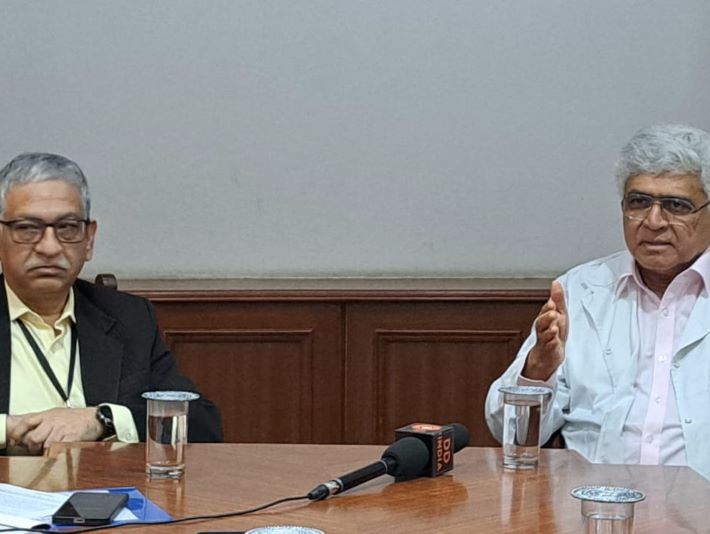
Dr. Sudeep Gupta (left) and Dr. Rajendra A. Badwe briefing the media in Mumbai on Friday (GN Photo)

Adding the inexpensive chemotherapy drug Carboplatin to standard treatment significantly improves survival in patients with triple-negative breast cancer (TNBC), a clinical trial at the Tata Memorial Centre (TMC) in Mumbai has found.

TNBC is an aggressive form of breast cancer and lacks the common hormone and protein markers seen in other breast cancers, leaving chemotherapy as one of the few effective treatment options.

The  randomized Phase III trial was held over a 10-year period (2010-20) on 720 Indian women with Stage II–III TNBC. It was funded by the Department of Atomic Energy, Government of India.

All participants received the standard chemotherapy regimen (weekly paclitaxel followed by doxorubicin plus cyclophosphamide every 21 days for 4 cycles) to shrink their tumours before surgery.  Half the patients also received weekly Carboplatin injections for eight weeks before surgery.

Carboplatin is a commonly available inexpensive chemotherapy drug often used for other cancers. It’s a cost-effective option for resource-limited countries where TNBC represents nearly 30% of breast cancers. All patients later underwent surgery, radiation, and long-term follow-up.

The total cost of carboplatin for the entire eight-week treatment is approximately between Rs 5,000 and Rs 6,000, ranging from Rs 625 to Rs 750 per dose every week. The total cost of drugs for the eight-week treatment and chemotherapy comes up to around Rs 25,000.

Key Findings
After an average follow-up of 67 months, the Carboplatin group improved  in overall survival (5 years) from 66.8% to 74.4% with 7 more women out of every 100 alive at five  years after Carboplatin treatment. Disease-Free Survival (5 years) improved from 64% to 71%.The improvement was dramatic in premenopausal women aged 50 years and below with overall survival improving from 66% to 77% and disease-free survival improving  from 62% to 74%.

The addition of carboplatin caused no major increase in side effects due to its weekly low-dose schedule.

“This landmark Indian trail settles a long standing question on breast cancer treatment. We now have evidence that a simple, affordable addition to chemotherapy can save lives. Carboplatin increased the five-year survival rate by around 7.6 percentage points -  a statistically and clinically meaningful improvement,” said Dr. Sudeep Gupta, Professor of Medical Oncology and Director, Tata Memorial Centre and lead author of the study, during a media briefing here on Friday.

Dr. Rajendra A. Badwe, Honorary Professor Emeritus, Ex-Director, TMC and principal investigator of the study  said that every year 1.8 lakh women in India are afflicted with breast cancer. Every year  Tata Memorial Hospital in Mumbai gets 5000 new breast cancer patients and 30% of these patients  are high mortality triple negative. This study has been hailed by global cancer specialists calling it  ‘practise defining’. It shows high-quality research in India can change global cancer care.

The study was earlier presented at the San Antonio Breast Cancer Symposium in 2022.

Comments


Other News

New Delhi’s Indo-Pacific strategy enters a new phase

India appears to be investing fresh dynamism in its Indo-Pacific strategy. At the time when the US, under president Donald Trump, has adopted a conciliatory approach towards China and has changed the name of America’s Indo-Pacific Command to just Pacific Command, India has quietly moved towards con

CAG flags major fiscal lapses in Maharashtra

Maharashtra`s fiscal management has come under sharp scrutiny after the Comptroller and Auditor General (CAG) of India, in its State Finances Audit Report for 2024-25, flagged significant budgetary inefficiencies, accounting irregularities, understatement of key fiscal indicators and widespread governanc

The health sector research we are not doing

Some neglect is loud. This kind is quiet. It sits in research never commissioned, data never collected, questions never asked. In South Asia, that quiet has let the region’s worst health problems stay understudied, underfunded, and out of sight of those who could act.  

Study flags accessibility and last-mile challenges on Mumbai Metro Aqua Line

Mumbai Metro Line 3 (Aqua Line), the city`s first fully underground metro corridor and one of its largest public transport investments, represents a major engineering achievement and has been widely welcomed by commuters. However, the overall commuter experience continues to be constrained by accessibili

Centre intensifies preparedness as El Niño threat looms

Amid uncertainty in the southwest monsoon due to the potential impact of El Niño, the government is addressing the situation with comprehensive preparedness, a clear strategy, and strong ground-level action. While challenges remain, the entire system has been activated in advance and is working proa

India is crossing a climate threshold

On June 28, Delhi recorded a maximum temperature of 41.3°C, four degrees above the seasonal normal. But the “feels like” temperature, which factors in humidity, showed more than 51°C. What the body experienced was very different from what the thermometer recorded.  India`


Archives

Current Issue

Opinion

Facebook Twitter Google Plus Linkedin Subscribe Newsletter

Twitter







