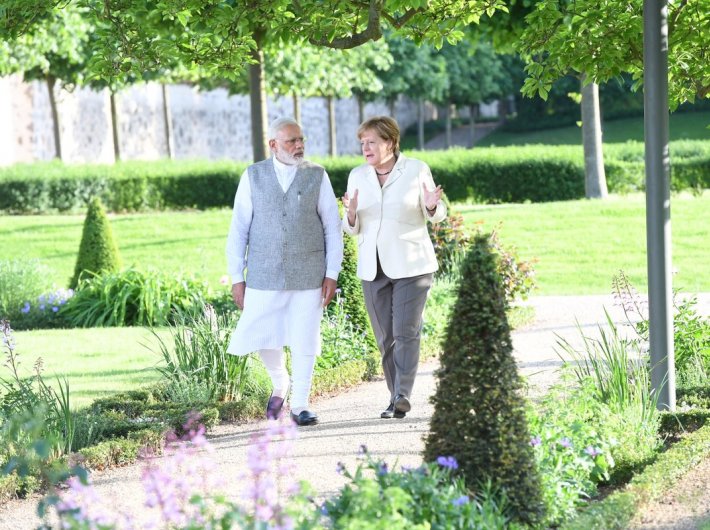
Prime minister Narendra Modi’s four nation trip is expected to shore up support for India’s bid to enter the exclusive Nuclear Suppliers Group, ahead of its meeting scheduled for next month.
Modi’s six days visit to Germany, Spain, Russia and France began on May 29.
“The current uncertainty in the relations between America, China and Russia demands that India move closer to the European middle powers—France and Germany. Delhi must also devote more attention to other parts of the continent, from Spain to Sweden and Portugal to Poland, that have so much to offer India,” C Raja Mohan, director, Carnegie India, said in his opinion piece in a daily.
Germany will be Modi’s first port of call. The fourth Inter-Governmental Council (IGC) meeting between Modi and German Chancellor Angela Merkel is significant.
“Our two countries are continuously engaged on several global issues of common concerns including expansion of the UN Security Council, how we deal with terrorism and also on other issues of importance in the multilateral arena,” Ministry of External Affairs’ spokesperson Gopal Baglay observed.
Germany played a key role in making Austria, New Zealand, Turkey and Iceland soften their stand on India’s accommodation at the 48-nation Nuclear Suppliers Group.
The next NSG meet is taking place in June.
At the bilateral level, India and Germany are expected to sign several memorandum of understandings (MoUs), on science and technology and cyber security.
Germany is one of the leading sources of Foreign Direct Investment in India. “We have more than 1600 German companies and 600 joint ventures here in India,” Gopal Baglay said. Germany, as per Joint Secretary (Western Europe) Randhir Jaiswal, is supporting India in Smart City project, Skill India, Clean India, Make in India and Digital India initiatives.
While Modi’s Germany visit would be highly watched affair, it would be his trip to Spain, first by an Indian prime minister in almost 30 years, which would be the highlight of his itinerary.
Rajiv Gandhi was the last Indian prime minister to visit Madrid in 1988. Spain is known for renewal energy, high speed rail technology, tunneling, air space management, waste water management. India and Spain, as per the MEA spokesperson, are going to witness signing of several agreements, including on high speed rail technology.
In the third leg of his visit, Modi will reach St Petersburg in Russia where the prime minister will attend the St Petersburg International Economic Forum conclave on June 1. India and Russia will also hold their bilateral meeting on the sidelines of the conclave.
Experts say the prime ministerial visit to Russia is taking place at a time when the two countries are witnessing a drift in their bilateral engagement. New Delhi is unhappy with Moscow as Russian President Vladimir Putin participated at the May 14-15 One Belt One Road summit in Beijing.
Last year, despite India’s opposition, Russian and Pakistan troops held their military exercise in Pakistan. The first ever military exercise between the two countries took place soon after Pakistan-sponsored terrorist attack on an army camp in Uri in September 2016.
New Delhi feels that Moscow has not adequately leveraged its influence on China in making India’s entry to the NSG possible.
If high placed diplomatic sources are to be believed, Foreign Secretary S Jaishankar during his visit to Moscow in March made Russian authorities clear that that if they (Russian authorities) are not able to India pass “Chinese hurdle” in the NSG, “New Delhi may not sign agreement with Moscow for the Kudankulm nuclear project Vth and VIth”.
During the just concluded visit of NSA Ajit Doval to Moscow some thorny issues between the two nations on the nuclear issues were ironed out.
Modi’s France visit will be keenly watched. The buzz in South Block is that France was included in Modi’s itinerary plan in the last minute. The two countries are cooperating on several fronts, including defence, space, nuclear, renewable energy, railways and urban development. India’s ninth largest business partner, France is one of the key strategic partners of the country.