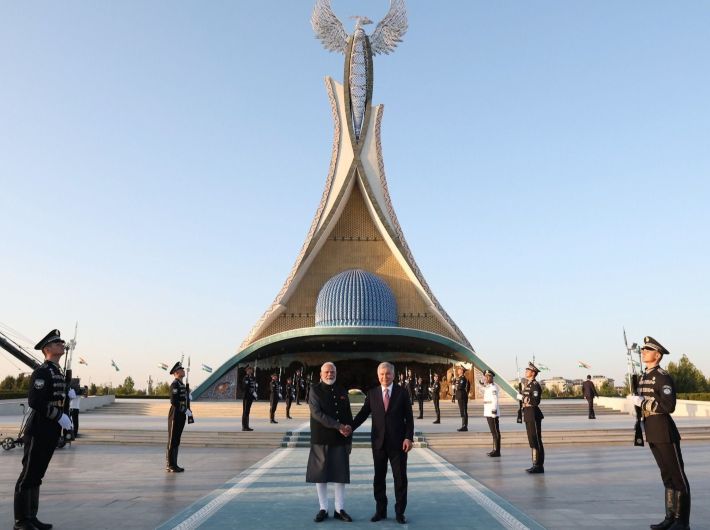
Modi's Tashkent visit turned a shared love of old Bollywood melodies into a long-term uranium supply deal, anchoring India's nuclear fuel security in a friendship that predates the geopolitics
There's a certain moment in diplomacy that's too personal to be captured in a communiqué, too small to make the front page, but more revealing than the front page. This week, prime minister Narendra Modi reached Tashkent and, amid the pomp of state visits, managed to evoke the old Bollywood tunes that generations of Uzbeks have been singing since childhood, doing more than just paying homage to the past. He was reminding two countries, two cultures, separated by the Hindu Kush, by seven decades of Cold War geography, that their friendship did not start with a treaty. It started with a song.
That's something to ponder before moving on to uranium. Like many Central Asian countries, Soviet Uzbekistan embraced Hindi cinema with a fervour that exceeded the ideological mission that had enabled its entry into the country. The dubbed and subtitled voice of Mohammed Rafi filled cinema halls in Tashkent and Samarkand, when most of the Uzbeks could not locate India on a map with any degree of accuracy but could sing the chorus of a Raj Kapoor film without any hesitation. This can be easily viewed as trivia. It is not. The soft power of this sort creates a bank of goodwill that transcends the political systems that enabled it, and India is now tapping into that bank in a surprisingly hard-power arena: nuclear fuel security.
The visit was serious in nature. The two nations elevated their ties to a 'Comprehensive Strategic Partnership,' marking the highest tier in their bilateral relationship, and Modi was awarded Uzbekistan's highest civilian honor, the Order of the Highest Friendship, which a small group of world leaders holds. The main result, however, which will have long-term consequences and outlast the ceremonial photos, was the agreement to establish a long-term deal for the supply of uranium from Uzbekistan to India. It was accompanied by a goal to increase bilateral trade fivefold, from today's just over a billion dollars to five billion dollars by 2030, and a wider set of agreements covering critical minerals, digital infrastructure, artificial intelligence, mining, and tourism.
Why is a uranium deal with Uzbekistan significant for India, while a uranium deal with, say, Kazakhstan or Australia might not be as resonant? In part, it's geography. Uzbekistan is located in the middle of a resource-rich belt in Central Asia, which India has been unable to access due to Pakistan's denial of transit rights and China's growing presence in the region through the Belt and Road Initiative. Each time India signs a deal in Tashkent, Astana, or Dushanbe, it is also, tacitly, an affirmation that New Delhi does not want to give up Central Asia to Beijing. Partly it's substance. Uzbekistan has some of the world's most important uranium deposits and has been steadily increasing its export potential, making it a viable long-term supplier rather than a symbolic one.
But the real significance of this deal is what it means for India's civil nuclear aspirations at a time when they have suddenly become very urgent. India has committed to expanding its nuclear power footprint by more than 10 times over the next few decades, from a few gigawatts today to a much larger presence, as it aims to decarbonize a power grid that remains highly dependent on coal. The expansion is as believable as the fuel that powers it. India has its own uranium reserves, mostly in the Jaduguda belt in Jharkhand, along with some newer discoveries. Still, they are not large or accessible at the rate the country's reactors will eventually need. New Delhi has been building up a list of external suppliers for two decades since the India-US civil nuclear deal lifted the nuclear ban on India and opened the door to international fuel markets, including Kazakhstan, France, Russia, and, more recently, Canada, which signed a multi-billion dollar deal with India to supply uranium earlier this year. Now Uzbekistan has been added to that portfolio, and such diversification is not a luxury; it's the difference between an energy strategy and an energy gamble. A country that relies on two or three suppliers for a fuel it can't easily replace is a country one geopolitical shock away from a stalled reactor fleet.
There's also a more subtle strategic rationale, one that's not about megawatts, but about alignment. Since independence, the five Central Asian republics have been playing a game of cat and mouse with Russia, China, the West, and, more recently, the Gulf states, fearing they will be made into a client state of one or more of them. India's policy of cultural affinity, limited but expanding trade, and now resource partnerships instead of infrastructure loans like those China has extended through the Belt and Road provides Tashkent with a relatively inexpensive safety cushion and genuine diversification. A friendly, resource-rich Uzbekistan, meanwhile, lessens India's reliance on the Pakistan-controlled land routes that have long been a choke point for Indian access to the region, while connectivity initiatives such as the Chabahar port gradually open alternative routes through Iran.
None of this detracts from the softer touches that surrounded the visit. The mention of old film songs was not a mere theatre; it was a reminder that India's Central Asia policy has something that transactional diplomacy can't create – decades of familiarity that makes a uranium negotiation feel less like two strangers striking a deal, more like two old friends formalizing an understanding. Cultural capital of that sort takes generations to build and cannot be conjured for a summit. Modi's government has been clever in understanding that the songs that used to cross the Iron Curtain on smuggled reels are still working their diplomatic magic half a century later.
Critics will be right to question whether a "long-term arrangement" is a contract that can be banked on for a specific volume of fuel and when it will be delivered, or whether it is, for the time being, a blueprint for a future contract, or a mere wish list that will never materialize. That is a fair warning, as India's diplomatic history is rife with agreements that were formed over the years and only became binding treaties. However, the trend is clear. New Delhi has discovered a partnership in Uzbekistan that is as sentimental as it is strategic: between a Mohammed Rafi song still played in the older neighborhoods of Tashkent and a pledge to provide the fuel for India's nuclear future – and in an energy-hungry, geopolitically anxious decade, that's not nothing.
Ayush Kumar Upadhyay is an Advocate and Master’s student in Public Policy and Governance & LLM in Social Policy at Tata Institute of Social Sciences (TISS), Mumbai.