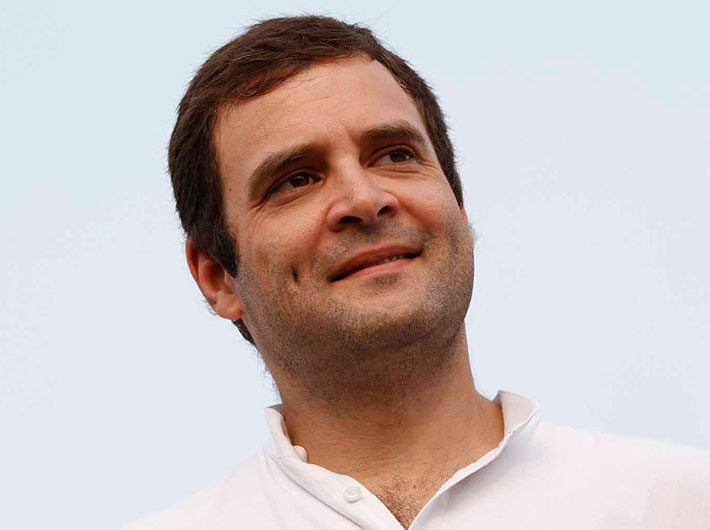
To paraphrase his own description of Manmohan Singh, “or anyone else”, in solving all problems, if industrialists expected the Congress vice-president to talk political economy, they can keep expecting
If this was the baby’s day out, the baby was a bit cranky, leaving everyone impressed with his transparency but also wondering how he was going to put his ideas in action. At the end of Congress vice-president Rahul Gandhi’s half-hour speech to the captains of the industry at the Confederation of Indian Industry (CII) AGM on Thursday, the feeling was a bit like that: Come again?
On the whole, the young Gandhi managed the charm the audience with his frankness and directness in the question-answer session though the speech had a few embarrassments (for example, when he could not find a document he wanted to quote from). Contrary to the impression in some circles, he showed he had a thorough understanding of the ground reality of politics – extending to chiding even his own party and praising the Left and Dravidian parties for empowering panchayati raj bodies.
Rahul's speech has generated a lot of debate. Read another view here: Rahul’s game-changer: radical reforms in politics
Read the curtain-raiser: Rahul woos industry captains with his economic vision
Follow updates on Twitter: https://twitter.com/governancenow
However, by the end, as Gandhi began a question-answer session bigger than his speech, telling tales about the complexity and strength of India to make everyone comprehend his grandfather’s discovery of India theses amid bursts of confused applause, his vision and mission emerged as a bit of a mish-mash. It was perhaps a right speech at the wrong platform; a politically correct, vision-like statement in a gathering of industrialists, telling the honchos of India Inc to go out and see the problems staring at India.
Talking in an extremely informal manner, with sprinklings of “boss” throughout, Gandhi began with vagueness — “There is a tendency to look at India as a country, but go back a thousand or two thousand years, India was an energy, a force” — and only moved on to further ambiguity, calling to mind the entrepreneurship of India he found at a Mumbai chawl, “during monsoons, with our feet in puddles”, when a migrant worker from Gorakhpur in UP offered him chai at an unearthly 4 or 5 am (question: isn’t it the chaiwalla who opens shop so early the right example of entrepreneurship?); telling the industrialists “what threatens or should worry you: exclusion of the poor, the minorities, the women” (question: shouldn’t industrialists be bothered more about a dipping growth, rising inflation, slipping sales and increasing procurement costs, among others?); to finally announcing that he is not the “guy who would arrive on a horseback” and rid India of all its problems.
Clarifying on multiple occasions that he prefers to speak the truth, the reality and from his heart, he came across as sincere (“our economic vision must be more than money; it must be about compassion [and] embracing the excluded is essential), a bit naive (“when I went to college in 1991, people asked me if elephants walked on the streets of India... no one asks that now”), optimistic (“as we talk here a billion people are breaking their shackles… we are sitting on an unstoppable tide of human aspiration”), pluralistic (“India will move forward with inclusive growth that embraces everyone… inclusive growth is a win-win situation for everyone”), and even, well, futuristic (“I have come here to forge a long-term partnership with you to take this country forward…Let us build a brave new empowered India together”).
All hallmarks of a classic Congress leader.
And that precisely is the problem with Vision Rahul: it’s all heart, little head. For, not many would begin his speech saying, “Over the last couple of years you (the industry) have done a tremendous job... the image of India has changed” at a time when the mood everywhere — from Moody’s to the market — is on a southward curve, like the regularly-readjusted GDP growth forecast.
Politically, not many politicians would use the words “we have to make/do/realise/forge”, and a few more verbs, so many times over so short a time — especially when your party has been leading an alliance for nearly nine years, and has governed from Raisina Hill for decades. Because the risk remains huge: if you have to do and realise so many things now, what were you doing for nine years, and more?
But in the end, what stood out was his sincerity (“Give me, or any one individual, all the power and he can't solve the problems of a billion people but give one billion people the power and the problems will be solved immediately”), and unaffected approach despite “sharing the DNAs” of an illustrious family —recalling the services and foresight of Montek (Singh Ahluwalia), Sam (Pitroda) and Nandan (Nilekani) on many occasions and that of Manmohan Singh once (“If you expect Manmohan Singhji or anyone else to solve everything, you can keep expecting”).