
Rajan spares surprise, key rates unchanged

The RBI governor has clarified that he does not plan to go in for further tightening of rates if CPI inflation continues to move down along intended glide path

GN Bureau | April 1, 2014
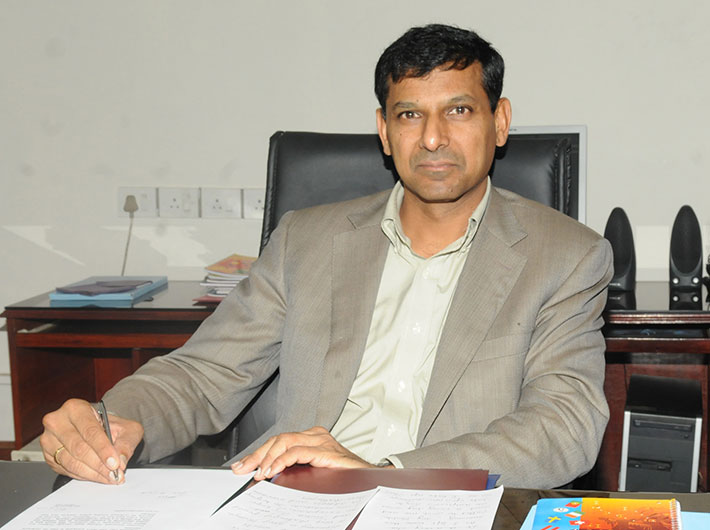


For the handful of market watchers expecting another rabbit being pulled out of a hat, Reserve Bank of India governor Raghuram Rajan’s first bi-monthly monetary policy announcement on Tuesday came as a complete bummer.

In line with market expectations, Rajan decided to keep the policy rates unchanged as the existing inflationary pressures did not call for a review.

At 8 percent, the repo rate, at which banks borrow from the apex bank, remained unchanged and the reverse repo rate, at which the RBI borrows from banks, has also been maintained at 7 percent. In addition the cash reserve ratio, the amount of cash banks have to set aside with the apex bank, has also been left untouched at 4 percent.

“At the current juncture, it is appropriate to hold the policy rate, while allowing the rate increases undertaken during September 2013-January 2014 to work their way through the economy. Furthermore, if inflation continues along the intended glide path, further policy tightening in the near term is not anticipated at this juncture,” Rajan said during his announcement.

Conceding the accuracy of market predictions on the policy stance, the governor joked that “the only thing surprising about the monetary policy announcement was the lack of any surprise.”

The governor also made an important announcement that certain recommendations of the Urjit Patel committee have been adopted. These include adopting the new CPI (combined) as the key measure of inflation, transition to a bi-monthly monetary policy cycle (of which this was the first announcement), and reducing emphasis on overnight “guaranteed-access” windows for liquidity management.

On the issue of new bank licences and changes in the banking framework, Rajan clarified that the election commission nod for new bank licences was sought to ensure that the announcement would not come under any cloud of doubt and controversy. He also said that licences would be issued virtually on a tap basis to ensure more banks in the sector. With the governor mentioning differentiated licences for banks, it is also clear that he in principle agrees with the Dr Nachiket Mor panel’s recommendation for introducing payments banks. “The intent is to expand the variety and efficiency of players in the banking system while maintaining financial stability. The Reserve Bank will also be open to banking mergers, provided competition and stability are not compromised,” Rajan said.

Emphasising the urgency for a stable economic policy, Rajan said that for growth to be restored it is very important for the new government to be a stable one which should use funds on investments instead of consumption.

Industry bodies meanwhile were disappointed as they wanted Rajan to slash rates and revive growth. “At a time when growth impulses remain weak and WPI inflation has been on the declining trajectory for the last nine months, the RBI should have taken this opportunity to announce a cut in policy rates which would stimulate demand and kick-start the investment cycle. This is especially the case as deposit growth has outpaced growth in credit indicating that high cost of credit is dissuading industry from building additional capacity,” CII director general Chandrajit Banerjee said.

The next policy announcement has been scheduled for June 3. With a new and hopefully a stable government in power, Rajan can be expected to make more interesting announcements.

Comments


Other News

Food inflation: Not a macroeconomic statistic but a developmental indicator

India`s retail inflation shows a reassuring picture at first glance. According to the latest data, Consumer Price Index (CPI) inflation edged up to 4.38% in June 2026 from 3.93% in May 2026, but continued to remain within the Reserve Bank of India`s (RBI) target band of 4% (+/- 2%). However, beneath this

Skin in the game or masterful market timing?

When a company founder opens their personal chequebook to buy shares in their own business, stock markets usually applaud. To the average retail investor, it feels like the ultimate vote of confidence, a sign that the people running the show have real skin in the game and believe brighter days are ahead.

India’s freedom struggle was shaped by wider Asian political thought

As we mark 80th anniversary of independence, ‘Asianism and the Fall of Empire’ (HarperCollins India) by historian Mithi Mukherjee offers a new perspective on Ind

What is colonialism? A relook at modern history

The Chromatic World Order: The Fiction That Rules Our World  By Sajid Mohamed Aakar Books  

Monsoon session of parliament adjourns sine die

The Monsoon Session, 2026 of Parliament which commenced on July 20 was adjourned sine die on Thursday. The session provided 19 sittings spread over a period of 25 days.   During the session 11 Bills were introduced in Lok Sabha and 2 Bills were introduced in Rajya Sabha. 12 B

Consumer Justice at a Crossroads

Over the past four decades, India`s consumer protection landscape has undergone a remarkable transformation. What began with the Consumer Protection Act, 1986 as a simple mechanism to empower ordinary citizens has evolved into a comprehensive framework capable of addressing challenges ranging from mislea

Upcoming Conferences


-->

Archives

Current Issue

Opinion

Facebook Twitter Google Plus Linkedin Subscribe Newsletter

Twitter






