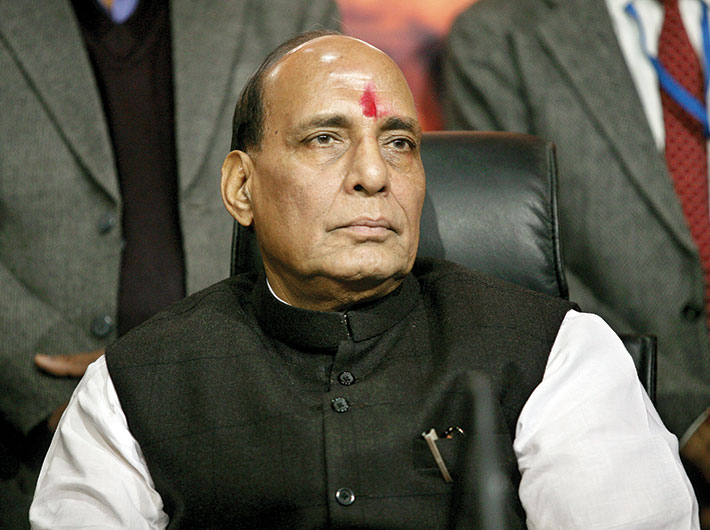
Rajnath's team of unknowns adds numbers, not value

Officer-bearers in the new Team BJP seem to have been selected not for their intrinsic worth but for their potential to keep camp fights under wraps

ajay

Ajay Singh | April 3, 2013


BJP president Rajnath Singh


Christophe Jaffrelot’s scholarly work on the rise of Hindu nationalism deals extensively with the role Kushabhau Thakre played in building up the organization from scratch, for the BJP as well as its predecessor, Bhartiya Jana Sangh (BJS), in Madhya Pradesh. Thakre thus was a figure more revered than Atal Bihari Vajpayee and LK Advani for BJP workers in the state.

In Advani’s team, he served as general secretary (organisation) and was elevated to the post of BJP president in 1999. As an RSS pracharak loaned to the BJS, Thakre emerged as the fulcrum around whom the BJP’s organisational structure used to revolve. But Advani’s team had four other dynamic general secretaries — KN Govindacharya, M Venkaiah Naidu, Pramod Mahajan and Sushma Swaraj — and the roles allocated to them were unambiguously defined.

If Mahajan was a fundraiser and strategist, Govindacharya was the interface with the media to put across the BJP’s socialist and amiable face in the idioms of Hindutva. Swaraj represented the face of the woman next door with a unique gift of gab, while Venkaiah Naidu was allowed to experiment in a domain till then known as infertile ground for Hindutva: south India.

By any stretch of imagination, this was the most cohesive and winning team of five general secretaries cohered by Advani with full support of the RSS. The team delivered results not only in 1996 (albeit for only 13 days), but also in 1998 and 1999.

Nearly 15 years later, BJP president Rajnath Singh has doubled the strength of general secretaries in his team. Ram Lal is the general secretary (organisation), a post held by Thakre in Advani’s time. Unlike Thakre, Ram Lal is known for all the wrong reasons among the BJP cadre, particularly those from western UP. Leave aside Ram Lal, have you heard of Thawarchand Gehlot or Tapir Gao? The new incumbents like Varun Gandhi and Amit Shah are classic cases of infamy getting legitimised in public life. Rajiv Pratap Rudy is hardly a force in his own home state, Bihar, where he lost successive elections, while Ananth Kumar represents a faction from the Karnataka BJP.

Rajnath Singh seems to have cobbled together a team with members selected primarily to appease factional groups within the Sangh parivar. Their roles remain undefined and they repose loyalty to their chieftains in the faction-ridden saffron fold. There is no denying the fact that unlike Vajpayee and Advani, Rajnath Singh has neither stature nor charisma to make office-bearers fall in line.

At the moment there is hardly a defined political goal before the party other than to keep afloat and retain the base. This is precisely what explains the induction of Uma Bharti and Prabhat Jha as vice-presidents in the BJP’s national team. Members of Singh’s team seem to have been chosen not for their intrinsic worth but for their potential to keep factional feuds under wraps.

Of course, there were indications that Rajnath Singh’s task of choosing the team was made all the more difficult by ambitious satraps within the parivar. The RSS has lost its moral authority and is divided in various camps to pursue their different political goals. For instance, Suresh Soni, the RSS joint general secretary, has managed to induct his own set of protégés in the team.

But, by and large, a team largely comprising acolytes and social climbers can hardly be called a winning team.

Comments


Other News

Here’s an I.D.E.A. for career growth and success

Success in today’s professional organisation is no longer solely determined by academic qualifications, technical expertise or years of experience. While these attributes do matter, organisations increasingly value individuals who demonstrate the right mindset and behavioural qualities. The ability

PM interacts with CEOs, founders of space startups

Prime minister Narendra Modi interacted with CEOs and Founders of 20 Space Startups at Seva Teerth on Friday.   CEOs of leading companies in the space sector working in diverse fields ranging from building rockets and reusable semi-cryogenic launch vehicles, avionics, satelli

From one cow to a dairy business

In 2012, Anita Dash wasn`t dreaming of building a dairy brand. She wasn`t studying business models or planning market expansion. Like countless mothers across India, her focus was on something much simpler: giving her children a better future.   At the time, her most valuable

Ethanol blending: The two sides of a story

India`s crude oil consumption is estimated to be around 88.5% imported from abroad. This one single figure is also responsible for why ethanol has become both an economic strategy and fuel policy at the same time. In an economy like India, which depends so heavily on foreign oil, any increase in internat

Food inflation: Not a macroeconomic statistic but a developmental indicator

India`s retail inflation shows a reassuring picture at first glance. According to the latest data, Consumer Price Index (CPI) inflation edged up to 4.38% in June 2026 from 3.93% in May 2026, but continued to remain within the Reserve Bank of India`s (RBI) target band of 4% (+/- 2%). However, beneath this

Skin in the game or masterful market timing?

When a company founder opens their personal chequebook to buy shares in their own business, stock markets usually applaud. To the average retail investor, it feels like the ultimate vote of confidence, a sign that the people running the show have real skin in the game and believe brighter days are ahead.

Upcoming Conferences


-->

Archives

Current Issue

Opinion

Facebook Twitter Google Plus Linkedin Subscribe Newsletter

Twitter