
Even with alarming increase in population, beautification remains prime concern, neglecting issues of higher priority
Vishal Dhingra | July 5, 2014

Many slums in Delhi are skilled in various art forms. One such slum is Kathputli Colony, which is said to be the biggest single concentration of traditional street artists in the world spanning in 5.22 hectares (12.89) in an impoverished northern pocket of Shadipur. It accommodates 3,000 families of dancers, musicians, acrobats, puppeteers, crafts men and embroiders. The Delhi government, in 2007, launched a proposal of In-situ rehabilitation in Kathputli Colony under PPP which had similar issues under its purview. This PPP proposal is another hazard which would result in an annihilation of this age-old vibrant culture.
Delhi is growing at a rapid rate. Even with the alarming increase in population, beautification remains the prime concern, neglecting the issues of higher priority.
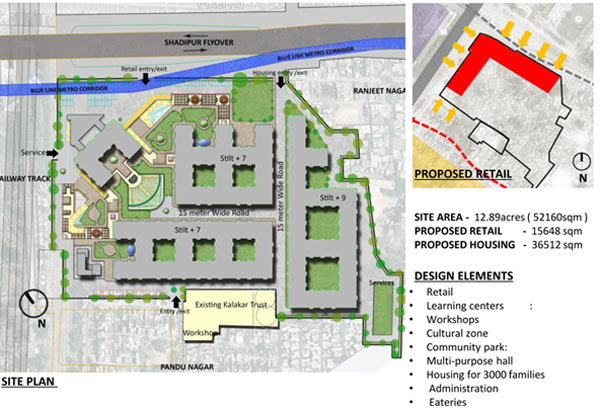
The Government’s efforts to rebuild living conditions of the colony have gone futile. Even in the age of advanced cities, rehabilitation of these artists has taken a back-seat. Most of the government proposals promise to provide better dwellings but neglect practical issues such as source of income and employment opportunities, which would enable the dwellers to pay for basic living expenses. Lack of income compels the slum dwellers to revert back to their original roots — renting out houses that have been allotted to them — for an additional income source. The superficial layout of Delhi expresses slums as insects but deep down they form the backbone of a city, as these slums account for most of the labourers in the city. A platform to showcase their skills could act as a way out for better and sustainable livelihood.
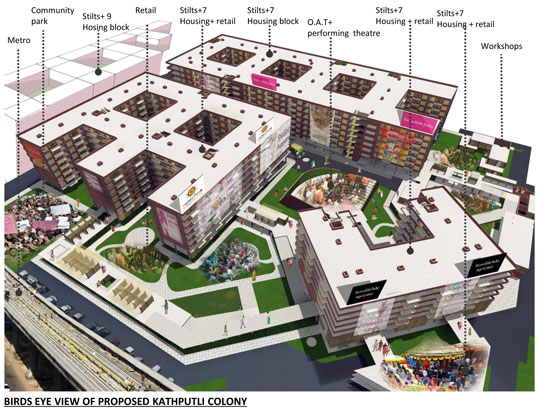
An alternative proposal
After six months of community participation with Kathputli dwellers, a solution to the problem transpires with the proposal of retail-cum-cultural space on the area of land allotted to Raheja Developers by DDA for revenue generation. Applicability of this structure not only promises to sustain an income source, it also unveils Kathputli Colony as a brand augmenting the handful spots of crafts market, cultural places and theater in the city. Direct and easy proximity to main road, metros and railway station, fabricate it as a suitable space to create buzz in the public realm. However, expenditure of construction is a big issue but it can be collected later through the revenue generated from retail. Even though it is a slow pace process, it could be seen as the pilot project to benefit culture and humanity.
Vishal Dhingra has completed B-arch programme from Gateway College of Architecture
The union cabinet, chaired by prime minister Narendra Modi, on Tuesday approved the setting up of a Special Purpose Vehicle (SPV), called Integrated Transport & Logistics Authority (ITLA), to strengthen research, planning, appraisal, monitoring and impact assessment within the broad domains of Transp
Foundational Literacy and Numeracy (FLN) are often described as the building blocks of education. Yet, their significance goes well beyond a child’s ability to read a sentence, write a response or solve a basic mathematical problem. These foundational skills shape how children understand the world,
For decades, policing has followed a familiar sequence: a crime occurs, the police respond, an investigation produces records and those records become part of the institutional memory of the criminal justice system. Artificial intelligence is beginning to alter that sequence. Instead of merely recording
“We are making a Constitution forever and not only for today.” Shibban Lal Saksena said this in the Constituent Assembly on June 15, 1949. He was warning that a ruling party might one day choose a loyalist to run India’s elections. Seventy-seven years later, the Supreme Court is wrestli
The Cabinet Committee on Economic Affairs (CCEA), chaired by prime minister Narendra Modi, has approved implementation of the ITMS Project by Delhi Police at an estimated cost of Rs.1,789.52 crore, inclusive of taxes. The project will cover 42 identified traffic corridors and will be implemented in three
The extraordinary transaction volumes and value (₹29.82 Lakh crore in August 2026 alone) of the Unified Payments Interface (UPI) have made it not only an Indian success story, but a global one. In 2024, UPI accounted for nearly 49% of the world’s real-time payment transaction volume, with more th










