
Scrapping notes a blow to fake currency

The decision to do away with Rs 500 and Rs 1,000 currency note will help tackle the acute problem of counterfeit currency

GN Bureau | November 10, 2016

#Rs1000   #Bank Notes   #Black Money   #Cashless Economy   #Rs500   #Corruption  


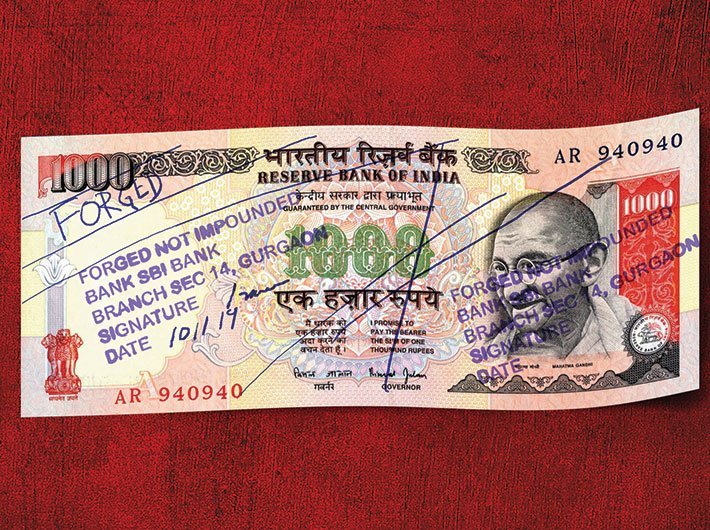
The government’s announcement to scrap Rs 500 and 1000 currency notes will go a long way towards bringing halt to the circulation of counterfeit currency in the country. The common man finds it virtually impossible to distinguish between a genuine currency note and a fake one. Most of the times it takes the expert eye of a bank teller to spot a fake one. We are reissuing a story on counterfeit money that appeared in November 16-30, 2014 issue.


                                                         Fake in India: a counterfeit economy

Sahil got a shock when the bank employee told him that one of the 20 notes of Rs 500 he had brought to deposit was a counterfeit. He was also embarrassed – at being fooled as well as being possibly taken for a criminal. He first argued that he did not know, a common man like him could not be expected to cross-check all the security parameters (there are 14 of them, to be precise), and the bank should accept the note. The Safdarjung Enclave branch of Central Bank of India refused.

Sahil was lucky, though. His father, who runs a small confectionery shop in Arjun Nagar of south Delhi, managed to catch the customer who had passed the dubious note on to him. Now was the customer’s turn to be shocked and embarrassed, but he changed the note.

In the process, however, the dubious currency note won another life.

It had started its journey, most likely from a sophisticated printing press in a neighbouring country. It had crossed the border possibly near Malda in West Bengal – as part of a bunch of fake notes with a total face value of Rs10-15 lakh in a gunny sack thrown in a nullah from one side of the border and picked up on the other side. Now it would continue to circulate, changing hands as a genuine one and harming the economy. Travelling alone, it cannot be captured by any law enforcement agency. The only way to catch it and put it out of business is when it comes to a bank counter.

That is why the Reserve Bank of India (RBI) has asked banks to net fake notes, not reject them. It wants banks to accept all cash, without bothering about veracity, and give due credit to the customer. Counterfeits are to be filtered out at the back office. The RBI directive says, “In no case, the counterfeit notes should be returned to the tenderer.”

Read complete story here

Comments


Other News

Ethanol blending: The two sides of a story

India`s crude oil consumption is estimated to be around 88.5% imported from abroad. This one single figure is also responsible for why ethanol has become both an economic strategy and fuel policy at the same time. In an economy like India, which depends so heavily on foreign oil, any increase in internat

Food inflation: Not a macroeconomic statistic but a developmental indicator

India`s retail inflation shows a reassuring picture at first glance. According to the latest data, Consumer Price Index (CPI) inflation edged up to 4.38% in June 2026 from 3.93% in May 2026, but continued to remain within the Reserve Bank of India`s (RBI) target band of 4% (+/- 2%). However, beneath this

Skin in the game or masterful market timing?

When a company founder opens their personal chequebook to buy shares in their own business, stock markets usually applaud. To the average retail investor, it feels like the ultimate vote of confidence, a sign that the people running the show have real skin in the game and believe brighter days are ahead.

India’s freedom struggle was shaped by wider Asian political thought

As we mark 80th anniversary of independence, ‘Asianism and the Fall of Empire’ (HarperCollins India) by historian Mithi Mukherjee offers a new perspective on Ind

What is colonialism? A relook at modern history

The Chromatic World Order: The Fiction That Rules Our World  By Sajid Mohamed Aakar Books  

Monsoon session of parliament adjourns sine die

The Monsoon Session, 2026 of Parliament which commenced on July 20 was adjourned sine die on Thursday. The session provided 19 sittings spread over a period of 25 days.   During the session 11 Bills were introduced in Lok Sabha and 2 Bills were introduced in Rajya Sabha. 12 B

Upcoming Conferences


-->

Archives

Current Issue

Opinion

Facebook Twitter Google Plus Linkedin Subscribe Newsletter

Twitter







