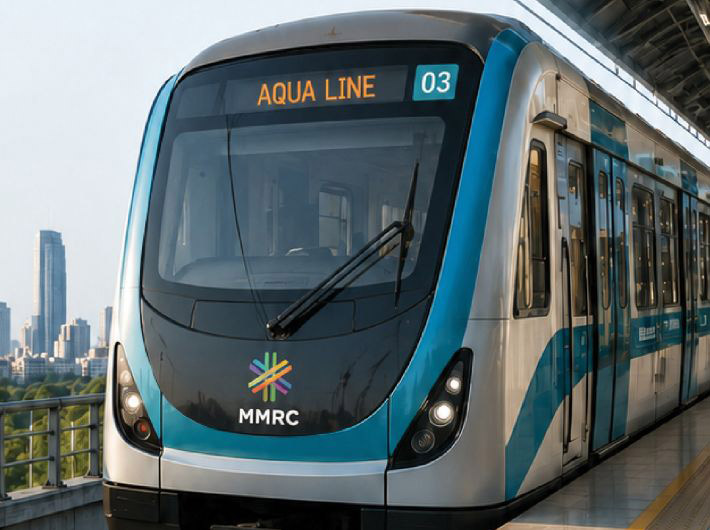
Moneylife Foundation audit of 27 stations identifies barriers that disproportionately affect elderly commuters, persons with disabilities and airport travellers
Mumbai Metro Line 3 (Aqua Line), the city's first fully underground metro corridor and one of its largest public transport investments, represents a major engineering achievement and has been widely welcomed by commuters. However, the overall commuter experience continues to be constrained by accessibility barriers at station entrances and exits, inadequate wayfinding and weak last-mile connectivity, according to a new study.
Moneylife Foundation on Wednesday released its report, ‘Study on the Accessibility and User-Friendliness of Mumbai Metro Aqua Line (Line 3)', an independent, station-by-station assessment of the city's newest metro corridor from the perspective of everyday commuters.
The study notes that despite the corridor's significance, average daily ridership in mid-2026 stood at around 1.5-2 lakh passengers, substantially below the projected 13.87 lakh daily riders for 2025. While factors such as fares, awareness and competing transport options contribute to the gap, the report identifies accessibility and first- and last-mile connectivity as major deterrents, particularly for senior citizens, persons with disabilities, families travelling with young children and passengers carrying luggage.
The findings are based on an audit of all 27 Metro Line 3 stations and 144 exits, documenting escalator directions, lift availability, staircase counts and signage, along with an online survey of more than 300 commuters, including daily riders, students, senior citizens and airport travellers.
Key Findings
The study highlights several recurring challenges affecting commuter convenience:
* Accessibility varies considerably across station exits, with many requiring commuters to climb or descend long flights of stairs.
Downward escalators are available at only a limited number of exits, making station entry difficult for senior citizens, passengers with reduced mobility and travellers carrying luggage.
*Last-mile connectivity emerged as one of the most significant concerns raised by commuters, reducing the overall attractiveness of using the Metro.
*While lifts and escalators are generally operational, their effectiveness is often reduced by inadequate planning of vertical mobility and insufficient wayfinding.
*Airport stations present particular challenges because of long walking distances between stations and terminals and limited availability of luggage trolleys.
*Improving accessibility would benefit not only persons with disabilities but also elderly commuters, parents with children, luggage-carrying passengers and the wider commuting public.
The report says that while the physical accessibility infrastructure largely exists, its effectiveness is undermined by inconsistent signage, one-directional escalators and inadequate integration with surrounding transport systems.
Among its immediate recommendations are:
*Standardise accessibility and wayfinding signage across all stations using plain language, intuitive icons and easy-to-understand maps.
*Correct inaccurate or outdated signage regarding lift and escalator locations.
*Install directional signs at one-way escalator gates informing commuters where downward access is available before they reach the gate.
*Introduce detailed exit-level neighbourhood maps at every station exit showing nearby landmarks, bus stops, taxi and auto-rickshaw stands, walking distances and accessibility infrastructure.
*Display clear visual guides indicating which exits provide lifts, escalators or step-free access, enabling commuters to choose the most suitable exit.
For improving connectivity beyond station premises, the report recommends:
*Conducting a comprehensive last-mile connectivity audit covering auto-rickshaw and taxi availability, BEST bus integration, suburban railway interchanges and pedestrian infrastructure.
*Strengthening coordination between Metro and BEST to introduce dedicated feeder and circular bus services, particularly in areas such as Bandra-Kurla Complex.
*Publishing accessibility maps on station websites and mobile applications and conducting periodic user-based accessibility audits.
The report also recommends several infrastructure improvements, including:
*Installing additional downward escalators at stations where only upward escalators currently exist.
*Prioritising bi-directional escalators at high-footfall, interchange, commercial and airport stations such as Bandra-Kurla Complex, Jagannath Shankar Sheth, CSMIA T1, CSMIA T2 and Dadar Metro.
*Creating dedicated, step-free, luggage-friendly routes at airport stations, improving trolley availability and evaluating the feasibility of travellators in long corridors.
*Improving integration between Metro and Mumbai's suburban railway network through direct subways or skywalks connecting stations such as Girgaon Metro–Charni Road, Santacruz Metro–Santacruz Railway Station and Mumbai Central Metro–Mumbai Central Terminus.