
Laura Spinney’s ‘Proto’ is an exciting, accessible story of the birth and spread of Indo-European languages
GN Bureau | July 7, 2025
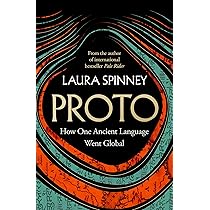
Proto: How One Ancient Language Went Global
By Laura Spinney
Distributed in India by HarperCollins India, 352 pages, Rs 599
 India is home to more than 1,600 languages that belong to, exceptions apart, four major language families. Hindi, Punjabi, Gujarati, Marathi, Bangla and Odia, among others, come from the Indo-Aryan family. Dravidian includes the four major languages of the south, the Austro-Asiatic languages such as Munda are spoken in many parts of the central as well as south and east India, while the Sino-Tibetan languages are the ones spoken mainly in the northeast.
The Indo-Aryan (IA) family, the largest by the number of native speakers, was once represented by Sanskrit, the subject of many tall claims on social media. Many wish to believe it is the oldest language in the world. It cannot be – it’s too recent in the scale of language evolution. The IA is part of a larger family, Indo-European (IE), which of course includes most of the major languages of Europe today.
There are several language families in the world – the count ranges from 140-odd to 400-plus, but what is noticeable is that the IE covers nearly half the world population. Now, IE too would have a predecessor. That goes back in time for which no direct records can be available, but linguists have been researching a hypothetical language (or languages) that was the mother to this family. It is called Proto Indo-European (PIE). That is the reason why we come across well-known family resemblances between, say, Sanskrit and English – the words for mother, daughter and so on.
Born in the Ukrainian steppes some thousands of years ago, PIE expanded its footprint in east and west with the migration of its original speakers. The language has been dead for long, and researchers today can only reconstruct parts of it. But this is the source of our civilization, our culture.
Laura Spinney, an acclaimed science journalist, tells the fascinating and exciting story of the PIE and how it came to dominate the world. Her previous works include ‘Pale Rider: The Spanish Flu of 1918 and How it Changed the World’. ‘Proto’, with its sweeping but reader-friendly narrative, is an ideal introductory book on this subject. She retraces the Indo-European odyssey across continents and millennia, taking the reader along on travelling the length of the steppe, navigating the Caucasus, the silk roads and the Hindu Kush. She retraces the epic journeys of nomads and monks, warriors and kings – the ancient peoples who carried these languages far and wide (including to India).
These voyages are interwoven with her talks with experts on their latest findings. Earlier, this was the domain of linguists and archeologists, but now geneticists have joined to find the missing pieces of the puzzle. Advances in various technologies have also helped in this interdisciplinary confluence. Spinney too brings together cutting-edge genetic research (like ancient DNA sequencing) with traditional linguistic reconstruction methods.
Along the way, ‘Proto’ also weaves together cultural threads, exploring how PIE-speaking peoples shaped mythology, trade, and governance across regions. It has a contemporary relevance too, as the author draws parallels between the language spread in ancient times and linguistic globalisation, especially of English, today. The linguistic detective work – a deep dive into how PIE is reconstructed through sound laws, grammar comparisons, and etymological patterns – is of course the most gripping part of the narrative.
Readers in India would be interested in the part Sanskrit plays in this saga. ‘Proto’ places Sanskrit as one of the earliest Indo-European languages, alongside Mycenaean Greek and Hittite. It thus has a central role in reconstructing PIE, as it has a rich textual corpus dating back to the Rigveda (roughly 1500 BCE), preservation of its grammatical features and systematic phonology. Such readers might wish ‘Proto’ offered more on Sanskrit. Yet, what it says is enough to provide a broader perspective to current identity politics in India, with languag being a key marker of identity.
While the book revisits the territory well explored by ‘The Horse, the Wheel, and Language’ by David Anthony, it takes into account a larger variety of evidence and arguments as well as most recent developments in the field. Also, ‘‘The Horse, …’ was meant for a specialised readership, whereas ‘Proto’ is more accessible for all curious readers – including linguists, archeologists and geneticists themselves who are not likely to be well versed in the other two branches of knowledge.
Indian agriculture is experiencing significant climate volatility, while the world economy seems to be in a highly volatile situation. Economic indices from various countries show that they need to recalibrate their strategies to withstand economic headwinds. In such a challenging situation, a country li
India’s southwest monsoon ended with a 13% rainfall deficit in 2026, its weakest performance in a decade, raising concerns over agricultural production, water security and the upcoming rabi season. With El Niño expected to persist into early 2027, experts warn that declining soil moisture, dep
For over a decade, India’s e-commerce story has rested on a simple premise: platforms connect buyers and sellers, while data fuels efficiency, personalisation, and scale. However, as the market matured, its structure has revealed a growing imbalance. E-commerce platforms, especially marketplace ent
The interaction between active Western Disturbances, increased atmospheric moisture and the region’s complex topography aswell as global warming are important factors behind intense rainfall in the Himalayas, leading to flash floods in Nepal, according to meteorologists. Nepal
Last summer, the two of us spent several weeks in rural Madhya Pradesh with a non-profit that works on gender justice through women’s self-help groups. We went in with a notebook full of laws. The Protection of Women from Domestic Violence Act. The Dowry Prohibition Act. Free legal aid for every wo
Digital payments have become a reflex for urban India, but the confidence earned in paying has not yet carried over to borrowing. That is the central finding of `How Urban India Pays Report 2026`, released by Pahlé India Foundation in collaboration with Amazon Pay. Based on a survey of 5,149 consu










