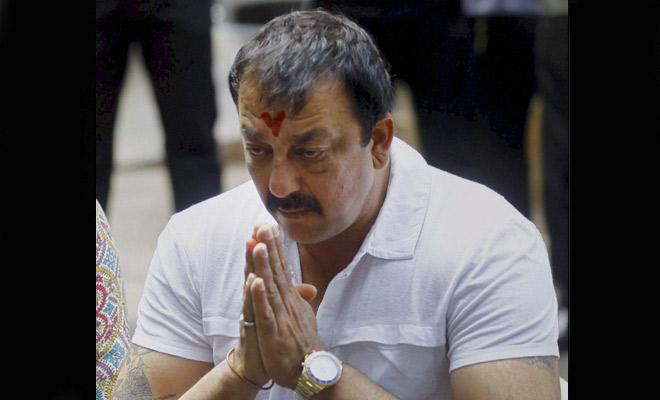
The world knew Sanjay Dutt had a few years of jail term left, and that the apex court had not had the last say. Didn’t these investors in Dutt’s films know they were making investments fraught with risk?
On Tuesday, a supreme court bench of justices P Sathasivam and BS Chauhanthe, while dismissing a petition by three convicts of 1993 Mumbai blasts seeking more time to surrender, said, "We have carefully gone through the review petitions and the connected papers. We find no merit in the review petitions and the same are accordingly dismissed.”
On Wednesday, the same bench, while hearing a similar petition filed by actor Sanjay Dutt, said, “…we extend the time by four weeks from tomorrow. It is made clear that no further extension will be granted.”
The court also said, “Considering the peculiar facts and circumstances of the case and reasons stated in the petition, we are not inclined to extend the time by six months.”
The “peculiar facts and circumstances” and the “reasons stated in the petition” relate to Dutt’s contention that he be allowed to finish shooting for his films, on which nearly Rs 278 crore was riding. The pending projects, he petitioned, would take at least 196 days to wind up.
The court, obviously, took into cognizance the fact that other people’s money is involved in films Dutt is acting in. So, the question is, how much money at stake is enough for a person to get more time to surrender? Does the fact that the apex court did not grant the 53-year-old the time that he had sought — 196 days would have meant nearly six and half months — for him to finish work on all pending projects mean all producers cannot expect to recover all their money?
Or does it mean it wants the actor to work at breakneck pace and wrap up six months’ work in one?
Or, would Zaibunissa Anwar Kazi, Issaq Hajwane and Shariff Abdul Gafoor Parker alias Dadabhai’s petitions have been heard, and the trio given a little more time to surrender, if Rs 46.3 crore — one-sixth of Dutt’s figure — was riding on them?
Which leads us to another question: since, in all probability, nine out of ten convicts in India would never have even a fraction of nearly Rs 50 crore riding on them, would they never get additional time to surrender before a court or police?
And does the fact that Dutt, or other affluent public figures, deals with more money than most Indians can ever dream of mean that their sins and misdemeanours can be treated a tad more tactfully, a.k.a. with kid-gloves?
This also brings us to the much-bandied contention that Dutt, 53, deserves to be pardoned since he has suffered enough for his relatively innocent offence at a young age — one of the arguments thrown around by Markandey Katju in his pardon petition for Dutt and Zaibunissa Kazi, among others, to president Pranab Mukherjee.
A story in today’s Times of India is interesting in this context, as it speaks with the kin of the other convicts, an angle not covered by the media even half as eagerly as spotting every tear or batting of eyelid by Dutt and his family and friends. The report quotes one of the convicts (name withheld for obvious reasons) sys, “I had told my employer that I was an undertrial in a case, but didn't specify the case. I wouldn't have got the job otherwise.”
That, Mr Katju, is what suffering entails; not doing work that you would have done otherwise, and making millions in the process, which many would argue is also thanks to the notoriety he achieved due to his tryst with 1993 blasts.
The world knows who Sanjay Dutt is, and what he did in 1993 in a city then called Bombay. The world also knows his career actually resurrected after the middle of 1993, with the release of the film Khalnayak, weeks after the first time he was arrested. The world — or at least those who invested Rs 278 crore or thereabouts in films starring him for which the apex court now thinks he has more reason to delay his surrender than, say, Zaibunissa Kazi — also knows the case against him was going on, and that he had served only 18 months out of the six years of imprisonment handed out to him by a TADA court. It’s another matter that the supreme court reduced that term to five years last month, meaning he would have to serve three and half years more.
So, didn’t these investors, which include astute filmmakers like Raj Kumar Hirani and Karan Johar, know they were making investments fraught with risk? If they did not, tough luck. If they did know and still invested, well, tough luck.
So, their investments perhaps are riskier than the livelihood of septuagenarian Zaibunissa Kazi, from whose Bandra house a cache of assault rifles, hand grenades and ammunition, allegedly brought from Sanjay Dutt's house, was found. And who, along with the other two, will have to surrender tomorrow as Dutt goes out to some studio.