
About 96% of the total income comes through donation
GN Bureau | April 10, 2018

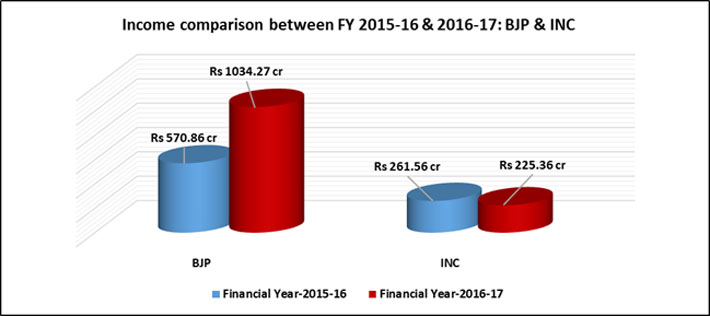
The Bharatiya Janata Party's total income has increased by 81.18% in one financial year. In 2015-16, the party's income was Rs 570.86 crores and this went up to Rs 1,034.27 crores during 2016-17. The party is the richest of all national parties.
At the same time, the income of INC has decreased by 14% from Rs 261.56 crore in 2015-16 to Rs 225.36% in 2016-17.
Association for Democratic Reforms (ADR), in its report, has analysed parties' income, expenditure and other details submitted to the Election Commission of India.
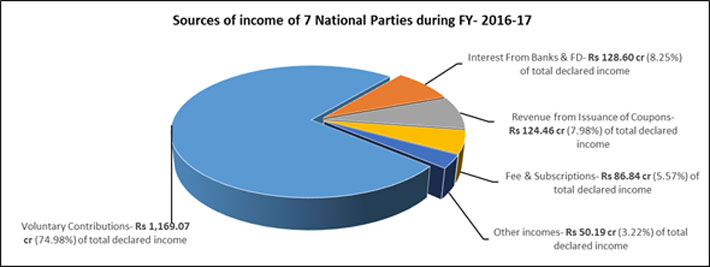
BJP and INC have declared donations/contributions as one of their three main sources of income. In BJP, Rs 997.12 crores comes through donations which forms 96.41% of the total income. Declaration of Rs 115.644 cr under Revenue from issuance of Coupons by INC forms the top most income of the party, contributing 51.32% of the total income of the party during FY 2016-17.
 The maximum expenditure for BJP during 2016-17 was towards election/general Propaganda which amounted to Rs 606.64 crores followed by expenses towards administrative cost, Rs 69.78 crores.
The INC spent the maximum of Rs 149.65 crores on elections followed by Rs 115.65 crores on administrative and general expenses.
Overall scenario of national parties.
There are significant delays in the handling of corruption cases involving officials of the Brihanmumbai Municipal Corporation (BMC), a Right to Information (RTI) response obtained by rights activist Jeetendra Ghadge has revealed. As of 30 April 2026, 207 BMC officials face Anti-Corruption Bureau (A
Every company is transforming, or so it claims. There was a time when the word ‘transformation’ carried weight. It signified bold strategic shifts, reinvention of business models, and breakthrough technologies that fundamentally changed how organizations created
Patel: A Life By Rajmohan Gandhi Aleph Books, 568 pages, Rs 1,199 There are many biographi
The month of July exceeded its rainfall target despite forecasts of a below-normal month under a strengthening El Niño. The reason could be that climate change is amplifying monsoon complexity: West Pacific warming, Western Disturbances and evolving ocean conditions increasingly interact with El Ni&
Mumbai`s public space crisis is as much about mismanagement as it is about scarcity, and offers a governance roadmap that can be implemented without new legislation, according to a new report by the Urban Design Research Institute (UDRI) and the NGO Alliance for Governance and Renewal (NAGAR).
The Lok Sabha on Wednesday passed the Public Examinations (Prevention of Unfair Means) Amendment Bill, 2026 by a voice vote after an extensive discussion. Replying to the debate, minister of state (independent charge) for science & technology; earth sciences and MoS in the PMO, Dr. Jite











