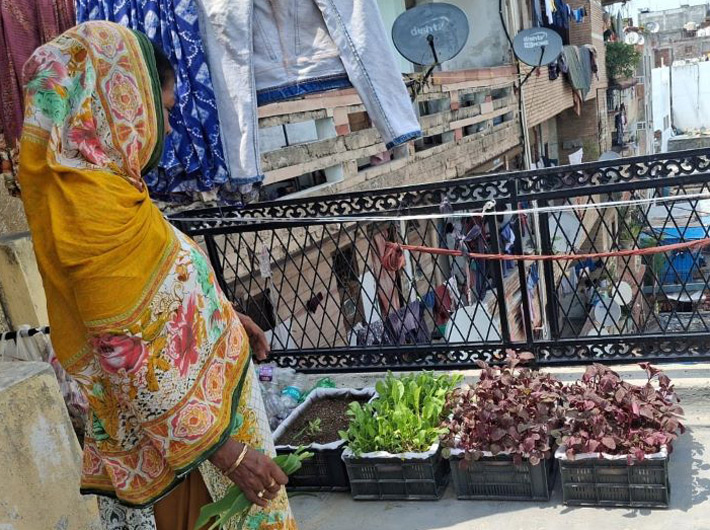
In the heart of Delhi’s Nizamuddin Basti, one of the world’s most densely populated neighbourhoods, women and young people across socio-economic groups are quietly reshaping their environment. Amidst narrow lanes and crowded homes, they are coaxing spinach, chillies, bitter gourd, and tulsi out of recycled buckets and broken tubs. These ‘Gardens of Hope’ are not simply just vegetables in containers - they embody the power of communities to reclaim food, health, and dignity even in the harshest urban conditions.
My own connection began a few years ago on our small terrace garden at home. Later, while volunteering in the Nizammuddin basti through ‘More Than Play’, a community development initiative, I saw families relying almost entirely on cheap, processed foods. In conversations with mothers, the idea surfaced: could we try kitchen gardens here? Space seemed impossible, but five mothers agreed. With guidance from a gardening expert, we began with spinach and coriander in discarded tubs. Tomatoes, karela, and chillies soon followed. Families traded seedlings and tips on WhatsApp groups. They discovered that planting Ram Tulsi and Sita Tulsi together made them thrive.
The gardens grew to be more than just about food. Women described nurturing plants as caring for another child, and the harvest the plants yielded helped them provide nutritious meal options for their own children. Neighbours gathered to both admire and share advice. In a place where nature felt absent, these patches brought pride, joy, and a sense of renewal.
On a practical level, the gardens improve nutrition with fresh, chemical-free vegetables. They cut household expenses, and our goal is a 15 percent saving. They also open up scope for collectives selling produce or pickles. But the deeper change lies in agency. Families are no longer passive consumers. They grow what they need, share with each other, and make food choices on their own terms.
This connects directly to the United Nations Sustainable Development Goals: SDG 2 (Zero Hunger), SDG 3 (Good Health), and SDG 11 (Sustainable Cities). They also advance SDG 12 (Responsible Consumption) and SDG 13 (Climate Action) by reducing waste and transport miles. Globally, agro-ecology and food sovereignty are gaining recognition as responses to hunger and climate change. The Gardens of Hope initiative fits into this discourse: they recycle waste into planters, follow seasonal cycles, and restore biodiversity.
Food security and climate resilience are among the greatest challenges for cities. Heatwaves, floods, disrupted supply chains, and price shocks hit the urban poor hardest. Meanwhile, industrial food systems drive emissions and biodiversity loss. Against this backdrop, kitchen gardens may appear modest, yet they are a practical model of decentralised resilience. They shorten supply chains, improve nutrition, and reduce reliance on volatile markets. With policy support including on seed banks, micro-grants, training, they could be scaled into schools, resettlement colonies, and housing projects. Imagine Delhi dotted with edible terraces and balcony gardens, linked into corridors of green. Beyond food, they would create micro-habitats for pollinators, cool the urban heat island, and improve air quality.
Cities from Havana to Nairobi to Tokyo have embedded urban food systems into their climate strategies. Delhi too could treat kitchen gardens as an essential public good.
One crucial lesson is the dependence on pollinators. Without bees, butterflies, and even bats, many crops will not fruit. Yet pollinator populations are collapsing. Even in Delhi, tree-lined as it is, there are too few pollinator-friendly plants to sustain them. This led me to start ‘Pollinators of Hope’, which raises awareness and distributes seed sachets containing food crops and flowering plants. By encouraging residents to grow them on terraces and balconies, we aim to support biodiversity alongside food security. This directly advances SDG 15 (Life on Land).
What began with five mothers in Nizamuddin now extends to Sarai Kale Khan, Aali Village, and Kusumpur Pahadi, with more than 40 families and an NGO involved. Each new garden strengthens the case for scale. This is about rethinking governance. Cities must stop treating food purely as a commodity and start seeing it as part of the commons.
Community-led green spaces are governance in action. When women and children in bastis grow food, they are improving diets and modelling resilience. They show policymakers what is possible and why it matters.
The Gardens of Hope remain small, but they carry seeds of transformation. They point to a future where edible cities regenerate biodiversity, reduce carbon footprints, and restore a sense of connection among residents. A future where the right to food and the right to nature come together.
As environmental activist, food sovereignty advocate, and ecofeminist Vandana Shiva reminds us, ‘Grow your health, grow your freedom, grow a garden of hope, even if it is one plant in one pot.’
In the end, gardening governance begins with something as simple as a pot of spinach. If nurtured with care, community spirit, and policy support, it can grow into a model of urban resilience that feeds not only bodies but also imaginations of what cities can become.
For more, visit The Gardens of Hope