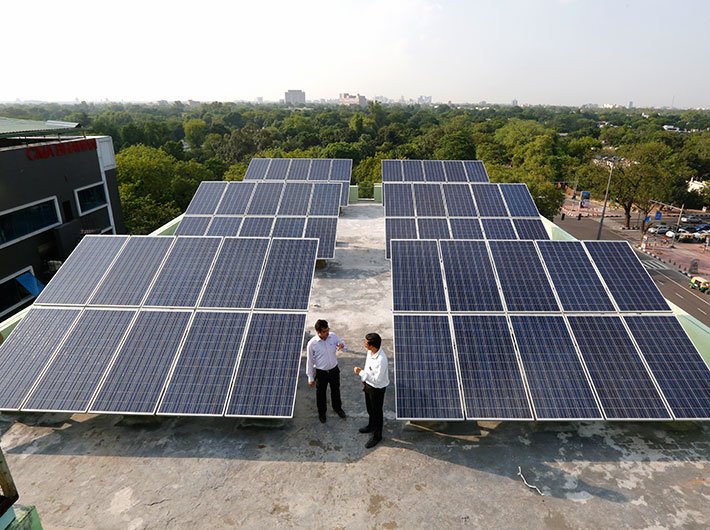
The first phase of India's renewable story made capacity the measure of ambition. The second will make coordination the measure of success
When Shell bought Sprng Energy in 2022, India's renewable energy market appeared to offer precisely what global energy majors were seeking: scale, growth and a place in one of the world's largest energy transitions. Four years later, Shell is selling the same business to Aditya Birla Group for an enterprise value of ₹17,200 crore. The asset has not become less green. What has changed is how two large companies value the same green asset.
Shell's exit is part of a wider recalibration of its power business towards a more trading-led model and away from some capital-intensive renewable assets. Aditya Birla Renewables, by contrast, is acquiring a contracted portfolio of 5 GWp, including 3.3 GWp of operational capacity and another 1.7 GWp under construction. The acquisition will take its renewable portfolio to around 9.4 GWp. The easy interpretation is that a global energy major is retreating while an Indian conglomerate is betting on India's green future. But that misses the more interesting question: why is an assembled renewable portfolio becoming so valuable now?
India no longer suffers from a shortage of renewable ambition. Grid-interactive renewable capacity rose from about 144 GW in March 2024 to more than 172 GW in March 2025, an increase of 20% in a single year. Solar accounts for more than 61% of this capacity. Yet the government's Energy Statistics India 2026 offers an important caution: generating capacity does not directly equate to actual generation.
The next phase of India's transition is institutionally harder. Land, transmission access, grid connectivity, power purchase agreements and project finance must converge before renewable capacity becomes a bankable electricity asset. This changes the economics of time. A company building capacity project by project must navigate this institutional chain repeatedly. An acquisition compresses it. Sprng brings operating projects, capacity under construction and long-term power purchase agreements with utilities and commercial customers.
Birla may not simply be buying megawatts. It may be buying time. It may also be buying ahead of a changing electricity consumer. India's future power demand will not come only from more factories or newly electrified villages. Rising incomes, heat stress and the gradual accumulation of appliances inside Indian homes are changing when and how electricity is consumed. Cooling and appliance use are becoming increasingly important to the household demand profile.
This distinction matters. A household buying an air conditioner, refrigerator or induction cooktop is not merely adding another unit of electricity demand. Millions of such decisions alter the timing and shape of the system's load. The problem therefore moves from generating sufficient electricity in aggregate to matching a more complex demand curve with increasingly variable generation.
This points to the second political economy of India's renewable transition. The first rewarded the ability to create capacity. The next may reward the ability to consolidate, finance and integrate energy assets against a far more dynamic demand profile. Energy companies are making long-term investment decisions while the composition and timing of electricity demand itself are changing.
Scale, in this environment, provides more than market share. Large portfolios can spread project risks, combine solar and wind assets and attract large pools of capital. They may also be better placed to integrate storage and other forms of flexibility as the electricity system evolves. For a large industrial group, renewable capacity can sit within a wider corporate energy strategy rather than remain a standalone investment. But this is where the Sprng transaction should interest policymakers rather than merely dealmakers.
India's regulatory debate remains heavily focused on capacity addition. That will remain essential as electricity demand rises. Yet the emerging problem is increasingly one of coordination: between variable generation and a demand profile reshaped by cooling, appliances and electrification. Policy must pay greater attention to the market around capacity, including transmission access, grid connectivity, viable power purchase agreements and the ability of the electricity system to respond to when consumers actually demand power.
The consolidation question deserves equal attention. Large integrated portfolios may be better positioned to combine technologies and eventually participate in storage and demand-response markets. But if grid access, contracted offtake and bankable projects increasingly accumulate within a handful of capital-rich firms, scale can shift from an efficiency advantage to an entry barrier. Shell and Birla may simply have different investment priorities. But their opposite decisions over the same asset tell us something about the transition itself. The first phase of India's renewable story made capacity the measure of ambition. The second will make coordination the measure of success. The difficult part is that our policy imagination still largely belongs to the first.
India will continue to add megawatts. The more consequential question is who will own the assets that are already connected, contracted and bankable, and whether the electricity system can make them responsive to a demand curve that is itself being rewritten. Birla's ₹17,200 crore bet is interesting not because it proves that renewables are valuable. We already know that. It is interesting because it forces us to ask where value will accumulate as the energy transition matures. The answer to that question may shape India's electricity market long after the race for capacity targets is over.
Tarun Kumar is a Master's Graduate in Public Policy and Governance, Tata Institute of Social Sciences, Hyderabad.