
They don’t want just jobs, they also want meaning and growth
Yvonna Tia Steele and Payal Seth | July 15, 2025

On World Youth Skills Day, observed every year on July 15, we’re reminded that the future of any economy depends on how well it invests in its youth. In India, where over half the population is under 30, the question of youth skills is not just about employment, it’s about meaning, wellbeing, and purpose. And it’s no longer just about training young people. It’s about retaining them too.
By 2030, Gen Z, those born between the mid-1990s and early 2010s, will make up 36% or the largest share of India’s workforce. But they are entering the world of work under very different circumstances than previous generations. Years of pandemic disruptions, climate anxiety, economic precarity, and mental health stress have shaped their expectations, not just of employers, but of work itself. If we’re serious about the future of work, this World Youth Skills Day it’s time to move beyond skill-building as charity—and start treating it as a strategy.
Gen Z Doesn’t Just Want Jobs. They Want Meaning and Growth.
Conversations around skilling often focus on technical knowledge, certifications, and digital proficiency. But Gen Z is seeking more than hard skills, they’re looking for alignment. They want to grow, yes, but on their own terms.
A key part of this is purpose. The Japanese concept of ‘ikigai’, which translates to "reason for being," provides a helpful lens for understanding this drive. Represented as the intersection of what one loves, what one is good at, what the world needs, and what one can be paid for, ikigai reflects the multifaceted motivations that influence human engagement with work (see Figure 1). Work, for Gen Z, isn’t just about making a living, it’s about making a life that feels coherent.
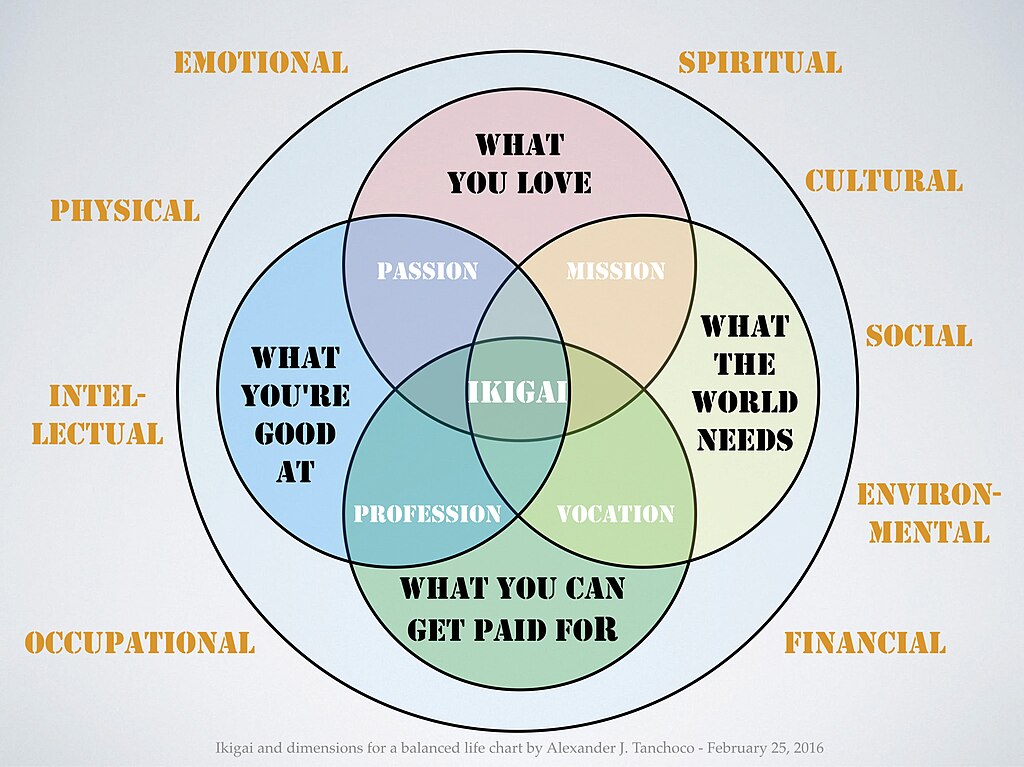
Figure 1: The very centre, where the four pillars overlap, is your ikigai
(Image: Courtesy https://commons.wikimedia.org/wiki/File:IkigaiAndDimensionsForABalancedLife.jpg)
Skills Alone Aren’t Enough. Psychological Safety Matters Too.
Much of the skilling discourse assumes that if we teach young people how to work, they’ll succeed. But what if the workplace isn’t designed to help them stay?
That’s where the idea of psychological contracts comes in. While not legally binding, these psychological contracts shape the motivation and satisfaction of workers. For Baby Boomers, the psychological contract was often grounded in loyalty and a lifetime employment model. Gen X, in contrast, accepted a more transactional view, prioritizing autonomy and performance-based rewards. Millennials infused their contracts with purpose and mentorship. Gen Z's psychological contract is deeply relational and dynamic. They expect transparency, fairness, growth, and respect, all underpinned by a desire for their work to reflect their identities and values. They want to be seen not just as resources, but as people. When these expectations go unmet, they often withdraw, either mentally or physically.
This may explain the rise of “quiet quitting”, where employees remain on the job but mentally check out. It isn’t laziness. It’s a signal: Something is missing.
What Gen Z Values, and Why Employers Must Listen
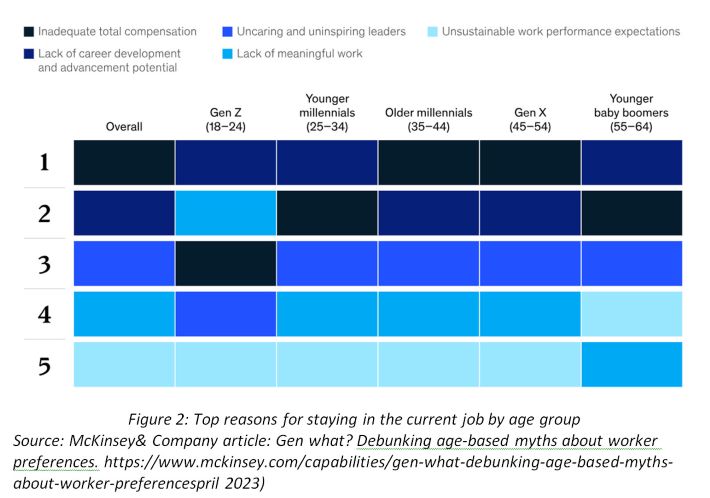
A McKinsey global survey (2022) of over 30,000 employees found that Gen Z prioritizes four things more than previous generations (see Figure 2):
● Meaningful work
● Clear career growth
● Flexibility
● Supportive colleagues
In contrast, older generations such as Gen X and Boomers tend to prioritize financial stability and long-term security. This shift is critical when thinking about retention as a skill-building strategy. If companies fail to create cultures that young people want to stay in, even the best skilling initiatives will fall short.
Who’s Getting It Right?
Some companies are already redesigning their workplaces with Gen Z in mind:
• Swiggy offers paw-ternity leave and pet insurance, not just as perks, but as a way of affirming employees’ whole lives beyond work.
• Myntra has embraced more casual communication, using emojis, GIFs, and short check-ins, to help Gen Z feel more at ease.
• WebVeda, founded by Ankur Warikoo, supports employee wellbeing through therapy reimbursements, profit-sharing, and flexible work, all of which build emotional loyalty.
These efforts reflect more than good intentions. They’re rooted in behavioural insights. Clear communication makes goals and roles more salient. Wellness benefits build loss aversion, people stay when they feel deeply supported. Team culture builds social proof, when others feel valued, you’re more likely to stay too.
On World Youth Skills Day, Let’s Update the Skills We Talk About
Skilling young people is essential. But let’s expand the frame. Let’s skill our institutions to be more flexible. Let’s skill our leadership to listen better. Let’s skill our companies to create spaces where young people can not only survive, but belong. This World Youth Skills Day, let’s ensure that our workplaces help young people manifest that perfection, not block it. Because the real measure of a skill ecosystem is not how many young people it trains, but how many it sustains.
Yvonna Tia Steele is a Research Associate, and Payal Seth is a Fellow, at Pahlé India Foundation, New Delhi.
When a company founder opens their personal chequebook to buy shares in their own business, stock markets usually applaud. To the average retail investor, it feels like the ultimate vote of confidence, a sign that the people running the show have real skin in the game and believe brighter days are ahead.
As we mark 80th anniversary of independence, ‘Asianism and the Fall of Empire’ (HarperCollins India) by historian Mithi Mukherjee offers a new perspective on Ind
The Chromatic World Order: The Fiction That Rules Our World By Sajid Mohamed Aakar Books
The Monsoon Session, 2026 of Parliament which commenced on July 20 was adjourned sine die on Thursday. The session provided 19 sittings spread over a period of 25 days. During the session 11 Bills were introduced in Lok Sabha and 2 Bills were introduced in Rajya Sabha. 12 B
Over the past four decades, India`s consumer protection landscape has undergone a remarkable transformation. What began with the Consumer Protection Act, 1986 as a simple mechanism to empower ordinary citizens has evolved into a comprehensive framework capable of addressing challenges ranging from mislea
More than 30 doctors, medical scientists and public health professionals have urged the government to take decisive action against the aggressive advertising and marketing of junk food, calling for a watershed ban on advertisements for foods high in fat, sugar and salt (HFSS) and ultra-processed foods (UPF











