
NHAI-backed Raajmarg Infra InvIT lists on BSE

Public InvIT advances highway monetisation, opens infrastructure investment to retail participants

geetanjali

Geetanjali Minhas | March 24, 2026 | Mumbai

#Infrastructure   #BSE   #NHAI   #Nitin Gadkari  


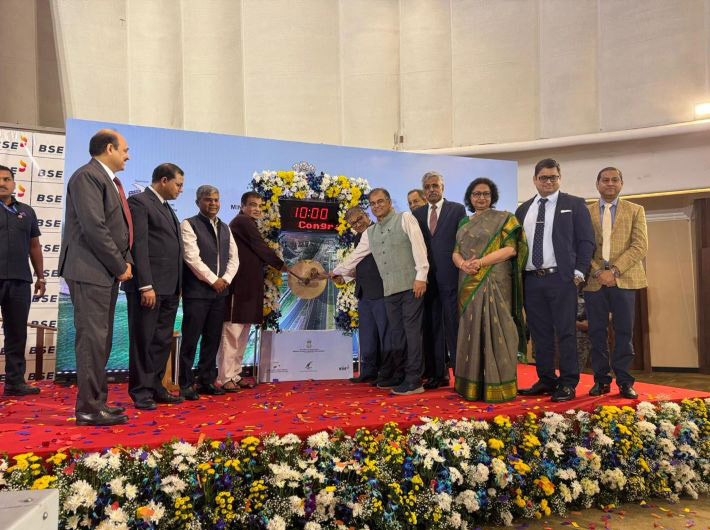
The maiden public issue of NHAI-sponsored Raajmarg Infra Investment Trust (RIIT) listed on the Bombay Stock Exchange (BSE) Tuesday in the presence of union minister for road transport and highways Nitin Gadkari. The listing marks a key step in the Government of India’s asset monetisation strategy.

 
Under the national monetisation pipeline (NMP-1), the Ministry of Road Transport and Highways (MoRTH) and the National Highways Authority of India (NHAI) have monetised assets worth approximately Rs 1.5 lakh crore through instruments such as toll-operate-transfer (ToT), privately placed InvITs, and securitisation emerging as the top-performing ministry under the programme. To sustain this momentum under NMP-2, NHAI established the public Infrastructure Investment Trust Raajmarg Infra Investment Trust (RIIT).
 
Launched under the regulatory framework of the Securities and Exchange Board of India (SEBI), RIIT is designed to broaden investor participation in India’s highway sector.
 
Speaking at the event, Gadkari said the InvIT would enable citizens to directly participate in infrastructure development, advancing the vision of turning road users into road owners. He noted strong investor interest, with the issue oversubscribed nearly 14 times, and outlined plans to monetise 1,500 km of highways over the next three years via the InvIT route.
 
RIIT is sponsored by NHAI and managed by Raajmarg Investment Managers Private Limited (RIIMPL), a public-private partnership involving NHAI, NaBFID, and leading financial institutions, ensuring professional governance and financial discipline.
 
The trust has secured five operational highway assets across Jharkhand, Tamil Nadu, Andhra Pradesh, and Karnataka, with a total concession value of around Rs 9,500 crore. The acquisition is funded through a mix of equity (Rs 6,000 crore) and debt.
 
Strategic investors including EPFO and SBI Life Insurance subscribed about Rs 1,260 crore, while anchor investors committed approximately Rs 1,728 crore. The remaining Rs 2,100 crore public issue saw strong demand, underscoring confidence in India’s infrastructure growth story.

Comments


Other News

The women India doesn`t count enough

She runs a tailoring shop from a single room in her house. Every morning she stitches school uniforms, answers queries on WhatsApp, collects payments through UPI and orders fabric online. Officially, she still belongs to India`s informal economy. Yet her enterprise is no longer disconnected from the formal

“Cancer is just a mind game”

Dr. Ananda Shankar Jayant, a Padma Shri awardee, inspired audiences for decades through her mastery of Bharatanatyam and Kuchipudi. But it was her journey through cancer that taught some of life`s most powerful lessons in courage and resilience.

Why Swami Vivekananda is the pathfinder for our times

Swami Vivekananda for Our Times  Edited and compiled by Rajiv Sikri, with Introduction by S. Gurumurthy Rupa Publications, 552 pages, Rs 695  

Five ways to realise the potential of India’s handicraft and handloom sector

India`s economic ambitions are increasingly defined by the industries of the future. Semiconductors, electronics, artificial intelligence and advanced manufacturing dominate policy conversations. Yet one of India`s largest employment-intensive sectors continues to occupy a surprisingly marginal place in ec

Beyond toilets: Why open defecation persists in rural India

Despite the awareness campaigns on sanitation across India, open defecation (OD) is practised openly and widely in both rural and urban areas. Research shows that rural respondents are well aware of the negative impacts of OD, yet this awareness does not lead to toilet construction or use. In rural North I

What unpaid nation builders want from policymakers

The Supreme Court recently described homemakers as “nation builders” and fixed a notional monthly income of Rs 30,000 for them in motor accident compensation cases. The judgment was not about wages. It was about compensation. Yet it inadvertently raised a larger economic question: If a homemake


Archives

Current Issue

Opinion

Facebook Twitter Google Plus Linkedin Subscribe Newsletter

Twitter






