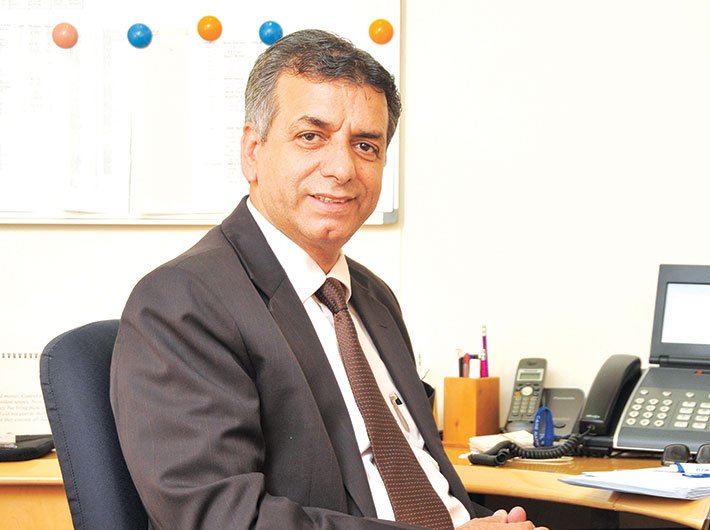
DR Dogra had spent long years with Credit Analysis and Research Limited (CARE), one of the leading credit rating agencies, before becoming its CEO and MD in August 2009. In an interview with Sweta Ranjan, he gives the rating agency’s perspective on financial inclusion. Excerpts:
What is your perception about the Jan-Dhan yojana?
One of the main problems in India is financial literacy. A substantial part of the population does not have bank accounts. Most of their savings are not fruitful. We have been a saving nation. Savings used to be 35-36 percent of the GDP, but they have come down to around 30 percent. Savings in financial instruments is not even 13-14 percent. General thinking is that a substantial part goes to real estate, then comes our love for gold and some people put their money in their pillows or almirahs. Most of these non-financial options are non-productive. They don’t help economy at all. The GDP requires a lot of investment but this money is not available for investment. If savings are put into financial instruments like insurance, mutual fund, bank deposit or debt market, it can grow and also help in capital formation. Having a basic bank account is giving an opportunity to a prospective saver to put his money into financial instruments. The PMJDY has made that available because many people are not near a bank branch. More than one crore accounts have been opened and more than '10,000 crore have been deposited in them. It shows this scheme is going to bring out the idle cash. This scheme will boost capital formation.
How will it impact the banks’ performance?
Banks should use technology to restrict the cost of opening accounts in unbanked areas. If you are able to raise money in these accounts through current and savings balances where the cost of deposits are not that high, you will break even one day. Then you will start making money too. But, yes, it’s like the investment game. You have to wait for a year or two to break even. That will happen for some time.
In rating a bank will you also look at its performance in PMJDY?
We certainly look at the cost of deposits and the net spreads – the difference between the interest you earn and the interest you pay and other costs. Certainly, if the scheme affects the cost, this will go against the bank. I don’t know whether it will make a dent. But suppose it results in a lot of CASA [current accounts, savings accounts] deposits, it will certainly improve spreads because on CASA you pay low rates and you are able to earn better rates if you lend appropriately. I don’t think there is a direct impact of this [scheme]. The CASA will increase your spread and the cost of opening that account will reduce your spread to some extent. It is a balancing game. Some banks do it more efficiently by using greater IT technology and support.
On PMJDY, how will you compare public sector and private sector banks?
It is not a level-playing field. Most of the Jan-Dhan accounts have been opened by the public sector banks because they play a greater role in meeting the social and economic objectives of the nation. After all, 75 percent of the total banking is still with them. They have much wider reach and better spread compared to private sector banks.
Can initiatives like PMJDY boost the rating sector too?
I don’t find any direct relation but indirectly it can. If there is more capital formation, if there is more investment in the economy, rating agencies will have better times. If financial savings go up, if the number of financial instruments goes up, I will certainly have more business.
How do you view the rating sector in India?
The rating industry is more than 25 years old now. The first rating company in India came up in 1987, followed by another in 1991. We were the third agency, in 1993. The rating agencies in India have matured because this period has seen two or three [business] cycles. But we are not as mature as the US rating agencies which are over 100 years old.
What changes would you suggest to make Indian companies less risk prone?
We have to make resources available to the corporate community in a bigger way. As of now, there is a lot of intermediation through banks. You put your money in a bank and the bank lends that money to a borrower. In other countries it doesn’t happen that way. In Thailand, Indonesia and Malaysia most of debt comes through debt markets, not through banks. It’s only in countries like India and China that majority funds come from banks.
The recent years have been depressing for economy. Do you see the situation improving?
There were two factors that weakened the economy: high inflation and policy paralysis. The new government has done a lot of things to address these issues. Fortunately, inflation is down, interest rates will start coming down and if money comes in the hands of the consumers the demand cycle will also go up. I think the market should behave positively because this government is taking many steps in the right direction.