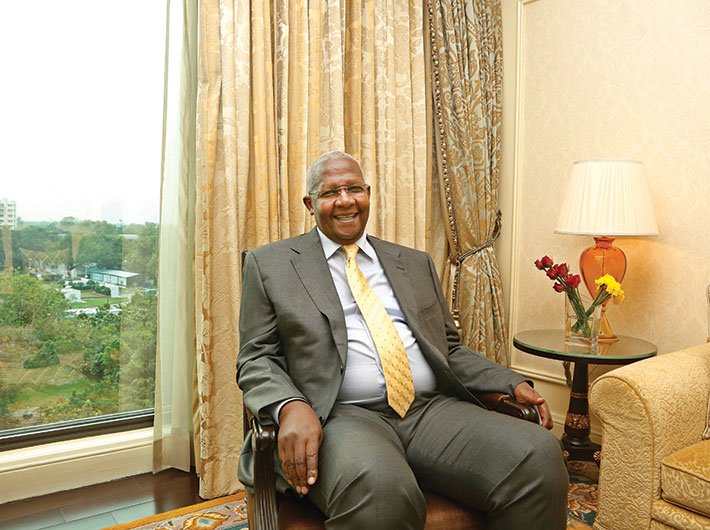
On September 18, Sam Kahamba Kutesa of Uganda took over as the president of the UN General Assembly for its 69th session. He was elected to the post in June. He proposed Delivering on and implementing a transformative post-2015 development agenda as the theme for the session. UN secretary-general Ban Ki-moon said the role of the 69th Assembly president will be “especially important during the Assembly’s upcoming session, when many critical streams of work will converge and reach moments of truth”. Kutesa, the Ugandan minister for foreign affairs, spoke with Shreerupa Mitra-Jha. Edited excerpts from the interview:
What in your views will be the areas of focus at the UN during your tenure as UNGA president for its 69th session?
Our overarching area of focus will be negotiating the post-2015 sustainable goals which would be transformative and universal. We believe India has a big role to play. The world will be coming together after all these years to discuss this. I have also proposed a theme for the 69th session, which will be Delivering on and implementing a transformative post-2015 development agenda. That’s a big focus. It entails, first, drawing up the agenda; second, coming up with more innovative ways of financing the agenda; third, [finding ways] of transfer of technology between the developed and the developing countries; and, fourth, negotiating to see if we can have a binding treaty on climate change by the end of 2015.
I also think it is a priority to focus on United Nations Security Council (UNSC) reforms as well as reforms in the general workings of the United Nations General Assembly (UNGA). The other priority is working with UN Women to further the cause of gender equality. There are other concerns that I have too but these are the highlights.
It is quite obvious that the develop-ing world has high expectations from you in your new role. Will these expectations be a burden or an asset in discharge of your functions?
It is an opportunity, not an asset or a burden. I fully understand the needs of the developing world. I was a minister in my country for 10 years. I also know that we can succeed only if we have a global partnership between the developing and the developed countries. So it’s not for or against one or the other but the need to focus on a global partnership. Since I was the foreign minister of my country, it also helps me understand the concerns of the various sides.
In your post-election speech you have specifically mentioned the need for UNSC reforms. Do you believe that the progress on reforms has slowed down in recent years? Will this issue receive your special attention?
There have been certain efforts in inter-governmental negotiations but we need to give it more impetus and even work towards a negotiating text, so we can talk about our issues and positions. I hope that in my tenure we are able to push it. We might not be able to finish it but we do want to come up with a negotiating text.
What role do you foresee for India in addressing issues of global concern, such as climate change, terrorism and piracy?
First of all, India is the largest democracy on the planet. It has a huge population and has emerged as a strong economy. It has always played a big role as a leading non-aligned state. Now they are a part of the BRICS [group]. They [India] will have a big role in security, fighting terrorism and economic development. We [Uganda and India] share the same position on climate change of working towards common but differentiated responsibilities for the world.
It [India] will play a major role in shaping the post-2015 development agenda as well as in [issues related to] climate change.
Could you elaborate on some of the challenges that you foresee in your new assignment?
Of course, when you talk of negotiations it is never easy to get the whole world to agree given the agenda [of different countries]. It requires a lot of patience, an attitude of give and take and to understand everybody’s concerns. Also, financing of the development agenda will be challenging. We will have to find innovative ways of financing it. I believe the private sector will have to play an important role. We have to strike a balance between the private sector whose motive is profit-making [and corporate responsibility]. Also, getting them to agree [to work on the development agenda] will be an issue. The civil society will also have to play a role. It is a challenge but, as I said, also an opportunity.
This interview first appeared in Magazine Volume 05 issue 16 (16-30 September 2014)