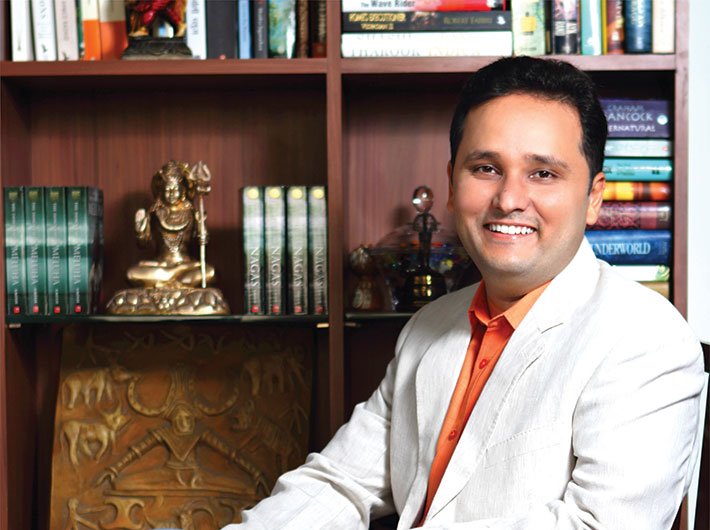
A banker turned author, Tripathi has written the highly successful Shiva Trilogy, a mythical fantasy based on Lord Shiva which shot him to fame in a short span and placed him in the best-selling category.
Amish Tripathi, a banker turned author, has written the highly successful Shiva Trilogy, a mythical fantasy based on Lord Shiva which shot him to fame in a short span and placed him in the best-selling category. He is a devotee of Lord Shiva and has his roots in the holy city of Varanasi where his grandfather served as a Pundit and Sanskrit scholar. He is currently busy with the Ram Chandra Series, the first book of which, Scion of Ikshvaku, was released in June 2015.
The role an author can play in society
Time is the only true judge of an author’s role in society. There are some very popular authors with little impact and there are others who have been loved by critics but failed to make much impact. If a book is being read 100 years after it is first published, it means the book has made an impact.
Does the current social and political scenario affect creative expression?
For a creative person there is no better country than India. We have always had a culture of celebrating different points of view. The society gives you a lot of freedom and encourages creativity.
What troubles did you initially face in getting your books published?
My first book was rejected by almost every publisher I approached. They reasoned that youngsters are not interested in religion. Finally I had to self-publish it.
What do you want to change in the books space
More than 10-15 years ago, the Indian publishing industry, though based in India, had a west-focused approach. Its cultural roots did not stem out of India. This is slowly changing now, which is good. The industry must bring out more books with subjects that connect with those who live in the real India, in cities like Satna and Jabalpur.
How do keep your work relevant to society?
I let my work flow naturally and write what I believe in. Trying to fit in reader expectations and doing market research corrupts the idea. While I genuinely believe we are a secular and liberal country, issues like poverty and oppression of women in India trouble me. Naturally, these discussions come out in my books. Patriotism should not blind us to things which can be improved.
What are the most important governance issues for you?
Out of several ancient governance methods, the two that truly stand out are the ‘Ashokan’ and ‘Chanakyan’ systems of governance. Since 1947, unfortunately, India has followed the ‘Ashokan’ model of an interfering and weak state which is completely antithetical to the Indian way. Because a state cannot be efficient if it is trying to do everything, it will in effect become a weak state. My submission is that the ‘Ashokan’ state is not in line with India’s natural culture. The ‘Chanakyan’ model is more in line. In the ‘Chanakyan’ model the state plays a minimalistic role except for key issues like security and trade; so it is a strong but minimal state. The tax takeaway of the government is actually very low. The states too must follow the ‘Chanakyan’ model and decentralise. This is what the classical liberals speak of.
How can government help promote creativity?
The government shouldn’t be interfering in cultural matters at all. Let people decide.
Major challenges that India is facing today
We have to eliminate poverty and need to create wealth. We also have to respect women. By disrespecting women we are going against our own ancient culture. In the Rigveda there are more than 30 hymns written by ‘Rishikas’ (women seers). Their status was even higher than that of the kings.
What’s keeping you busy these days?
I am writing the second book in the ‘Ram Chandra’ series.
Any message for the youngsters?
Follow you heart, work hard for the country and be happy.
(The interview appears in July 1-15, 2016 edition of Governance Now)