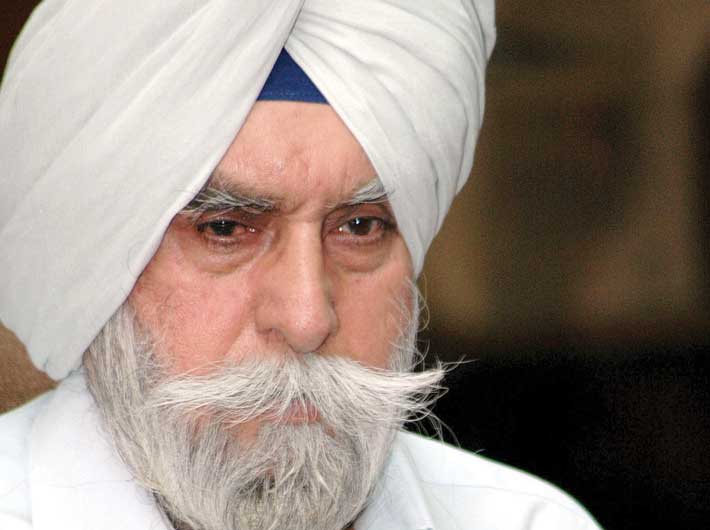
Former Punjab director general of Police. KPS Gill talks about the fight between the two elite security agencies in the country- IB and CBI and the impact it will have on the security scenario
In conversation with Pankaj Kumar, former Punjab director general of police KPS Gill, the man known for eliminating terrorism from Punjab, says what is happening between the two agencies poses a threat to the national security.
The CBI is blaming the IB and the two agencies seem to be acting against each other. Don’t you think it will affect counterterrorism operations?
The CBI’s role is different and IB has a much wider role in counterterrorism operations. The investigative agency largely looks into the corruption part – of the officers and mafias, but the intelligence agency’s duty is to protect the country, against both inside and outside threats. That’s why IB has a much bigger role to play in India’s security. I do agree with you that targeting IB will hamper its officers’ morale and internal security would be at stake.
The basic nature of crime has changed. Now, the underworld is more powerful and connected and well supported by the ISI and other agencies working against India. So, is it that unorthodox methods are applied in order to tackle the insurgency?
IB has a much bigger and wider role to play in saving the country from all forms of threats. It acts as per the demands of the situation and these cannot be discussed in the public domain. However, their role is to look after the internal security of the country and it is always a challenging job. So, one cannot and should not target its own intelligence agency, otherwise the security scenario will degenerate.
But, don’t you think that there should be a mechanism to ensure that IB is accountable?
IB should be accountable to whom – you, me or the CBI? Please for god’s sake, don’t talk like this. IB is very much accountable and its commitment cannot be questioned. IB reports to the top political master and the union ministry of home looks after its reports. There is a proper chain (of command) and IB follows that. There is hardly a case like Ishrat Jahan and that looks more like a political issue. I would rather say that please don’t bring politics into security, otherwise you will pay heavily.
What do you mean by the political issue? Do you mean to say that IB is above the law?
I said political issue, because various parties are settling political scores over this issue. Although this matter is sub judice and is being probed, my only concern is that IB’s role is being targeted and its style of functioning is being questioned, which will ultimately hamper the morale of the intelligence agency. I believe bona fide mistakes should be ignored.
If you were to face the kind of challenge you once faced in Punjab, how would you tackle it?
In Punjab, hardly anybody questioned our style of tackling terrorism those days. They fought with AK-47s, we defeated them. They used explosive devices, we crushed them. They used human rights allegations and propaganda on all fronts, accusing us of killing thousands of innocent Sikh youths and finally they lost because people at large were not ready to buy their logic. They filed more than 300 petitions in courts and could not succeed in their motive. We defeated them on all fronts, but the problem starts when after so many years, some vested interests start targeting you. In my days when I was the director general of police, Punjab, I had kept all the records of rapes committed by terrorists. Later on, all of them were destroyed to prove that they were the good people. What can you do if you face such a situation? We could succeed because people at large were by our side as they were fed up with bullets and the government too was determined to wipe out terrorism. All agencies were working together. But if one starts working against another then the security scenario will degenerate.
You once said politics poses a bigger challenge to the security of the country than Pakistan. Do you feel the statement holds true even today?
I had said that a long time ago, when I was looking after the northeast. I had accused all the (political) parties, irrespective of their national or regional stature, because their act there was not to solve the problems. It was not said in the pan-India context. As far as the Ishrat Jahan case is concerned, it seems to bring one agency against another and it should end here. For god’s sake, those who talk about giving autonomy to the CBI are doing disservice to the country. People like Arvind Kejriwal and Anna Hazare are very few, they should not be given due attention as far as the CBI’s autonomy is concerned.
How do you see today’s security scenario?
The security scenario will definitely get weakened because IB is unnecessarily targeted. They (IB officials) cannot bring or disclose their sources and mode of functioning because then it will all come in the public domain. As far as the law and order situation is concerned, it is a state subject. However, on the terrorism issue, different states have different views. Jammu and Kashmir has different views than Gujarat’s and Punjab has different views on terrorism altogether. You cannot centralise the thing. Unfortunately, this is being done. India is best run as a collection of districts. If any riots break out, district officials should be held accountable. In Gujarat, all the riots took place is six districts in 2002, so the superintendents of police and district collectors should be held accountable. After I took over the charge (in Gujarat), it (rioting) was finished within three days. n