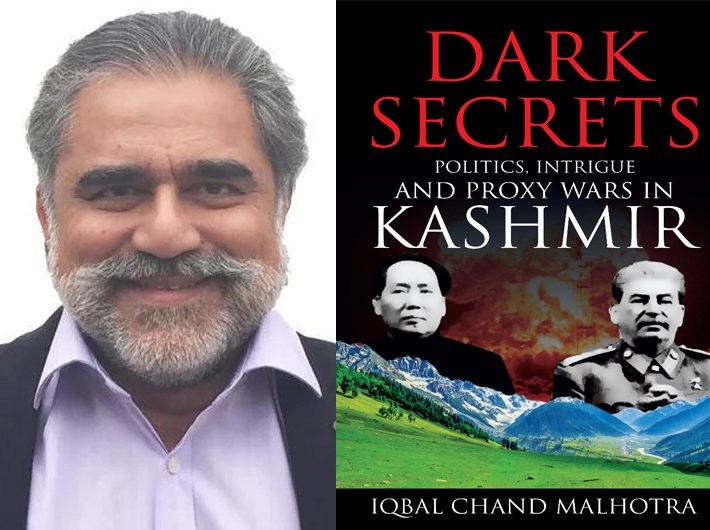
Iqbal Chand Malhotra follows up on his Kashmir history project, uncovering ‘Dark Secrets’ of extended Great Game involving Stalin, Mao…
Dark Secrets: Politics, Intrigue and Proxy Wars in Kashmir
By Iqbal Chand Malhotra
Bloomsbury, 277 pages
With his latest work, ‘Dark Secrets’, scholar and media personality Iqbal Chand Malhotra continues the investigation he began with the previous work, ‘Kashmir’s Untold Story: Declassified’ (co-authored with Maroof Raza). Ahead of its publication, the author answered a few questions from Governance Now.
Scholars might be familiar with your central thesis, but an average reader probably does not know that what was called ‘Great Game’ – the focus of superpowers of the 19thand early 20th centuries on Afghanistan due to the importance of its geostrategic location – also extended to Kashmir. How does the latest work add to your previous book, ‘Kashmir’s Untold Story: Declassified’?
My latest work fills in the blanks to a number of questions that were not answered in my previous two books or by anyone else so far, namely, the reason why India was given independence without a fight by the British; why partition took place; why the date for transfer of power was advanced to 15 August 1947; why Kashmir was invaded; why Aksai Chin was invaded. These questions have remained unanswered in the public realm so far and the reverberations generated from the parting fault lines they created in our polity continue to affect our lives even today. No government in the last 75 years has bothered to answer these questions and have been content to simply look the other way and present their own political spin to explain the present that is inexorably entwined with the past.
You have accumulated enough evidence to show that Britain wanted to keep Kashmir, or at least part of it, under its tabs so as to keep an eye on the USSR from that vantage point. Pakistan was willing to do Britain’s bidding. Just a hypothetical query: Couldn’t India have agreed to play that role in larger and common interest?
India had the choice but this choice was shunned by Nehru as he wished to propagate the philosophy of non-alignment and this fact was inconsistent with exercising the choice. If the choice had been exercised correctly, we may have been saved the collective grief that we continue to suffer today as a result of that bad choice. Exercising that choice would have opened up many new doorways to enable India to have become a great power on the world stage by today.
When Britain wanted to continue spying on Soviet nuclear activities in Soviet Kazakhstan and Sinkiang from Gilgit, what compelled the US to throw its weight behind India? Wouldn’t it also have preferred to play along Britain?
The US has always been drawn towards democracies and saw India as a partner in containing communism in Asia and perhaps in other parts of the world. The US did not share Britain’s colonial mind set nor her Churchillian prejudices towards India. A US-India partnership from 1949 when it was first offered to India would have changed the world order and enabled India to have become a mid-wife that helped in the birth of strong democracies in the newly decolonising post-war world. Nehru’s utopia of non-alignment is long forgotten but the crisis it created still pervades the lives of those who fell prey to non-alignment. Where is Tito’s Yugoslavia today? Where is the confederation of Syria and Egypt called the United Arab Republic today? What is Syria’s fate? We ourselves are politically torn apart…….
How was the Chinese intrusion on Aksai Chin in 1950 part of the Soviet bomb saga?
The Soviets desperately needed to access Aksai Chin’s uranium ores and transport them by road to their uranium extraction plant in Khojand in Tajikistan. For the Soviets, using the Chinese as a decoy, both hid their secret and also brought in a third party to become a buffer between them and the Muslim insurgents in Sinkiang, led by Osman Bator, who were privy to the Soviet designs and staunchly opposed them with covert US help. Further, the Soviets also wanted to break India’s then hegemonistic hold over Tibet and its politico-military interests in that country, as did Mao. Stalin’s suggestion to Mao to invade uninhabited western Tibet provided the smokescreen to build the road from Aksai Chin to Khojand and kill many birds with one stone.
China’s friendly ties with Pakistan and its interest in Central Asia, especially for connectivity, has been an overarching theme of late in diplomatic discourse. Its roots in Kashmir, however, are now so well known. How does Beijing perceive unrest in Kashmir?
Beijing is behind the unrest in Kashmir as it keeps India from creating vital infrastructure projects, the establishment of which would be inimical to both China’s tactical and strategic interests in Kashmir and Ladakh. Keeping the insurgency alive in Kashmir has been a low cost option for China and provided the Pakistani Army with the necessary cause celebre to have an institutionalised veto over every civilian govt. in Pakistan.
As climate change is predicted to be a supremely significant factor in geo-political equations in near future, it is quite a revelation to see that already happening in Kashmir, with China eyeing its water resources. What more do you foresee on the climate front regarding Kashmir?
I see a Chinese attempt to aim at pushing the Indian Army out of Siachen and well past the western banks of the Indus in Ladakh so as to have untrammelled physical control of the Nubra, Shyok, Galwan and Chang Chemo rivers in order to take advantage of the surge in water because of glacial melt due to climate change. The Siachen glacier and the glaciers on the Saltoro range, collectively hold over 150 million acre feet of fresh water. These waters are vital to be routed to the Indus River so that it feeds the giant Diamer Basha and Bunji dams built by China on the Indus in POK. Both the electricity generated from these dams and the retained water in vast reservoirs become vital inputs for the newly transported and established Chinese micro-chip industry in southern Xinjiang.
Lastly, if there was one thing in Kashmir’s back story that you wish could have been changed, what would it be?
Nehru should have abandoned non-alignment and thrown his lot behind the western alliance against communism. India would have been where China is today, instead of having to suffer a combination of political humiliation and economic dominance at its hands.