
An excerpt from Dr. Joseph K. Thomas’s new book: “The Fight for peace and the fight for the planet are, after all, two sides of the same coin”
GN Bureau | June 19, 2024
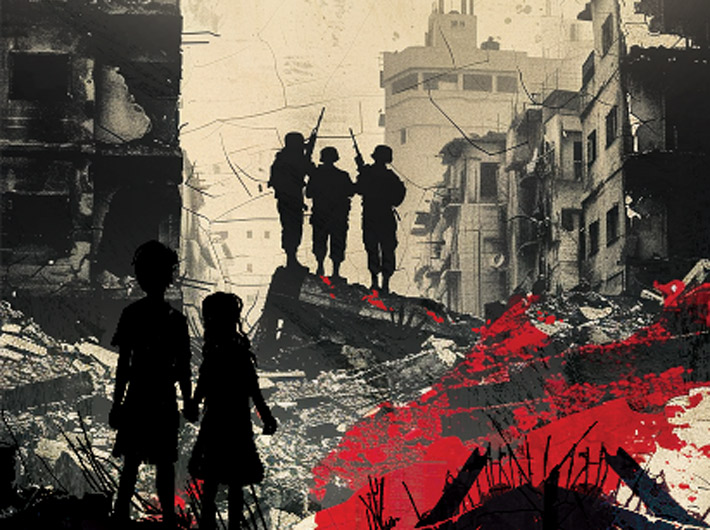
Israel-Palestine War: Give Peace a Chance
By Dr. Joseph K. Thomas
IndiePress, 243 pages, Rs 399
 This is a deeply researched and nuanced book on the ongoing Israel-Palestine discord by an Army veteran, and it offers a comprehensive analysis of one of the most complex and the oldest conflicts still affecting the world. It provides a comprehensive overview, from the Balfour Declaration to the dramatic events of the October 2023 invasion, presenting a layered portrait of how this is impacting the world right from the diplomatic impasse to the environment, economic and health crisis it brings with it.
Peering into the future, the book probes prospects for peace, drawing insights from historical endeavours and offering a roadmap for reconciliation in this deeply fractured region. This is the time to rewrite history, to heal the wounds of the past, and to build a legacy of peace.
A soldier by choice, an engineer by profession, an educationist by passion, Dr. Joseph K. Thomas has received numerous awards and commendations, including six national awards and five international awards, for his service and contribution to the fields of education and philanthropy. His previous book ‘Russia – Ukraine War’ was a bestseller.
Here is an excerpt from the book:
The Road to Reconciliation: Lessons from Past Peace Efforts
In the entanglement of conflicts that have marred human history, the Israeli-Palestinian dispute stands as one of the most enduring and complex. The path towards peace in this region has been fraught with setbacks and setbacks for victories, each attempt at resolution weaving its own intricate blend of hope and disillusionment. The pursuit of peace between Israelis and Palestinians is not just a political challenge; it is a chronicle of human endeavor, echoing the worry and aspirations of countless individuals caught in the storm.
At the heart of this saga are the earliest origins of conflicts, tracing back to the early 20th century. Zionism and Arab nationalism grew in parallel, yet on a collision course, as both aspired to lay claim to the same geographical fabric. The Balfour Declaration of 1917, promising a Jewish homeland in Palestine, in contrast to the rising tide of Arab self-determination, sowed the seeds of contention that would sprout into decades of discord.
A chronicle of milestones marks the fraught journey towards peace. The 1947 UN Partition Plan attempted to delineate a two-state solution, but the subsequent Arab-Israeli War of 1948 led to the establishment of Israel and the displacement of Palestinians, a tragedy they call the Nakba, or catastrophe. The Six-Day War of 1967 saw Israel’s territorial expansion and the beginning of the occupation of Gaza and the West Bank, further complicating the geopolitical landscape.
Cultural and regional variations in the peace process are stark. The Oslo Accords of the 1990s, symbolized by the iconic handshake between Yitzhak Rabin and Yasser Arafat on the White House lawn, brought the promise of Palestinian self-governance, yet failed to address the core issues like Jerusalem and refugees. The Camp David Summit of 2000, and the consequent breakdown, underscored how differing narratives and unmet expectations can derail even the most concerted efforts.
The recent Abraham Accords, normalizing relations between Israel and several Arab states, suggest a shift in regional dynamics, but the Palestinian question remains unresolved. The journey is rife with challenges, controversies, and turning points. The unilateral disengagement from Gaza in 2005, the ongoing expansion of Israeli settlements, the intermittent wars in Gaza, and the cycles of violence and retaliation all these elements underscore the fragility of the status quo. How does one reconcile the legitimate aspirations of two peoples bound to the same land?
One might ask, have the lessons from past efforts been internalized? The importance of mutual recognition, the necessity of a viable economic framework for Palestine, the imperative of addressing security concerns, and, above all, the need for a political horizon that can inspire both sides to transcend decades of enmity.
In the search for peace, the adage ‘those who cannot remember the past are condemned to repeat it’ rings with a haunting resonance. Delving into details, one uncovers a litany of moments when decisions, both bold and misguided, shaped the contours of the present. The assassination of Rabin, the Second Intifada, and the blockade of Gaza each a chapter in the annals of a history that is as much about missed opportunities as it is about the relentless quest for a resolution.
In this moment of contemplation, we pause. We reflect on the gravity of the past, the complexity of the present, and the uncertainty of the future. The lessons from past peace efforts are like beacons in the seas of history, guiding us toward the elusive shores of reconciliation.
And so, the search for peace continues, a journey wrought with challenges, but sustained by the unwavering hope that, one day, the bells of harmony will ring through the hills and valleys of Israel and Palestine.
[…]
A Vision for Coexistence
In the pages to follow, you will not simply read about peace as an abstract concept; rather, you will embark on an intellectual journey to uncover a pragmatic blueprint for harmony, a vision where Israelis and Palestinians not only co-exist but also thrive together. This is not a utopian fantasy, but a tangible reality within our grasp if we dare to reimagine our approach to the cultural, social, and political fabric of this storied land.
How can one propose harmony in a land where the drumbeats of war have drowned out the whispers of peace for generations? I acknowledge the weight of history and the depth of wounds that both communities have borne. My assurance to you is not born from naivety, but from a profound belief in humanity’s capacity for transformation, underpinned by practical strategies that have seen the light of day in other corners of our world.
Close your eyes for a moment and picture the transformation. Imagine bustling markets in Jerusalem, where Hebrew and Arabic laughter intertwine. Visualize the classrooms in Haifa where children of all backgrounds learn not just the history that divides them but also the shared human values that unite them. Conjure the image of joint innovation hubs in Tel Aviv and Ramallah, where young entrepreneurs collaborate across cultural chasms to forge a prosperous future.
This book is a commitment, a pact between you, the reader, and myself. We are not bystanders in history; we are its sculptors. Through the journey of these pages, you will gain not just knowledge, but a call to action. The life-changing potential of what you are about to read is more than an opportunity; it is a responsibility we share to sow the seeds of a peace that will flourish for generations to come.
[The excerpt reproduced with the permission of the publishers.]
The Golden Chisel: The Story Behind the Making of Ram Lalla By Seethalakshmi S. and Rahul Nandan Rupa Publications, 168 pages, Rs 395
Mumbai’s real estate market keeps growing, yet homeownership remains out of reach for much of its population. Three experts – urban researcher Hussain Indorewala, urban planner Vidyadhar Phatak and developer Kamlesh Thakur of NAREDCO Maharashtra, agree that simply constructing more apartments
US secretary of state Marco Rubio has said he was unfamiliar with the Wall Street Journal report suggesting Elon Musk had decided to throttle Starlink services in Ukraine, but rejected claims that Washington had ordered the restrictions to pressure Kyiv. “There was no
Breast cancer has become a public-health challenge in India. The greatest opportunity is to find cancers earlier. Artificial intelligence (AI) is opening a new era in breast cancer detection. AI systems can analyse mammograms and other breast-imaging studies, identify subtle abnormalities and assist radi
Indian agriculture is experiencing significant climate volatility, while the world economy seems to be in a highly volatile situation. Economic indices from various countries show that they need to recalibrate their strategies to withstand economic headwinds. In such a challenging situation, a country li
India’s southwest monsoon ended with a 13% rainfall deficit in 2026, its weakest performance in a decade, raising concerns over agricultural production, water security and the upcoming rabi season. With El Niño expected to persist into early 2027, experts warn that declining soil moisture, dep










