
Shalini Modi’s new book draws from Vedic hymns, Aranyakas and Brahmanas, as well as later Puranic tales to illuminate Surya’s enduring role in Hindu thought
GN Bureau | January 25, 2026

The Eternal Sun: The Legacy of Surya Deva
By Shalini Modi
Rupa Publications, 192 pages, Rs 295
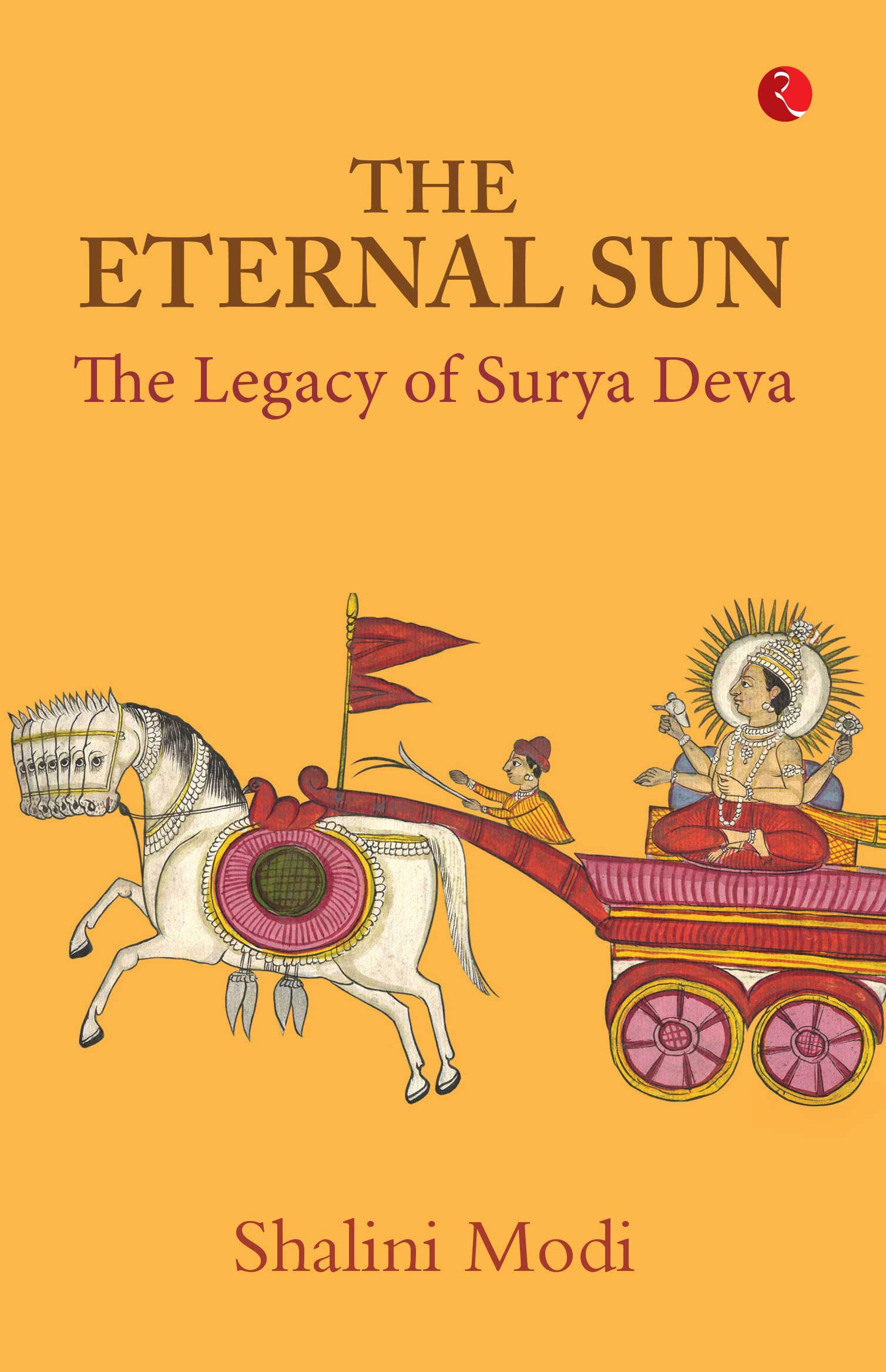 ‘The Eternal Sun’ illuminates Surya’s enduring role in Hindu thought, examining his relationships, lineage, devotees and influence on human life. Drawing from Vedic hymns, Aranyakas and Brahmanas, as well as later Puranic stories, it reveals how ancient symbolism of the Sun as the source of knowledge and life was encoded into stories that still inspire awe today. Readers are invited to explore the myths, mantras and mysteries surrounding this eternal luminary, the god who watches over us, dispels darkness, and inspires us to seek the light within.
Here is an excerpt from the book:
THE HOLY-RIVER
Yami, the twin sister of Yama, became the river Yamuna, dipping in whose waters freed one from sins and the fear of death.
Yami’s sisterly love for her brother Yama has become an integral part of the stories and festivals of Hinduism. One story goes that on the second day of the waxing moon in the month of Kartik, Yami invited her brother to her house for a meal. She prepared a sumptuous meal for Yama and fed him with great love. Thereafter this day has become known as Yamadwitiya, or more popularly Bhai Dooj. Dining at one’s sister’s house on this day and giving her gifts is considered to ensure longevity and well-being of the brother, and to also grant him freedom from the cycle of life and death.
Yama was so happy on the day that Yami invited him that he decided to free all souls suffering in hell, a tradition he follows to this day. On this auspicious day, Yami—also known as Yamuna—grants freedom to those in Yamaloka who have bathed in her sacred water.
Yami, as Yamuna, flowed between Mathura and Gokul and was a source of life for many. In Mathura lived a king named Surasena, who was the leader of the Yadus, and Mathura was his capital. King Surasena’s son, Vasudeva, married Devaki. After their wedding, Vasudeva mounted the chariot with Devaki to depart for their home. The chariot’s reins turned out to be in the hands of Devaki’s favourite cousin, Kansa. He was the eldest son of Ugrasena, the ruler of Mathura. Devaki was the daughter of Devaka, the younger brother of Ugrasena.
Devaki and Vasudeva’s marriage procession was grand, which wasn’t surprising, considering the illustrious lineage of both the bride and groom. As they prepared to leave the marriage hall, the sound of conches, clarinets, clay tom-toms and kettledrums resounded in the air all at once. They created an auspicious vibration in the air.
Just then an incorporeal voice, addressing Kansa, echoed in the air, bringing everything to a standstill. Everyone gathered listened intently to this divine prophecy, ‘Kansa, you are a fool! The eighth son of the newly-wedded couple, whom you are fondly driving home, will slay you.’
Kansa was livid and drawing his sword out of his sheath, he raised it to kill Devaki when Vasudev stepped between them and pleaded with him to let her go. He said, ‘You have nothing to fear from my wife. I will personally hand her sons, the eighth of whom the divine voice has prophesied to be your slayer, over to you.’ Kansa was thus prevented from killing Devaki and he let the couple go.
It wasn’t long before Vasudeva returned, as promised, to Kansa with his firstborn boy, Kirtiman. Happy to see Vasudeva’s unflinching truthfulness, Kansa said, ‘You can take this boy back to his mother as my death has been decreed at the hands of your eighth progeny.’ Vasudeva and Devaki were overjoyed but their joy was short-lived as they were mere actors playing their part in the bigger scheme designed by the Divine.
Sage Narada, an ardent devotee of Lord Narayana, fanned Kansa’s anger, giving him reasons to not spare any progeny of his cousin. He informed him, ‘Lord Brahma and the devatas want to rid Earth of the daityas whom they consider a burden. With the sole aim of slaying you, they have planned for Lord Vishnu’s birth as the son of Devaki and Vasudev. Lord Vishnu himself has permitted this.’ Completely brainwashed, Kansa at first imprisoned his cousin, Devaki, and her husband, Vasudeva, in their own house, binding them with fetters. When his father Ugrasena objected, he put him also behind bars and proclaimed himself the king of Mathura. He annihilated the next six sons of his cousin the moment they were born, suspecting each one of them to be Lord Vishnu.
Ananta Shesha Naga entered Devaki’s womb, filling her with extreme delight and grief at the same time. Lord Vishnu, addressing Yogamaya, said, ‘In Devaki’s womb is residing my own manifestation, Shesha Naga, in the form of an embryo. Take it out and place it in the womb of Rohini, wife of Vasudeva. She lives in the village of Gokul which is owned by Nanda. Then I shall be born as Devaki and Vasudeva’s son while you will be born as a daughter to Yashoda and Nanda.’
Devi Yogamaya accepted the Lord’s command and said, ‘Let it be so.’ The Goddess then went around him from left to right as a mark of respect and descended to Earth to carry out the tasks she had been entrusted with. Lord Vishnu himself descended on Earth and entered Devaki’s womb. Devaki, bearing the invincible Lord within her, illuminated her quarters by her uncommon lustre. A bright smile, radiating her happiness and inner divinity, always shone on her countenance. Looking at her, Kansa knew that Hari, who was going to slay him, had entered her womb. He wasn’t oblivious to his divinity.
Then came the most delightful hour, when the stars and planets aligned perfectly for the advent of the Lord. Rohini nakshatra was in the ascendant, the clouds cleared in the sky, the rivers flowed in a limpid stream, lotuses bloomed in ponds, and the sky was filled with bright, shining stars. Subtle changes in the atmosphere showed auspicious signs. Trees laden with beautifully-scented flowers attracted the bees and the birds. A gentle breeze, laden with a beautiful fragrance and pleasurable to the senses, was blowing. People following the path of righteousness were filled with hope and happiness. Their minds were freed from all oppression temporarily.
The birth of the Lord was heralded by the sound of celestial kettledrums echoing through the heavens.
[The excerpt reproduced with the permission of the publishers.]
US secretary of state Marco Rubio has said he was unfamiliar with the Wall Street Journal report suggesting Elon Musk had decided to throttle Starlink services in Ukraine, but rejected claims that Washington had ordered the restrictions to pressure Kyiv. “There was no
Breast cancer has become a public-health challenge in India. The greatest opportunity is to find cancers earlier. Artificial intelligence (AI) is opening a new era in breast cancer detection. AI systems can analyse mammograms and other breast-imaging studies, identify subtle abnormalities and assist radi
Indian agriculture is experiencing significant climate volatility, while the world economy seems to be in a highly volatile situation. Economic indices from various countries show that they need to recalibrate their strategies to withstand economic headwinds. In such a challenging situation, a country li
India’s southwest monsoon ended with a 13% rainfall deficit in 2026, its weakest performance in a decade, raising concerns over agricultural production, water security and the upcoming rabi season. With El Niño expected to persist into early 2027, experts warn that declining soil moisture, dep
For over a decade, India’s e-commerce story has rested on a simple premise: platforms connect buyers and sellers, while data fuels efficiency, personalisation, and scale. However, as the market matured, its structure has revealed a growing imbalance. E-commerce platforms, especially marketplace ent
The interaction between active Western Disturbances, increased atmospheric moisture and the region’s complex topography aswell as global warming are important factors behind intense rainfall in the Himalayas, leading to flash floods in Nepal, according to meteorologists. Nepal










