
Excerpt of an essay from the new book ‘Punjabi Centuries: Tracing Histories of Punjab’
GN Bureau | July 17, 2024
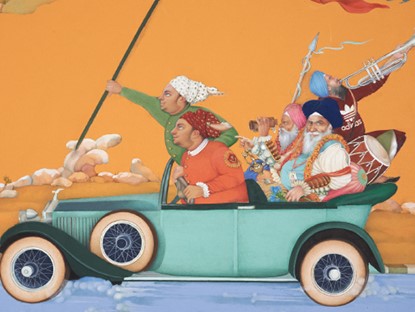
Punjabi Centuries: Tracing Histories of Punjab
Edited by Anshu Malhotra
Orient BlackSwan, 404 pages, Rs. 2,150
 The historical and territorial space of Punjab has been politically and spatially unstable and changing, What Punjab means to different people also varies over time and context. Equally, what one holds dear about Punjab, the sense of ‘Punjabiyat/Punjabiness’, is both emotionally and culturally complex.
‘Punjabi Centuries’ highlights some critically important issues. Including India, Pakistan and the diaspora, the volume focuses on the crucial nineteenth and twentieth centuries, leading up to the present. The chapters explore the cultural, social and economic continuities and changes across this time.
The editor, Anshu Malhotra, is is Professor and Chair, Department of Global Studies, and Kundan Kaur Kapany Chair for Sikh & Punjab Studies, University of California, Santa Barbara. The book includes chapters by scholars from India, UK, USA and Canada, devoted to diverse issues such as,
• economic transformations;
• the politics of the Punjabi language;
• gender imaginations in Punjab and the construction of gender identities;
• diasporic journeys;
• cultural changes in music, literature and religion;
• religious and caste identities; and
• changes from the colonial period to the last three decades of the twentieth century, to our contemporary times.
Here is an excerpt from an essay, ‘The Civil Servant and Super Cop: Modesty, Security and the State in Punjab’, by Inderpal Grewal:
Excerpt
In order to examine the interconnections of feminist activism, gender, security and the continued politics of territoriality, I focus on the crisis of the Indian state in the 1980s through the period of the Sikh-Khalistan movements and the Indian counter-insurgency against that movement in the state of Punjab. Most accounts suggest that Indira Gandhi’s use of religious division was responsible for beginning a new phase of communalism in the service of electoral politics, especially after she declared the Emergency in 1975 and suspended all elections and civil liberties (Noorani 1990; Prakash 2019; Puri 1985). By the 1970s and 1980s, her discourse of one minority community, the Sikhs, as intrinsically violent, or as ‘terrorists’, became widespread in the dominant media in both vernacular and English-language press, responding also to the emerging movement for a separate Sikh nation, and after the assassination of Indira Gandhi by her Sikh bodyguard, leading to a pogrom against Sikhs in Delhi and several other Indian cities (Van Dyke 1996). In such representations, Sikh males were presented and recuperated as hypermasculine and therefore a violent threat to the nation; a long history of war, religion and military service in the pre-colonial period and during British rule over-determined a warrior masculinity within this group, enabling this representation to become weaponised by the Indian state (Chowdhry 2013b; Sinha 1995; Streets 2004). In the postcolonial state, however, the use of this masculinity for counter-insurgency by the state, deployed on both sides of the struggle, made it much more suspect, leaving openings to challenge both the state and this masculinity, even as the security state’s power remained overwhelming (Axel 2001; Singh and Purewal 2013).
The particular challenge to the security state in Punjab that emerged within the Indian state’s counter-insurgency operations came in the form of an incident of sexual harassment (as it was called) and its court cases, which I examine in this chapter. This is the case of Rupan Deol Bajaj v. K. P. S. Gill, often referred to in India as the ‘butt-slapping case’ (Admin Lawnn 2015) which, seemingly about sexual harassment, and sometimes seen as trivial, opened up questions about what militarised security meant, who it protected and what it looked like on the ground for women in the state. It is a case that the Supreme Court directed as concerning Section 354 and Section 509 of the Indian Penal Code (IPC) (though Bajaj invoked other IPC sections that the SC decided were not relevant).
These statutes, though distinct from those concerning rape, are linked to them by the focus on violence against women; as feminist scholars have pointed out, they rely on notions of female respectability rather than sexual rights or sexual autonomy for women. Section 354 of the IPC concerns the ‘assault of criminal force to woman with intent to outrage her modesty’:
“Whoever assaults or uses criminal force to any woman, intending to outrage or knowing it to be likely that he will thereby outrage her modesty, shall be punished with imprisonment of either description for a term which may extend to two years, or with fine, or with both” (The Indian Penal Code 1860a).
Section 509 states:
“Whoever, intending to insult the modesty of any woman, utters any word, makes any sound or gesture, or exhibits any object, intending that such word or sound shall be heard, or that such gesture or object shall be seen, by such woman, or intrudes upon the privacy of such woman, shall be punished with simple imprisonment for a term which may extend to one year, or with fine, or with both” (The Indian Penal Code 1860b).
Both sections recuperate problematic notions regarding women, given that the laws came from a colonial era that reflected a Victorian view of women, and the Supreme Court came to define modesty in ways that enshrined patriarchal ideas of women’s behaviour.
While the Supreme Court ruling of 1996 found that Mrs Bajaj was justified in drawing on these statutes to claim she had been a victim of a crime, Justice Mukherjee’s ruling cited a previous case, Punjab v. Singh, which he said established that ‘a woman’s modesty is her sex and from her very birth she possesses the modesty which is the attribute of her sex’ (Bajaj v. Gill 1996). The enduring problem with these statutes is that, as with trials concerning rape, they have long kept women from reporting assaults because then it was their modesty that is being adjudicated in the courts. However, this eventuality did not happen in the case of Rupan Deol Bajaj v. K.P.S. Gill since Mrs Bajaj was open about what had transpired with her, pursued the case vigorously despite great opposition by the government anxious to protect the perpetrator, and saw herself as a role model for women to speak out. The Bajaj v. Gill case continued for about 10 years, going through the Punjab and Haryana High Court and the Supreme Court, which gave its final judgement in 2005 upholding the conviction by the High Court, and handing down to Gill a sentence of probation for three months and a small fine of Rs 200,000 (Admin Lawnn 2015).
Most analyses of the case suggest its inadequacy in helping all groups of women in the struggle against sexual harassment. Martha Nussbaum writes that the case ‘divides women by caste, class, occupation, and marital status, ultimately strengthening norms of proper female conduct that are subversive of women’s equality’ (2003: 635). Writing about the broader question of legal feminism, Ratna Kapur (2001) has argued that much of the sexual harassment law in India has enshrined conservative sexual morality and disregarded their sexual autonomy. While there is no doubt that the statutes and the judgment are both problematic with regard to constraining women’s sexuality and behaviour, a closer examination of questions of historical and social context might suggest why the case became notorious and noteworthy. I show in this chapter that the word ‘modesty’ came to mean much more than the lack of sexual autonomy that it is often taken to imply, and that the politics of respectability could be a broader question about power and position for women within a state continually struggling to control its borders and populations. The context of a patriarchal security state, with the collaboration of male power across state and community, requires us to engage with a more contextual understanding of modesty vis-à-vis the state, and to see how women, even those elite and powerful, struggle against forms of subordination and humiliation that emerge from gendered institutions, for which they come to blame the security state that takes away their rights. Elite women are thus torn between a feminism that allows them the claim to be models for women and the state that gives them the power to become role models by subjecting them to a state patriarchy as well as by acknowledging the gendered injustice done to them. While there is little doubt that elite class and caste status gives them access to the state, their interventions against the postcolonial security state can impact not only the politics of gender and sexuality, but also that of security and militarism.
[The excerpt reproduced with the permission of the publishers.]
September 12 marks the International Day for South-South Cooperation, commemorating the 1978 Buenos Aires Plan of Action (BAPA). Forty-eight years later, its central proposition remains relevant: countries of the Global South can draw on their own knowledge, experience and innovations to address shared d
As India prepares to host the 18th BRICS Summit this weekend, and as prime minister Narendra Modi is set to hold a bilateral meet with president Xi Jinping, China’s growing global influence and the changing dynamics of India-China relations will be under focus. But to understand where China is head
This year marks 20 years of BRICS, with India set to host the grouping’s leaders’ summit this weekend. The anniversary offers an opportune moment to assess BRICS’ growing importance at a time when the effectiveness of global governance and the credibility of multilateralism are under in
Triumph of the Indian Republic: My Life, My Struggles By Ram Nath Kovind Rupa Publications, 400 pages, Rs 795 All our presidents so far stand out, each for a different reason. Ram Nath Kovind, the 14th president of India, from 2017 t
Pathbreakers: How 10 Visionary Leaders Transformed India by award-winning journalists By Sucheta Dalal and Debashis Basu Rupa Publications, 304 pages, Rs 695
In a significant gain for citizen protection in the digital economy, the Department of Telecommunications (DoT) has helped prevent suspected cyber fraud losses of more than ₹5,000 crore through its Financial Fraud Risk Indicator (FRI) within fifteen months of its launch on May 22, 2025. This money did











