
Suresh Prabhu calls combined union budget ‘visionary’

Centre’s allocation of Rs 55,000 crore will be spent on rail automation and technology

vishwas

Vishwas Dass | February 2, 2017 | New Delhi

#ministry of railways   #rail budget   #union budget 2017   #Suresh Prabhu  


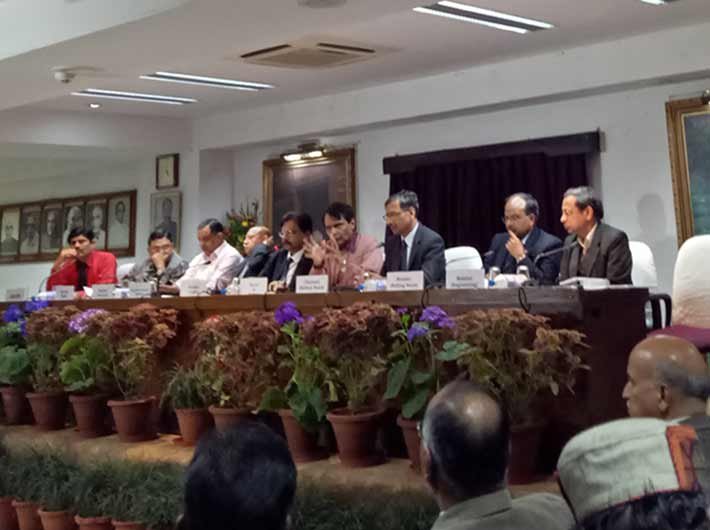
Railway minister Suresh Prabhu lauded the government for presenting a ‘visionary’ combined union budget, saying the provision for Rashtriya Rail Sanraksha Kosh would help railways step-up safety works.
 
While addressing media at Rail Bhawan on Wednesday, Prabhu said that the timing of union budget was crucial as the country witnessed two major events — demonetisation and GST. 
 
Prabhu highlighted that the centre’s allocation of Rs 55,000 to the railways would largely be used for automation and technology.
 
Furthermore, safety and rail modernisation are the biggest priorities. He called improvement of rail infrastructure as a matter of global concern.
 
“The recent spate of derailment mishaps was quite unfortunate and the railways laid strong emphasis on the need of having dedicated funds to carry out safety works. The government has decided to create Rashtriya Rail Sanraksha Kosh to allocate Rs 1 lakh crore in a period of five years to strengthen safety works including maintenance of tracks, renovation of bridges and replace old tracks. We would minimise the casualties and eliminate all the unmanned level crossings in the next four years,” Prabhu said.
 
The minister said that there is need of ramping up production of coaches with German technology LHB which are safer than conventional coaches. The new technology coaches do not topple in the event of derailment. “All 45,000 coaches cannot be replaced overnight with the LHB ones but the existing conventional coaches are being retrofited with centre buffer couple (CBC) to make them similar to those LHB carriages,” he said.
 
Finance minister Arun Jaitley while presenting the budget said that the railways will have to raise the remaining funds from its own resources to strengthen safety works. On this, Prabhu said that the railways would do it in consultation with the railway board.
 
Notably, the centre would allocate Rs 20,000 crore every year for safety works of the Indian Railways which would also be used to impart training to safety, signal and telecom department.  
 
On the progress of bullet trains, the minister said that a lot of things have been materialised like completion of geo-technical study, finalisation of general consultant and loan agreement would be done in the next six months. A new team selection procedure is on, he added.
 
Chairman, railway board, AK Mital said that the railways has been given seven years to introduce bullet trains and this dream can’t be achieved in a year or two. “We have already introduced a semi-high speed train on the Delhi-Agra route and finalised another two routes: Delhi-Mumbai and Delhi-Kolkata. The completion of a dedicated freight corridor (DFC) would facilitate faster movement of trains on the saturated routes,” Mital said.
 
Prabhu added that in order to encourage digital transactions, railways has waived service charge levied on e-tickets for which railways would have to bear the burden of Rs 500 crore. The online booking of tickets through IRCTC website has increased to 68 percent at present.
 
A holding would be formed by the government for listing railways’ PSUs, an official said.
 
After being asked about surge pricing or flexi fare system, Mital said that the decision is not affecting the poor as the system is meant for only a handful of premium class of certain VIP trains. “Flexi fare does not exceed 50 percent of the basic fare,” he added.
 

Comments


Other News

RBI pauses to assess inflation risks, policy transmission

The Reserve Bank of India (RBI) has begun the new fiscal year with a calibrated pause, keeping the repo rate unchanged at 5.25 per cent in its April Monetary Policy Committee (MPC) meeting. The decision, taken unanimously, reflects a shift from aggressive policy action to cautious observation after a signi

New pathways for tourism growth

Traditionally, India’s tourism policy has been based on three main components: the number of visitors, building tourist attractions and providing facilities for tourists. Due to the increase in climate-related issues and environmental destruction that occurred over previous years, policymakers have b

Is the US a superpower anymore?

On April 8, hours after warning that “a whole civilisation will die tonight,” US president Donald Trump, exhibiting his unique style of retreating from high-voltage brinkmanship, announced that he agreed to a two-week ceasefire with Iran. The weekend talks in Islamabad have failed and the futur

Machines communicate, humans connect

There is a moment every event professional knows—the kind that arrives without warning, usually an hour before the curtain rises. Months of meticulous planning are in place. And then comes the call: “We’ll also need a projector. For the slides.”   No email

Why India is entering a ‘stagflation lite’ phase

India’s macroeconomic narrative is quietly shifting—from a rare “Goldilocks” equilibrium of stable growth and contained inflation to a more fragile phase where external shocks are beginning to dominate domestic policy outcomes. The numbers still look reassuring at first glance: GDP

Labour law in India: A decade of transition

The story of labour law in India is not just about laws and codes, but also about how the nation has continued to negotiate the position of the workforce within its economic framework. The implementation of the Labour Codes across the country in November 2025 marks a definitive endpoint in the process. Yet


Archives

Current Issue

Opinion

Facebook Twitter Google Plus Linkedin Subscribe Newsletter

Twitter






