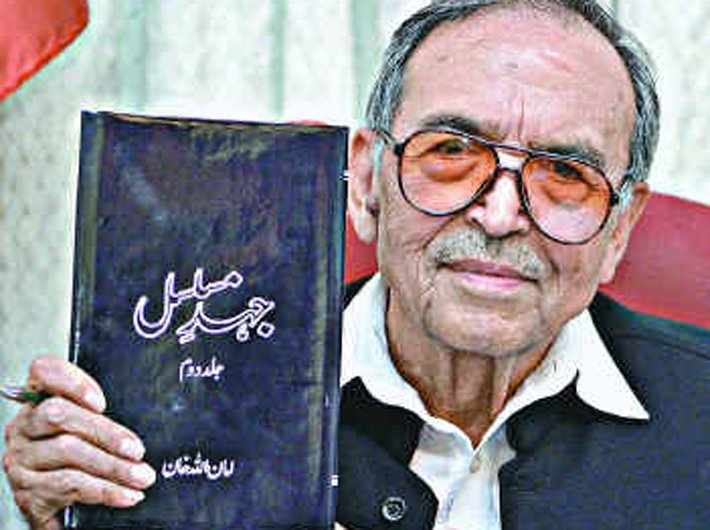
Recalling the life of a disillusioned separatist who was the precursor to today’s ‘masterminds’
I met Amanullah Khan, the Jammu and Kashmir Liberation Front (JKLF) founder, at a Rawalpindi hotel in 2000 on the occasion of his daughter Asma Khan’s wedding to Sajjad Lone, then a businessman and now a politician in Kashmir. He came across as an overexcited father of the bride, and was visibly elated to see us, a group of Kashmiri journalists who had come to report this cross-border liaison. It was happening at a time when relations between India and Pakistan had touched a new low, thanks to the Kargil war.
Khan spoke incoherently – probably out of sheer excitement of seeing people from a land that he had once wanted to be free. Strangely, he repeatedly apologised for not being able to host us as he was not a man of means. [Journalists were hosted in the Kashmir House, a state guesthouse, as the guests of the groom’s father].
Khan, who died on April 26 at the age of 82 in Rawalpindi, hardly looked like a terrorist, who would have directed people to kill for a political cause. But, the fact is that till his end, he remained a fugitive for the UK and an international terrorist for India for his involvement in the murder of the abducted Indian diplomat Ravindra Mhatre in London in 1984. His group JKLF was behind the crime, committed to focus on the cause of Kashmir’s azadi.
Khan did not speak Kashmiri as he belonged to Gilgit, a beautiful region now part of the Pakistan-occupied Kashmir, inhabited by people who are different from Kashmiris in their origins as well as lifestyle. Ironically, right in his lifetime itself, Gilgit-Baltistan, comprising northern areas of PoK, was being subsumed as Pakistan’s territory and the indigenous people were fighting against this.
At the pre-wedding interactions with media persons from Kashmir, he admitted to being impoverished and not as wealthy a person as others were. He also spoke about the possibility of India and Pakistan bridging the gap by encouraging cross-border interactions. He had advised his only child, Asma, to be an ‘ideal’ bahu. “I can never go to Kashmir, but I am happy to send my child there for the rest of her life,” he had told us. Asma later told me that her father regretted that he could not even attend her ‘walima’, or reception, in Srinagar.
Later, in the twin cities of Islamabad-Rawalpindi, I came across a number of persons who were once big names in Kashmir’s militancy like Hizbul Mujahideen chief Syed Salahuddin and Aasan Dar. They were being hosted by the ‘Agency’ – a euphemism in Pakistan for the Inter-Services Intelligence (ISI) – the notorious spy agency. Most outfits had offices in Rawalpindi, the older city. Salahudin, the middle-aged maulvi who was made to head the Hizbul Mujahideen and has remained stationed in Pakistan since, even came to attend the pre-wedding functions. He was escorted by a pilot car and was guarded by his personal bodyguards, all looking like militants with kohl-lined eyes and flowing beards.
However, later, after speaking to some of them, I realised that Pakistan had kept them confined to Rawalpindi-Islamabad and PoK’s Muzaffarabad areas; their weapons [for bodyguards] were accounted for and they were under strict instructions not to venture into other areas of Pakistan. One of them admitted that Pakistan was an “open jail” for them.
However, Khan was a class apart: dressed in a dark suit and a matching tie, the tall man with sharp features looked every inch a gentleman. I later came to know that he didn’t enjoy the same patronage from Islamabad as Saluhuddin did. He was a recluse and a political outcast for the establishment.
I was soon to figure out that his open admission of being a “poor man” was a reference to his not being in the list of favourites of Islamabad, which was otherwise spending mindboggling sums on the upkeep of Kashmiri militants – even those who were only paper tigers.
His disillusionment with Pakistan was complete, as Islamabad had imprisoned him the moment he even thought of taking the ‘azadi’ fight to PoK. He again became a suspect in the eyes of Islamabad when the Indian Airlines plane was hijacked by two Pakistan-based Kashmiris from Amritsar to Islamabad and blown up there in 1971. There are a lot of mysterious stories about who was behind the hijacking as it eventually helped India ban flights between East and West Pakistan over its territory in preparations for imminent liberation of Bangladesh. At any rate, Khan was again jailed for two years, obviously being suspect in the eyes of Pakistan.
The JKLF, the first ever group to launch an anti-India campaign that he had founded, has split like an amoeba. Khan himself had slipped into oblivion while others – Kashmiri-speaking leaders – took charge of its splinters.
Khan’s struggle seemed to have ended in a quagmire; it began with hate for India but seemed to have ended at, ironically, sending his lone child to India as a bride. He had even blessed his son-in-law for being on the side of India in the conflict over Kashmir.