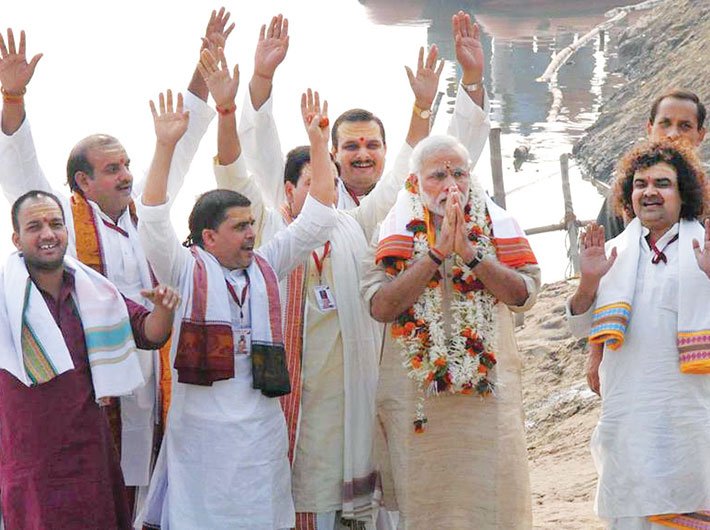
Holy Ganga took a political turn when it became the PM’s pet project last year. While he had chosen to contest from Varanasi last year, the Ganga found its protector, benefactor in the PM who took a pledge to clean up the river and restore its pristine glory. Soon after his victory, Modi announced the Clean Ganga Mission. Huge money was allocated. The water ministry was now called the ministry of water resource, river development and Ganga rejuvenation. The government even told the supreme court that the river would be cleaned by 2018. The government is about to complete a year and the poll promise seems to be just that – a promise.
Work done so far: In July 2014, the interim budget allocated '2,037 crore to the Clean Ganga Mission. In 2015, donations to the Clean Ganga Fund (established last year to collect donations) were made eligible for deductions under the Income Tax Act. The latest budget has allocated '4,173 crore to the ministry, of which half has been set aside for the Ganga. On May 13, the cabinet approved the Namami Gange programme, with a budget outlay of '20,000 crore for the next five years.
Funds are to be utilised for controlling agricultural run-off, eradicating open defecation in cities and villages on the banks of the river, building sewage treatment plants (STPs) and developing the riverfront. The National Ganga River Basin Authority (NGRBA) has held five meetings in the last 10 months, but has nothing much to show.
Out of the many STPs sanctioned by the earlier government under the Ganga Action Plan (launched by Rajiv Gandhi in 1986), only a few have started operating. There are 118 cities on the banks of the river in five states. Now, the government is going to set up more STPs in 56 cities where the load is higher. The present burden of sewage water on Ganga is 3,847 million litres per day (mld), which is expected to go up to 4,773 mld in 2030. The present capacity of STPs on Ganga is only 879 mld.
Most of the under-construction STPs are, however, running behind schedule due to land disputes and other hurdles. A new STP has been proposed by the Modi government for Varanasi even as the town awaits the one sanctioned by the earlier government.
Ganga needs water too: Water conservationist and Magsaysay award winner Rajendra Singh is concerned about the reducing flow of Ganga due to upstream dams. “I cannot see any significant change in (the last) one year. I feel Ganga needs water more than money. I had hopes from this government, but so far nothing has been done,” he said.
The spotlight is on pollution control. Around '20,000 crore has been spent on the river under the Ganga Action Plan in 30 years. The Modi government is going the same way. According to professor BD Tripathi, river scientist from Banaras Hindu University (BHU) and a member of NGRBA, the government despite showing its dedication in cleaning Ganga is not doing anything new. “Ganga water never rots. It has its own purification tendency because of the rich silt and minerals it carries. Municipal and industrial discharge create problem and when there is no flow in the river, the river looks like a dead polluted stream. Around 80 percent pollution can be checked if there is enough flow in the river. The government should work towards preserving the flowing river system instead of the pond (building dams) system of rejuvenation. Most of the problems are up the stream where the river water is sealed in dams,” he said.
Even boatmen are not very happy. “No law has been made to keep the river clean. It’s only May and we can see the course of the river drying on different stretches,” said Vinod Manjhi, a boatman in Varanasi.
The road ahead: Rejuvenating Ganga is going to be a great challenge for the PM. A recent report by a consortium of IITs said '6-7 lakh crore will be needed to bring the river back to life. About 45 crore people are dependent on the Ganga, which is dying from municipal and industrial waste, religious offerings and dead bodies on its 2,500 km course. The PM’s report card will look dull if ‘Maa Ganga’ is not restored to its pristine glory, as promised by him.
[email protected]
(The article appears in the May 16-31, 2015 issue)