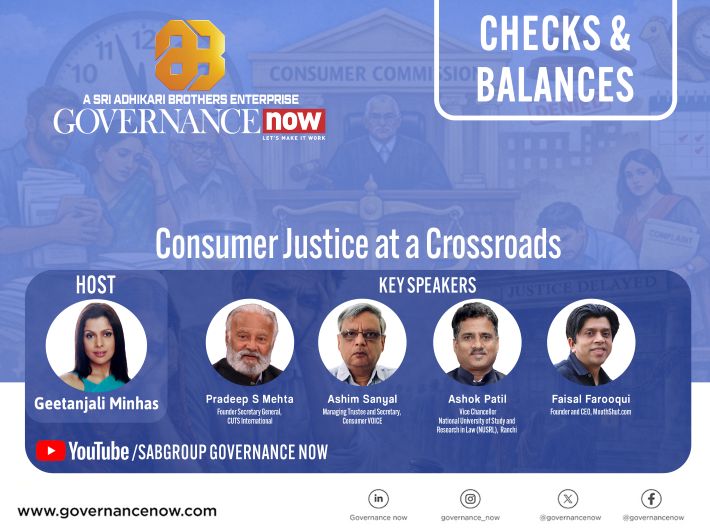
Checks and Balances: Four leading voices on how stronger laws, smarter regulation and greater accountability can shape the future of consumer protection in India
Over the past four decades, India's consumer protection landscape has undergone a remarkable transformation. What began with the Consumer Protection Act, 1986 as a simple mechanism to empower ordinary citizens has evolved into a comprehensive framework capable of addressing challenges ranging from misleading advertisements and defective products to digital commerce, artificial intelligence and cross-border transactions.
Today, consumers enjoy stronger legal rights, easier access to grievance redressal and greater awareness than ever before. Yet, as markets become increasingly digital and business models more complex, consumer protection is entering a new phase-one that demands not just stronger laws but stronger institutions, faster implementation and greater accountability.
Leading voices of India's consumer movement agree that while the country has made impressive legislative progress, the real challenge now lies in translating those rights into meaningful outcomes.
This is the topic of the latest episode of Checks and Balances in which Geetanjali Minhas of Governance Now discusses it with a panel of experts. To view the episode, click here: https://www.youtube.com/watch?v=8JAiY92KqYw
Pradeep Mehta, founder secretary general of CUTS International and one of the architects of the Consumer Protection Act, 1986, believes India's consumer movement has matured significantly since its early days. Consumers today have far greater opportunities to seek justice, and businesses have become more responsive to complaints than they were four decades ago.
However, Mehta argues that governance reforms have not kept pace with market reforms. Bureaucratic delays, administrative inefficiencies and corruption continue to affect consumer welfare, particularly in public services such as healthcare and insurance. Delays in government reimbursements under health insurance schemes, for instance, often create friction between hospitals and patients, ultimately affecting access to timely care.
According to Mehta, the challenge today extends beyond protecting consumers from unfair businesses. It also involves improving public systems that directly influence consumer experiences.
He also reflects on how consumer dispute resolution has evolved. The original vision behind the 1986 Act was to create simple, inexpensive and accessible consumer forums that ordinary citizens could approach without the complexities of conventional courts. Over time, however, increasing legal formalities and court-like procedures have made consumer commissions more complex, slowing dispute resolution and reducing accessibility.
The digital economy has further transformed the consumer landscape. E-commerce, online marketplaces, influencer marketing and AI have created opportunities for innovation while introducing new risks, including fake reviews, misleading advertisements, hidden charges and manipulative "dark patterns" that influence consumer decisions.
Recognising these emerging challenges, the Consumer Protection Act, 2019 introduced several landmark reforms, most notably the establishment of the Central Consumer Protection Authority (CCPA).
Professor Ashok Patil, vice chancellor of the National University of Study and Research in Law, Ranchi, describes the CCPA as a defining milestone in India's consumer protection journey. Unlike consumer commissions that primarily resolve individual disputes, the CCPA has the authority to investigate unfair trade practices, misleading advertisements and products affecting consumers on a large scale. Its powers to conduct investigations, order recalls and impose penalties represent a shift from reactive dispute resolution towards preventive regulation.
Professor Patil also highlights the role of technology in expanding access to justice. Platforms such as e-Daakhil now enable consumers to file complaints online without physically visiting consumer commissions. The removal of geographical barriers, combined with video conferencing facilities, has made grievance redressal more accessible and convenient for consumers across the country.
Yet legal reforms alone cannot guarantee effective consumer justice. Implementation remains uneven across states, with vacancies in consumer commissions, inadequate infrastructure and staff shortages slowing the disposal of cases. Professor Patil argues that strengthening institutions must become a priority if the promise of the 2019 Act is to be fully realised.
He also advocates greater use of mediation as a faster and less adversarial alternative to litigation. Although India has pioneered online consumer mediation, its potential remains underutilised because of limited infrastructure and inadequate participation by businesses. Expanding mediation mechanisms could significantly reduce case backlogs while delivering quicker resolutions for consumers.
For Ashim Sanyal, CEO of Consumer Voice, the Consumer Protection Act, 2019 represents a shift from simply resolving complaints to preventing consumer harm. He believes the Act has strengthened consumer rights through technology-driven reforms, expanded jurisdiction of district commissions and stronger enforcement powers.
Sanyal considers the CCPA one of the Act's most important achievements. Equipped with powers to investigate, conduct searches, seize products, order recalls and act against misleading advertisements, the authority has strengthened regulatory oversight and reinforced accountability among businesses.
However, Sanyal believes the digital marketplace presents challenges that require continuous vigilance. Fake reviews, deceptive endorsements and dark patterns remain widespread across e-commerce platforms, travel portals and online services. While regulators have issued guidelines and engaged with industry stakeholders, he argues that consumer protection must increasingly focus on preventing such practices rather than merely penalising them after the damage is done.
Financial-consumer protection is another growing concern. Mis-selling of insurance and financial products continues to expose consumers to unsuitable investments and inadequate disclosures. Sanyal believes stronger penalties are essential to deter repeat violations, particularly for large corporations where modest fines often fail to influence business behaviour.
He also highlights emerging concerns around food safety and public health, advocating mandatory front-of-pack warning labels for foods high in fat, salt and sugar. Transparent information, he argues, enables consumers to make informed choices without restricting their freedom to decide.
AI, too, represents both an opportunity and a challenge. AI can strengthen fraud detection, improve grievance redressal and enhance regulatory surveillance, but it can also facilitate sophisticated scams, identity theft and digital manipulation. Regulators and consumer organisations must therefore harness AI not only to improve services but also to anticipate and prevent emerging risks.
Offering the perspective of the digital marketplace, Faisal Farooqui, founder and CEO of MouthShut.com, believes the balance of power has shifted significantly towards consumers over the past two decades. Online reviews, ratings and public feedback have become powerful drivers of corporate behaviour, compelling companies to invest in customer experience and reputation management.
Yet Farooqui argues that genuine customer-centricity must come from organisational leadership rather than marketing departments alone. Businesses that view complaints as opportunities to improve, rather than threats to their reputation, are more likely to earn long-term consumer trust.
He also cautions against over-reliance on automation. While AI powered chatbots have improved efficiency, they cannot replace empathy when consumers seek refunds, warranty support or resolution of complex disputes. Technology should complement-not replace-the human element in customer service.
Like the other experts, Farooqui identifies fake reviews, hidden charges and manipulative digital design as growing threats to consumer confidence. Platforms that host user-generated content, he believes, have a responsibility to ensure authenticity through robust moderation, technological safeguards and transparent policies.
Collectively, these perspectives reveal that India's consumer protection journey is entering a decisive new phase. The country has built an impressive legislative foundation supported by digital innovation and stronger regulatory institutions. The next challenge is ensuring that these systems function efficiently, remain accessible and adapt to rapidly changing technologies.
The future of consumer protection will depend on faster dispute resolution, stronger institutional capacity, greater accountability for digital platforms, ethical use of AI and closer collaboration between regulators, businesses and consumer organisations. Most importantly, it will require a shift from reactive enforcement to proactive governance that prevents consumer harm before it occurs.
Consumer protection is not simply about resolving complaints – it is about building trust. In an economy increasingly shaped by digital transactions, data and technology, trust has become the foundation of sustainable growth. Protecting that trust will define the next chapter of India's consumer movement and determine whether the promise of stronger consumer rights translates into a fairer, more transparent marketplace for all.