About 15 lakh engineers pass out every year; but there are jobs only for about a third of them. Most passouts have degrees in information technology and electronics, because the IT sector was booming over the last two decades. Now, the National Association of Software and Services Companies (NASSCOM) says the IT sector has only 1.5 lakh jobs to offer to the huge army of engineering undergrads.
In India, since the fifties, engineering has been a coveted stream. Seats were limited, since most colleges were run either by the centre or by state governments. It was only after private engineering colleges came into the picture in a big way, mid-eighties onwards, especially in states like Karnataka and Andhra Pradesh, that engineering became an easy option: anyone who had passed higher secondary with science and maths could get a seat. There were jobs, too, to absorb the steady stream of engineers flowing out of the hundreds of colleges across the country. But that’s no longer the case. Read: Engineering a glut
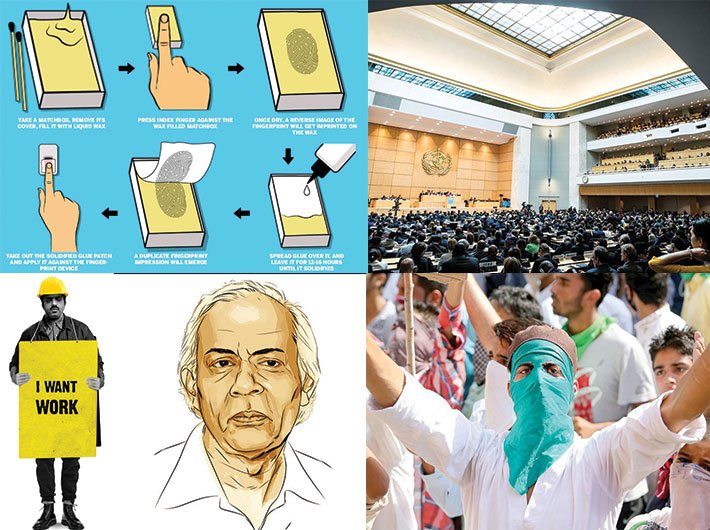
After browsing through several such videos and educating themselves in the hacking tools, it was time to experiment. Their method was simple: they took a matchbox, removed its cover, filled it with liquid wax and pressed their index finger against it. Once dry, a reverse image of the fingerprint gets imprinted on the wax. To bring it to its original form, the students spread sticky Fevicol glue over it, and left it for 12-16 hours until it solidified – the climate in Mumbai anyway remains humid during summers. And, voila, a duplicate fingerprint impression was made. However, this was just one part of the experiment. The real test lay in actually checking the fingerprint against the biometric device in the institute. Read: Aadhaar: On a sticky wicket
This generation of Kashmiris was fed such anti-India stories to ignite the fire in their bellies, while on the ground the gun culture was resulting in the mushrooming of tombstones in the Valley’s graveyards. The reality is that, in those days, elections in Kashmir were as much rigged as they were in, say, Bihar or Uttar Pradesh. The ostensible dispute as regards the 1987 elections was limited to five to six constituencies; the MUF had won just four seats in the elections. With the benefit of hindsight, one can say today that the MUF was a premature idea and therefore didn’t trigger as much euphoria as its leaders had expected. Years later, the PDP, with its politics of soft-Muslim identity, did become a reality. However, the MUF and the 1987 polls created militant leaders like Yasin Malik and gave rise to the most violent phase in Kashmir’s history. Read: Stone’s throw from Pakistan
His colleagues in the bureaucracy say he’s clean. His 37 years as an IAS officer were spotless. His services batchmate SY Quraishi, a former chief election commissioner, goes so far as to say: “He’s a sadhu. He has not done anything wrong and is not capable of doing anything wrong. I’m not [merely] saying this, but claiming this with authority, because I have seen him all these years.” But a court has held Harish Chandra Gupta, 67, a 1971 batch IAS officer who retired as coal secretary in November 2008, guilty in corruption cases related to the allocation of coal blocks – Coalgate, as it has been dubbed in the media. He has been fined Rs 1 lakh and sentenced to two years in jail. The case and the sentencing happened post-retirement. Read: The curious case of HC Gupta
In a world that sees far-from-perfect global healthcare systems, lack of access to cancer treatment – a disease which currently is the second leading cause of death – is the most unjustifiable fissure in the global health terrain resulting in more than 8.2 million deaths every year. The inhumanity of the situation apart, where a person dies even when medicines for her cure exist, non-communicable diseases (NCD), which include cancer, is a growing economic strain that is squeezing health budgets. A group of governments and non-government organisations (NGOs) working on global health came together to kick-start a conversation on redressing the situation during the 70th World Health Assembly (WHA) held between May 22 and May 31. Common sense decrees that it should have been easy to get governments to speak in one voice around the issue, since the economic health of a country has proved to be an irrelevant factor as far as soaring cancer drug prices are concerned, but the battle has not been easy for the initiators of the dialogue. Read: Making cancer treatment accessible