
UPA’s decade has ignored environment governance, but Modi's regime might worsen the situation further

Jasleen Kaur | May 1, 2014
The Gujarat model has come in for criticism on two counts: for not doing enough in social sector, and for not doing anything at all for environment. Indeed, an aggressively pro-industry policy has only added to the environmental disaster in the state. No wonder, environment activists fear that a Modi regime at the Centre will mean environment governance will go for a toss.
Also Read:
Ashish Kothari, working on environment and development issues and founder of Kalpavriksh, says the ‘Gujarat model’ has been disastrous for the environment and it is unlikely that Modi will change his approach if he becomes PM. Gujarat today has 30 percent of India’s major accident-hazard industries and over 4,500 hazardous chemical factories, he says. Moreover, Ankleshwar and Vapi in the central-to-south Gujarat industrial corridor topped the list of India’s critically polluted areas in 2009, 2011 and 2013.
Industrial projects in the sensitive coastal areas and Kutch have received clearance under the Modi regime without a care for ecology and wildlife there, Kothari says. The government has also not dealt rightly with peaceful dissent by activists. “A fifth of the murders of RTI activists in the country have taken place in Gujarat,” he adds.
Of course, the UPA’s approach toward environment has not been any better, but a Modi government could be worse, he says. “UPA was still a little more open to civil society inputs. People at the national advisory council and planning commission were more ecologically and socially minded and there were some internal checks before giving clearances. But Modi is far more authoritarian and a one-man show. Environment is more or less missing from his agenda and he will further dilute laws and policies.”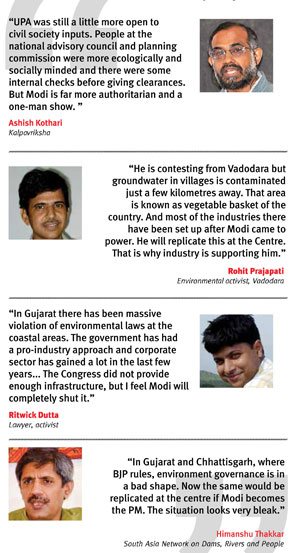
Kothari says though the UPA government had also diluted some laws related to coastal regulations, the environment impact assessment (EIA) process and the Forests Right Act, the new government may bypass it all completely or dilute it further if these factors come in the way of industry.
“BJP has mentioned its old promise of river inter-linking in its manifesto, which would be ecologically disastrous. He (Modi) has a pro-industry approach which will brush aside everything. In Gujarat, in the name of industrial development, there has been destruction of mangroves and he would replicate this nationally as well. The UPA took some progressive measures like RTI. But NDA likes to do things on its own terms, with no openness to civil society inputs,” he says. “I think it would be difficult to bring environment sensitivity.”
Rohit Prajapati, an environment activist based in Vadodara, says whatever development has taken place in the state has been at the cost of environment and the damage is irreversible. Though Modi has penned a book on climate change, he says it has ignored industrial pollution in the state. “More than environment, he is worried about environment clearances. He has been bold enough to even put it in the manifesto. His main focus has been GDP and he only talks in terms of investment.
“He is contesting from Vadodara but groundwater in villages is contaminated just a few kilometres away,” Prajapati says. “That area is known as vegetable basket of the country. And most of the industries there have been set up after Modi came to power. There are three departments in the Gujarat government – of environment, labour and industry – but all of them work only for industrial growth. I fear he will replicate this at the Centre. That is why industry is supporting him.”
But environment lawyer Ritwick Dutta feels nothing could be worse than the current situation. He says that favouritism to the corporate sector at the cost of environment has happened under the UPA rule as well and if Modi becomes the next prime minister the situation will not be much different. “So many laws have been violated to favour corporate houses like Posco and Adani,” he says. “Vedanta has been found to be funding both the BJP and the Congress.”
Dutta says there is nothing eco-friendly and sustainable about Gujarat’s development model, going by the way laws have been violated in the state; but that is not much different from other states like Andhra Pradesh and Maharashtra. “Gujarat has seen massive violation of environmental laws in coastal areas. The government has had a pro-industry approach and the corporate sector has gained a lot in the last few years,” Dutta says. “At the Centre, the National Green Tribunal has been affected. But I am not sure if the new government will continue with it. The Congress did not provide enough infrastructure, but I feel Modi will completely shut it.”
Himanshu Thakkar of the South Asia Network on Dams, Rivers and People (SANDRP) says the BJP manifesto offers no hope for improved environment governance. If anything, the manifesto talks about accelerating clearance to industrial projects, which will further worsen the situation. “In Gujarat and Chhattisgarh, where BJP rules, environment governance is in a bad shape,” he says. “Now the same would be replicated at the Centre if Modi becomes PM. The situation looks very bleak.”
Thakkar believes whether BJP will come to power is still questionable, but if Modi leads the next government, it will go ahead with hydro power projects in the Northeast and the river inter-linking will prove to be a social, economic and ecological disaster. He says such factors can lead to outcomes like what happened in Uttarakhand last year.
(This story appeared in the April 16-30, 2014 print issue)
The interaction between active Western Disturbances, increased atmospheric moisture and the region’s complex topography aswell as global warming are important factors behind intense rainfall in the Himalayas, leading to flash floods in Nepal, according to meteorologists. Nepal
Last summer, the two of us spent several weeks in rural Madhya Pradesh with a non-profit that works on gender justice through women’s self-help groups. We went in with a notebook full of laws. The Protection of Women from Domestic Violence Act. The Dowry Prohibition Act. Free legal aid for every wo
Digital payments have become a reflex for urban India, but the confidence earned in paying has not yet carried over to borrowing. That is the central finding of `How Urban India Pays Report 2026`, released by Pahlé India Foundation in collaboration with Amazon Pay. Based on a survey of 5,149 consu
Commerce and industry minister Piyush Goyal has called upon businesses in India and the United Kingdom to translate the opportunities created by the India-UK Comprehensive Economic and Trade Agreement (CETA) into expanded trade, investment, partnerships and job creation. Addressing the Bu
The Gandhian movement in India, after Gandhi’s death, failed, says Ramachandra Guha, and blames Vinoba Bhave for it. But the movement found new, fertile grounds around the world and succeeded in bringing about a change in South Africa, the US and elsewhere. It is high time it returned home. Of cour
Tavleen Singh, noted journalist and political commentator, has turned to fiction, with her debut novel ‘The Actor’ (HaperCollins India). Set in the near future, it has a superstar, Amit Singh, turning to politics, when the political landscape is dominated by prime minister Guru Gaynendraj










