
E-Voting: Elections take a technological leap

If things go as planned, each Indian voter will soon be able to get an option to vote online

taru

Taru Bhatia | February 25, 2016 | New Delhi

#chief election commissioner   #ECI   #Election commission of India   #e-voting   #Voting   #Nasim Zaidi  


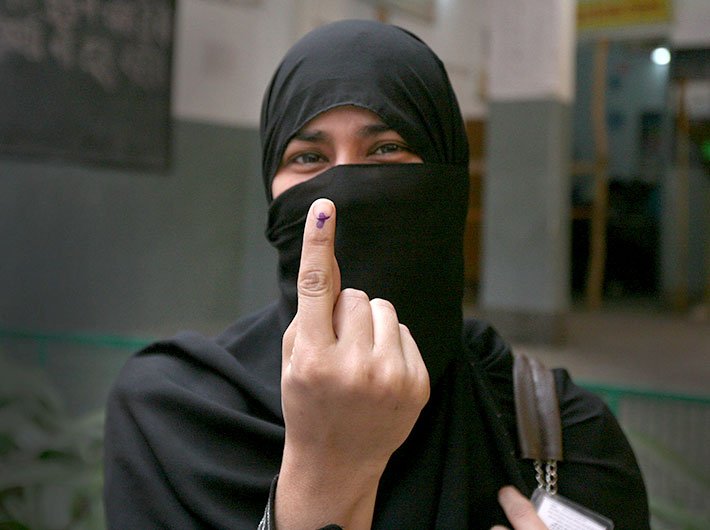
The election commission of India (ECI) is exploring the use of information technology in the voting process, as stated by the chief election commissioner, Nasim Zaidi, at an international seminar organised by ECI on Tuesday, titled ‘leveraging technology for transparent and credible elections’. 

Gujarat government is the first and only state that has introduced e-voting facility to its citizens. 

Moreover, he mentioned that to facilitate overseas Indians voters, the ECI is also developing an e-postal ballot facility. “We have recommended legislation on providing this facility. A safe technology has also been developed along with operational guidelines. The technology is being validated and tested currently,” Zaidi said.

ECI has set several digital goals to make electoral process in the country more integrated and transparent. These goals are part of e-governance vision 2020. Zaidi mentioned the key areas where focus would be -- to develop a national database that would serve all election-related information, to link each voter to information technology tools such as internet, smart phones, IVRS and SMS, to employ mobile technology for voting and grassroots work, to encourage the use of biometric GPRS-enabled handheld device to initiate doorstep electoral services and to develop a voice-based voting mechanism.

Addressing the challenges that come along with this technology, Zaidi said, “Employing internet voting or online voting may be explored by ECI in the long term though it will require serious consideration of the challenges posed by technology. We have to weigh between perceived and actual benefits with perceived and actual challenges associated with online voting. Security, secrecy of voting with encryption and end to end verification of voter are some of the most important considerations”.

Hence having a secure infrastructure is sacrosanct for the goal to be a success. “The biggest challenge in using information and communication technology (ICT) is ICT security, certification and third party auditing. No electoral democracy can afford to have a technology that fails at its simplest and can be manipulated or subjected to malpractices.  This can demolish the credibility of elections,” Zaidi said.

Sharing the achievements of the ECI over deploying the technology, Zaidi said that 38 IT applications have been developed and innovated at state and district levels. These applications have been categorised into providing services to voters, political parties, core election management with transparency and information sharing.
 

Comments


Other News

The Sardar biography that throws light on our times

Patel: A Life By Rajmohan Gandhi Aleph Books, 568 pages, Rs 1,199   There are many biographi

Climate change, El Niño rewrite Indian monsoon

The month of July exceeded its rainfall target despite forecasts of a below-normal month under a strengthening El Niño. The reason could be that climate change is amplifying monsoon complexity: West Pacific warming, Western Disturbances and evolving ocean conditions increasingly interact with El Ni&

Mumbai has just 1.28 sq.m. of open space per person: Study

Mumbai`s public space crisis is as much about mismanagement as it is about scarcity, and offers a governance roadmap that can be implemented without new legislation, according to a new report by the Urban Design Research Institute (UDRI) and the NGO Alliance for Governance and Renewal (NAGAR).  

Lok Sabha passes amendment bill to improve public examination system

The Lok Sabha on Wednesday passed the Public Examinations (Prevention of Unfair Means) Amendment Bill, 2026 by a voice vote after an extensive discussion. Replying to the debate, minister of state (independent charge) for science & technology; earth sciences and MoS in the PMO, Dr. Jite

Shri Abhijit Phukon (IES, 2004) appointed as Joint Secretary, Department of Agriculture & Farmers Welfare.

 Shri Abhijit Phukon (IES: 2004) has been appointed as Joint Secretary, Department of Agriculture & Farmers Welfare, Government of India. His appointment, approved by the

Shri Avanish Kumar Mishra (ISS, 2000) appointed as Joint Secretary, Department of Administrative Reforms & Public Grievances.

 Shri Avanish Kumar Mishra (ISS: 2000) has been appointed as Joint Secretary, Department of Administrative Reforms & Public Grievances (DARPG), Government of India. The appointment, approved by the Appointments

Upcoming Conferences


-->

Archives

Current Issue

Opinion

Facebook Twitter Google Plus Linkedin Subscribe Newsletter

Twitter






