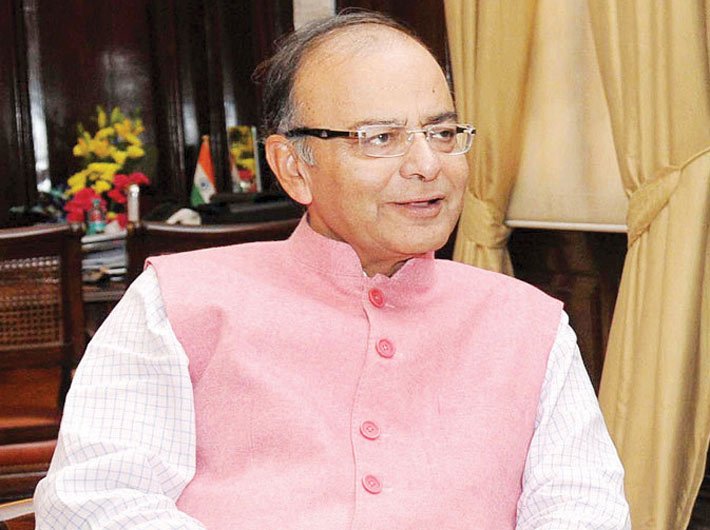
Finance minister Arun Jaitley has been playing the pivotal role when it comes to ensuring the delivery of a slew of initiatives the prime minister has been taking over the past year. His hands have been more than full with the extended budget session that saw him deftly piloting key legislations and the mammoth task of putting the economy back on track. Amid his busy schedule, Jaitley found time to respond to a series of questions from Governance Now on the ambitious financial inclusion drive and the challenges it faces. The text of the email interview:
The Pradhan Mantri Jan-Dhan Yojana (PMJDY) has emerged as the flagship initiative of the NDA government. In what ways does it help achieve the government’s overall vision?
The PMJDY has been launched with the objective of ensuring access to various financial services like availability of basic savings bank account, access to need-based credit, remittances facility, insurance and pension to the excluded sections, i.e., weaker sections and low-income groups. The NDA government believes that the fruits of development must reach the people at the margins and financial inclusion is the first step to reach governance to the doorstep of the needy and the poor. PMJDY combines effective use of technology to achieve deep penetration at affordable cost to reach all vulnerable sections of society. It is one of the main ingredients of the government’s overall vision of transparent and easy access to various services by all citizens.
Around 15.5 crore accounts opened, in nine months, without any increase in banking infrastructure and staff. Whom do you credit for this record-making achievement?
The credit for this stupendous achievement goes to the prime minister who supervised the whole scheme very closely. He sent his message to more than eight lakh bank employees. Of course, efforts of RBI, Indian banking industry, the will of people of India and the effective guidance and monitoring from the government of India worked to achieve the success. Around
1.25 lakh Bank Mitras played a very critical role in achieving this remarkable feat.
The public sector banks stretched themselves to meet the PMJDY targets, but the private sector was found lagging behind. Why?
Private sector banks have also played a significant role in meeting the PMJDY targets. However, the divergence from public sector banks comes mainly due to lower rural presence of private sector banks. We are continuously monitoring private sector banks to further boost their share in the success of Mission PMJDY.
The existing banking infrastructure – from staff to the ATM network – would come under strain with the addition of so many new accounts. How do you see banks coping with this?
The upgraded IT infrastructure of the alternate delivery channel has played a major role in coping with the strain created by addition of so many accounts. The network of 1.25 lakh Bank Mitras has also been used to cope with the strain. In fact, now many banks, for example, SBI, are using Bank Mitras for better recovery of loans as well as in expanding the credit.
With nearly every household having a bank account, a base has been created. How do you plan to effectively use this to ensure financial inclusion in the full sense?
For ensuring effective financial inclusion, various schemes have been linked with the bank account. Account holders will be provided overdraft, accidental insurance, personal insurance, RuPay debit card and these accounts are being used for direct benefit transfer (DBT-DBTL credits). These accounts will also work as a cornerstone for the insurance schemes, Pradhan Mantri Suraksha Bima Yojana and Pradhan Mantri Jeevan Jyoti Bima Yojana. The ascending figure in the balance accumulated in the PMJDY accounts shows that people have inculcated a habit of saving due to PMJDY.
Bankers are not happy with the overdraft provision, and have requested the finance ministry to set up a credit guarantee fund soon to cover possible delinquencies. What is your response to it?
To get over the concern of the credit guarantee fund, the MUDRA credit guarantee fund is proposed to be utilised, as the purpose for providing overdraft is mostly going to be the same.
The number of zero-balance accounts has reduced since the implementation of DBT. However, this alone will not ensure financial inclusion. Are you not hinging the success of the scheme on the DBT alone?
Only 7-8% accounts are receiving DBT credits as of now. The drastic reduction in the zero-balance accounts is mainly due to the awareness and inculcation of the saving habit in public at large.
Critics have warned of three main fault lines in PMJDY: multiple accounts for the same person, patchy coverage, and dormancy. How far do you think these concerns have been addressed?
We are conscious of these issues and taking steps towards mitigation. For de-duplication of accounts the facility of Aadhaar seeding is being used. The target of the mission was to open one account per household. There may be families not having a bank account even at this stage. However, the scheme is still open for citizens of India to open a bank account. The banks are still pursuing the goal of opening an account for each family. It may not be correct to call it a patchy coverage but we need to fill the gaps at the earliest. The use of DBT-DBTL credits by various agencies of the government and continuous improvement in balance in these accounts would eventually help deal with the issue of dormant accounts also.
In the budget speech you said that the widespread postal network will be used to increase people’s access to the formal financial system. A task-force report also recommended creating a Post Bank of India. Will it become a reality soon? How can the postal network help in financial inclusion?
As the outreach of post offices is large and postmen command certain respect in rural areas, this network will be highly useful to financial inclusion. People are accustomed to savings products in postal branches. NREGA DBT is also happening both through bank accounts as well as postal accounts.
It has been a common concern that too much stress on financial inclusion might affect the financial stability of banks. How do you react to this concern?
The accounts opened under PMJDY have in fact helped banks in garnering more CASA [current account, savings account] deposits and strengthen their economic stability. These accounts should not be treated as a liability as more and more usage of these accounts will prove to be a worthy asset for the bank.
When it comes to the settlement of insurance claims under PMJDY, the record so far is quite unimpressive. Your comments.
The main reason behind this is less awareness among the public about the modalities of the insurance schemes. We are continuously striving for more awareness and also monitoring the progress regularly. The new insurance products recently launched also address majority of the concerns with earlier insurance schemes.
How far will the RuPay card be effective in moving towards a cashless economy? Also, India has established its own clearing house or payment gateway for RuPay cards. Will it be used for existing credit/debit cards and save the commission outflow?
The government is committed to move towards a cashless digital economy. The RuPay card is a very effective tool for moving towards cashless transactions. More and more POS [point-of-sale] terminals, merchant terminals and micro ATMs are being enabled to support the RuPay card. I am sure the RuPay card will be the most favourite card of our people in the digital economy.