
How Kejriwal plans to wipe out Punjab’s drug menace

With assembly polls in sight, AAP chief says he has political will to fight the nexus

GN Bureau | March 11, 2016

#Badals   #Drugs   #Punjab   #Aam Aadmi Party   #Arvind Kejriwal   #politics  


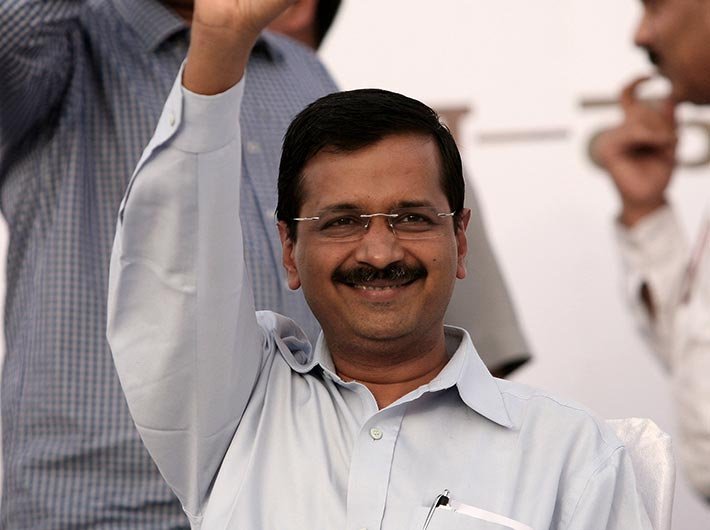
Delhi chief minister Arvind Kejriwal has a plan up his sleeves to tackle the grave problem of the open sale of narcotic drugs and rampant addiction among the youth in Punjab. “We will be able to make a significant dent in this in four months,” he claimed during an interaction with members of the Indian Women's Press Corps (IWPC) here on Thursday.

Kejriwal’s Aam Aadmi Party (AAP) is planning to contest next year’s Punjab assembly election. He says his party has studied the drug menace of Punjab. “There are addicts in each village and the problem is very serious,” he said.

“The drug problem in Punjab is created by a strong nexus of police, bureaucrats and top-rung politicians. Once this nexus is broken with honest leaders taking charge, I am sure in four months we will make a significant dent,” he added.

However, he said, while political will was important in rounding up drug peddlers, the rehabilitation of the addicts would be a major challenge.

Kejriwal, whose party had five MPs from Punjab in its maiden contest, claimed the mood of people in Punjab was in his favour. “People are dead against the Akalis; have tried the Congress many times and now they are in a mood to give us a chance,” he said.

Speaking on the drug menace in Punjab, Kejriwal said he was impressed by a group of youth who had launched a deaddiction campaign in the state. “I met a former addict who is now living in a shanty. He showed me a palatial bungalow and swaths of agriculture land nearby that he once owned and had lost it all for drugs.”

Kejriwal said that in case his party comes into power in Punjab, he would create a team of 15 volunteers in each village to help addicts.

Asked about his party’s alleged links with separatists in Punjab, Kejriwal quipped: “Give me one name; I will throw him out.”

Also read: The SAD saga of Punjab - How bad governance is good business in Punjab

Comments


Other News

Gandhian movement after Gandhi failed: Ram Guha

The Gandhian movement in India, after Gandhi’s death, failed, says Ramachandra Guha, and blames Vinoba Bhave for it. But the movement found new, fertile grounds around the world and succeeded in bringing about a change in South Africa, the US and elsewhere. It is high time it returned home. Of cour

When religion, politics and Bollywood come together

Tavleen Singh, noted journalist and political commentator, has turned to fiction, with her debut novel ‘The Actor’ (HaperCollins India). Set in the near future, it has a superstar, Amit Singh, turning to politics, when the political landscape is dominated by prime minister Guru Gaynendraj

Cabinet approves setting up of Integrated Transport & Logistics Authority

The union cabinet, chaired by prime minister Narendra Modi, on Tuesday approved the setting up of a Special Purpose Vehicle (SPV), called Integrated Transport & Logistics Authority (ITLA), to strengthen research, planning, appraisal, monitoring and impact assessment within the broad domains of Transp

Why foundational literacy and numeracy is key to school education

Foundational Literacy and Numeracy (FLN) are often described as the building blocks of education. Yet, their significance goes well beyond a child’s ability to read a sentence, write a response or solve a basic mathematical problem. These foundational skills shape how children understand the world,

When police data becomes the algorithm

For decades, policing has followed a familiar sequence: a crime occurs, the police respond, an investigation produces records and those records become part of the institutional memory of the criminal justice system. Artificial intelligence is beginning to alter that sequence. Instead of merely recording

Before India voted, the framers worried about the referee

“We are making a Constitution forever and not only for today.” Shibban Lal Saksena said this in the Constituent Assembly on June 15, 1949. He was warning that a ruling party might one day choose a loyalist to run India’s elections. Seventy-seven years later, the Supreme Court is wrestli


Upcoming Conferences


-->

Archives

Current Issue

Opinion

Facebook Twitter Google Plus Linkedin Subscribe Newsletter

Twitter





