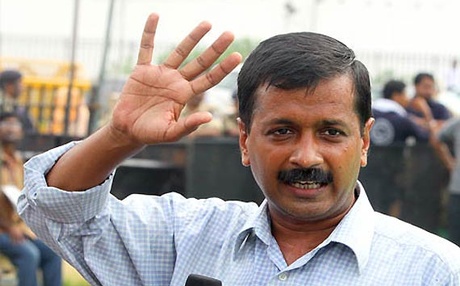
From entering the Modi-land to travelling in a local train in Mumbai, Kejriwal is leaving no stone unturned to recreate the magic of Delhi assembly elections
On his four-day tour to Gujarat on a fact-finding mission, Arvind Kejriwal took on the BJP's prime ministerial candidate and questioned Gujarat's development. He was briefly detained by the state police. Modi did not meet him and some BJP supporters reportedly attacked his car. AAP supporters then attacked the BJP headquarters in Delhi and clashed with workers in Lucknow.
Welcomed by a huge crowd of AAP activists in Mumbai, Kejriwal launched party’s campaign in Maharashtra. He travelled in an auto-rickshaw from the airport to the railway station, then boarded a local train.
While addressing a small gathering of Muslim leaders, Kejriwal said, “Congress has done nothing for the Muslims, just like the BJP has done nothing for Hindus. It is the miracle of Bhagwan and Allah that AAP has come into existence”. All of this helped the party and its leader garnered hours of prime television time and people’s attention.
Party’s anti-corruption agenda, road-shows, door-to-door campaigning and criticism of other political parties helped it to get connected with the voters in Delhi and it came across as an alternative during the Delhi assembly elections. People voted for him and had high hopes from his team when they formed the government.
But will AAP be able to recreate the same success on a national stage? Will it measure up as the best choice for an alternative? Not really, experts say.
Sandeep Shastri, a political scientist and national coordinator of Lokniti network, says the party must go beyond the politics of protest to get votes to win seats: "This strategy has been well planned and well thought of and it has given them enough visibility earlier as well. This will continue to keep them in the public and media eye. But will they be able to get enough votes to win a seat is the question? If they are not able to cross the threshold of winning a seat, they would remain a spoiler in the Lok Sabha elections."
But there are others like Manisha Priyam who see this as an inadequate sustained political activity by the party. Though Kejriwal, she says, is right in criticizing democracy and questioning the issues of minority: “He is making a point by criticizing Modi and his development model which is theoretically valid but party should have worked there on ground for a longer period before this. This is not coming across as a sustained political activity. Now it is a question whether this strategy will help the party to win votes.”
Despite the lack of an organisational base, the party has not just been able to attract some political heavyweights, but also charmed corporate honchos and activists. From captain G R Gopinath to TV journalist Ashutosh; from senior supreme court lawyer H S Phoolka to activist Medha Patkar. This has certainly helped the party get popularity. But Manisha says that party still has no alliance which can help them in long run: “The two states where the party was supposed to do well were Haryana and Punjab. And it was being said that Manpreet Badal of PPP will join hands. But that is not happening now and AAP has no large popular alliance.”
AAP’s spokeperson Deepak Bajpai sees this as a way to educate voters: “We are not in a crisis and not looking for any help. We are just trying to bring in the core issues on which the elections should be conducted. The Gujarat development model, which has been propagated by BJP, has been thoroughly checked by volunteers who have travelled across villages. And Arvind Kejriwal has only articulated it.”
Bajpai adds that party is just providing an alternative to people and it’s up to them to choose the government. “If we wanted to form the government or become prime minister, we would have picked up tainted leaders, but we are not doing that. We entered into politics for a cause and we are just educating voters who are dependent on media for all the election-related information.”
Bajpai admits that the odds against the AAP in the Lok Sabha polls are immense. “We are the only national party which has presence in all the states. But we are small, new and not structured enough and there are challenges in front of us. But people have hope that we will bring in change.”