Escalating tensions between Russia and Ukraine have made the Indian government worried if the market situation is conducive but it will go ahead with the upcoming initial public offering of the state-run insurance giant behemoth LIC, finance minister Nirmala Sitharaman has said.
“There is a buzz in the market and there is interest for the LIC IPO. We are going ahead with it,” she said, adding, “We are equally worried if the market situation is conducive.”
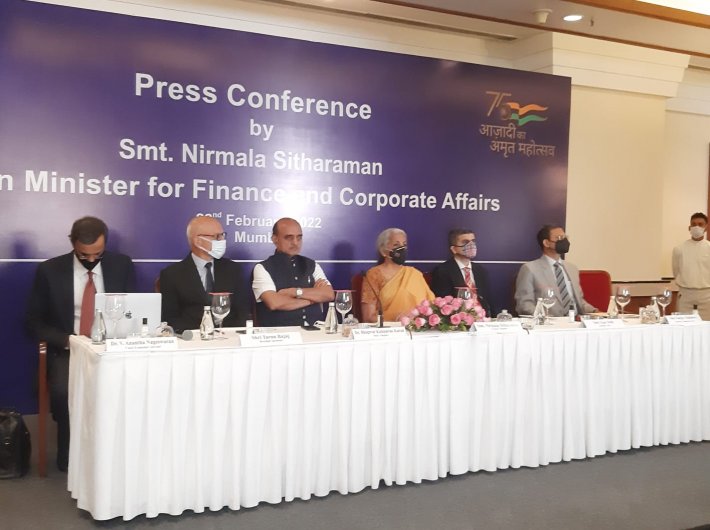
Sitharaman was speaking to reporters during her post-budget outreach press conference in Mumbai on Tuesday.
She said that the release of the draft red herring prospectus (DRHP) has fuelled interest in the LIC IPO. “I think the way it is crafted, it has generated a lot of interest.”
The DRHP for the LIC IPO, released on February 13, is for the sale of around 316.25 million shares (5%) of the government.
With the oil prices rising up sharply and crossing $99 per barrel a day earlier due to tensions in Eastern Europe, Sitharaman said, “Crude oil is a worrisome situation where we actually voiced that we wanted a diplomatic solution for the situation that is developing in Ukraine. All these headwinds on the crude... It is one of the very important considerations. We’ll have to see how it goes. We are keeping a watch on Brent.”
Adding that the prime minister had cut the fuel tax before Diwali in response to calls from public, she said, “The problem is that fuel prices are high because of global supply issues. What oil marketing companies do, I cannot answer. When we come to a stage that we need to take a decision on excise duty on fuel prices, we will come out publicly.”
Asked about the row between the centre and states over the payment of GST compensation to the latter, Sitharaman said there is "no adversarial relationship" between the two sides. “We all work together. The GST Council has itself decided that compensation cess will continue to be collected until March 2026. This will make up for the shortfall until now. This extension in GST compensation collection will also be used to pay interest on the borrowed money,” she said.
She further said that the finance ministers of all states participate in the GST council where decisions are taken. GST of all states is collected in front of everyone. Everything is transparently built in the system. Decisions are taken by the GST council and not by any individual.
In a lighter vein, Sitharaman added, “The Maharashtra finance minister is the chief of the group of ministers. We hold him in high regards.”
Speaking on the opposition’s claims that the government is misusing central agencies to put pressure on rivals, Sitharaman said, “ED is a law-enforcing agency which deals with predicate offence …which means there is an offence somewhere which is being acted upon and post that an offence created is coming under the PMLA (Prevention of Money Laundering Act) and only after which ED comes into picture. Without ground work and before an offence is already being investigated, ED cannot enter anywhere.”
When Governance Now sought a comment on banker Naina Lal Kidwai’s view on disinvestment – she said in recent Governance Now webinar that for disinvestment deals to happen it is important that investigative agencies do not revisit M&A deals 10-15 years down the line, Sitharaman said, “She is right.”
Sitharaman was in the financial capital on a two-day visit to hold discussions over the recent union budget with representatives of industry, trade and financial market.
Earlier in the day, she chaired a post-budget meeting with the heads of banks, NBFCs and financial institutions. She exhorted all banks to sign up to the account aggregator framework to improve the credit flow and promote digital lending. Her meeting emphasized that benefits of digital banking should reach every nook and corner of the country in a consumer-friendly manner.
She also chaired the 25th meeting of the Financial Stability and Development Council (FSDC). It deliberated on various mandates of FSDC and major macro-financial challenges arising in view of global and domestic developments.