
Mother of all data is out, zero-waste planning possible

socio-economic caste census figures will help in better management of govt schemes

GN Bureau | July 3, 2015

#planning   #government   #schemes   #rural households   #finance minister   #arun jaitley  


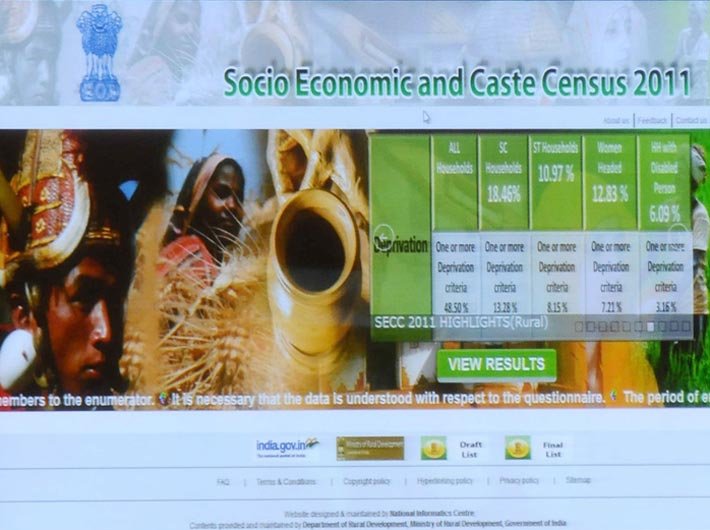
This could be mother of all data. Finance minister Arun Jaitley has released socio-economic caste census for 2011, which will form basis for governments targeted policy planning. The current figures are for the rural areas after covering all the 640 districts of the country.

The data will come very handy in housing for all, education and skills thrust, MGNREGA, national food security act and other welfare schemes. The SECC 2011 is a unique paperless census and date has been collected at every household level.

It addresses the multi dimensionality of poverty and provides for evidence based planning with a gram panchayat as a unit.

Underscoring the importance of the SECC, Jaitley said the document will reflect the reality of India and be a very important input for all policymakers both for the central and state governments.

This is the first Census released after 1932 and contains various details with regard to specific regions, communities, caste and economic groups and measures the progress of the households in India. “It is after 7-8 decades that we have this document after 1932 of the caste census. It is also a document which contains various details ... who are the ones who have qualitatively moved up in terms of life, which are the ones both in terms of geographical regions, social groupings which in future planning needs to be targeted,” Jaitley said. 

“The enormity of schemes and reaches that all governments have, this document will form a basis of helping us target groups for support in terms of policy planning,” Jaitley told reporters in New Delhi on Friday.

How SECC data collected and why it is important?

The enumeration of the data was done using over 6.4 lakh electronic handheld device. Household data was taken from the National Population Register along with the Temporary Identification Number (TIN).

At each stage there was an opportunity for transparency and grievance redressal. A total of 1.24 crore claims and objections were received of which 99.7% have already been resolved.

Gram panchayats and gram sabhas were involved in this process, besides school teachers and data entry operators as enumerators.

The districts and state governments have carried out the SECC with the ministry of rural development as the nodal ministry.

Ministry of housing and urban poverty alleviation carried out the survey in urban areas and the registrar general, census of India carried out the caste census.

It provides very useful data on households regarding various aspects of their socio-economic status – housing, land-holding/landlessness, educational status, status of women, the differently able, occupation, possession of assets, SC/ST households, incomes, etc.

The Ministry of Rural Development has taken a decision to use the SECC data in all its programmes.

The household data is also available for planners of programmes at state, district, block, gram panchayat and village level.

SECC provides an opportunity to simultaneously address the multi-dimensionality of poverty by addressing the deprivation of households in education, skills, housing, employment, health, nutrition, water, sanitation, social and gender mobilization and entitlement.

The use of the NPR TIN Number across programmes affords an opportunity to track the progress of households over the years.

 Full report: click here

Comments


Other News

AI: Code, Control, Conquer

India today stands at a critical juncture in the area of artificial intelligence. While the country is among the fastest adopters of AI in the world, it remains heavily reliant on technologies developed elsewhere. This paradox, experts warn, cannot persist if India seeks technological sovereignty.

RBI pauses to assess inflation risks, policy transmission

The Reserve Bank of India (RBI) has begun the new fiscal year with a calibrated pause, keeping the repo rate unchanged at 5.25 per cent in its April Monetary Policy Committee (MPC) meeting. The decision, taken unanimously, reflects a shift from aggressive policy action to cautious observation after a signi

New pathways for tourism growth

Traditionally, India’s tourism policy has been based on three main components: the number of visitors, building tourist attractions and providing facilities for tourists. Due to the increase in climate-related issues and environmental destruction that occurred over previous years, policymakers have b

Is the US a superpower anymore?

On April 8, hours after warning that “a whole civilisation will die tonight,” US president Donald Trump, exhibiting his unique style of retreating from high-voltage brinkmanship, announced that he agreed to a two-week ceasefire with Iran. The weekend talks in Islamabad have failed and the futur

Machines communicate, humans connect

There is a moment every event professional knows—the kind that arrives without warning, usually an hour before the curtain rises. Months of meticulous planning are in place. And then comes the call: “We’ll also need a projector. For the slides.”   No email

Why India is entering a ‘stagflation lite’ phase

India’s macroeconomic narrative is quietly shifting—from a rare “Goldilocks” equilibrium of stable growth and contained inflation to a more fragile phase where external shocks are beginning to dominate domestic policy outcomes. The numbers still look reassuring at first glance: GDP


Archives

Current Issue

Opinion

Facebook Twitter Google Plus Linkedin Subscribe Newsletter

Twitter






