On the New Year’s day, Mumbai, India’s financial capital, recorded the second worst air quality index (AQI) since 2016. On Thursday it worsened and dropped to 'very poor' category.
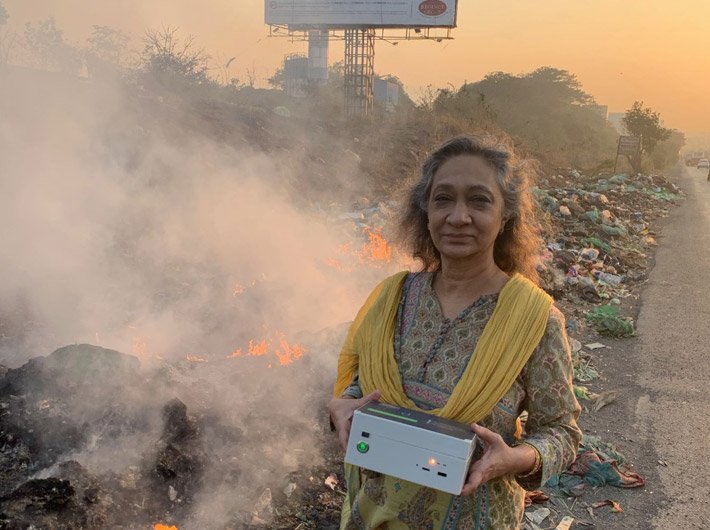
Pointing this out, city-based anti-pollution activist Sumaira Abdulali has written a letter to Maharashtra environment minister Aaditya Thackeray, saying that the burning at garbage dumps is increasing pollution levels.
She has appealed the state government to identify every individual source of localised air pollution and tackling them one by one. Unless this is done, it is impossible to control air pollution solely through generalised air quality index (AQI) monitoring, she adds. “In several countries localised information about air pollution sources are used to augment AQI data,” she says.
Abdulali, convenor, Awaaz Foundation, a member of the Clean Air Collective, has said that since 2016,the NGO has documented numerous sites of burning garbage in Panvel, Dharamtar, Poynad, Chondi and others along the Mumbai-Alibag road, the garbage disposal site at Alibag city centre, Bhiwandi, Kalher and other sites in Thane district and found that in absence of adequate municipal systems for disposal daily heaps of garbage is lining highways and roadsides.
“Burning is the easiest disposal and many of these dumps are deliberately or accidentally set on fire. Numerous heaps of burning garbage which are ubiquitous along roadsides in areas surrounding Mumbai are not identified as part of any specific initiative. These garbage dumps consist of mixed bio-mass and plastic and are a major contributing source of localized air pollution. The NGO Waatavaran conducted a one-month long test on air pollution in Taloja, Bhiwandi Panvel in Thane and Raigad districts and found that people were exposed to 17 hours a day of unhealthy exposure of extremely high level of air pollutants. There are no AQI monitoring systems in these areas most of which are recognized among the 18 non-attainment cities of Maharashtra and among the most polluted in the country. There is also no comprehensive data on the sources of pollution,” she writes in the letter.
Awaaz Foundation measured PM2.5 at some of these sites and found that pollution levels had a direct co-relation with the size of the garbage dump burning with the dump at Bhiwandi stretching for several kilometers alongside a busy road showing the highest level of PM2.5. The measurements were taken at 1-minute, 5-minute and 15-minute intervals at various times from January to December 2020. PM2.5 at Bhiwandi at 1-minute intervals recorded 612µ/mg3, at Panvel Naka - 182µ/mg3, and at Dharamtar it was 181µ/mg3.
PM2.5 are minute particles of 2.5 micrograms or smaller in diameter and contain a mixture of solids and liquids that include acids like sulfates, nitrates, ammonium, carbon and mineral dust.
Emissions are a major cause of climate change and burning plastic is especially toxic and can cause cancer, liver failure, respiratory and other diseases.
Mumbai is one of 40 cities worldwide committed to reduce emissions by 2030. Abdulali has appealed to the environment minister to ask all civic body across Maharashtra to prepare a road map to ensure no garbage is burnt as well as implement solid waste management rules to stop waste burning across the state on a priority basis.
She also cited the report of the Indian council of medical research (ICMR) published on December 22, 2020, listing ‘air pollution control initiatives’ which include reference to the ‘Promotion of Agricultural Mechanisation for in-situ management of crop residue in the states of Punjab, Haryana, Uttar Pradesh and NCR of Delhi’ and that 160.8 million US$ from 2018-2020 were released to tackle air pollution and subsidize machinery required for in-situ management of crop residue in these states.
“In Delhi, air pollution from burning stubble (a bio-mass) contributes to its status as one of the most air polluted cities in the world. As per the ICMR report, 1,39,118 people, i.e.; overall 16.7% people had premature air pollution related deaths in Maharashtra, the second highest number of air pollution related deaths in India even as it pegged GDP loss of Rs 7,200 crore due to air pollution. We request that lessons learned from the year 2020 when we saw both the cleanest air in decades as well as the first detailed reports of the actual death rate by air pollution and the GDP loss will result in a long-term action plan,” says Abdulali.