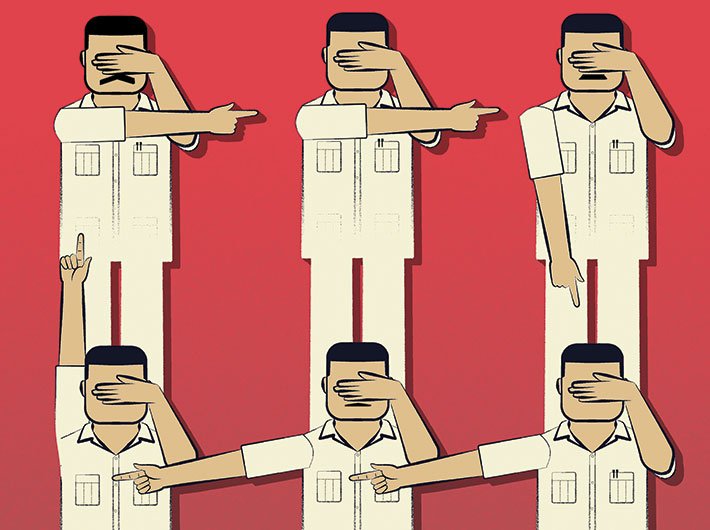
Lack of accountability in bureaucracy leads to results callous – and hilarious. Here is what needs to be done
We recently witnessed the shameful spectacle of a tribal girl’s death from starvation due to her inability to link her Aadhaar to her ration card. Once the media got hold of the story, all persons involved in the reprehensible episode, from ministers to village workers, started denying responsibility. Then there was the news story about the person who had to wait for hours in a queue at the AIIMS, till his daughter died. This person was also denied an ambulance; so he had to carry his daughter’s body on his shoulders to his house. A young boy in Andhra Pradesh committed suicide because he was not able to get Aadhaar – which would have enabled him to continue with his scholarship – because of a congenital deformity. In the two latter incidents also, all levels of officialdom denied all responsibility.
Such incidents, while highlighting the declining compassion in our society, also point to some serious deficiency in our administrative system. If the government is really serious about reforms, it should do adequate homework and dry runs before launching any scheme touching the lives of a large number of people. Additionally, all social welfare schemes should provide for human vagaries and disabilities because most of the beneficiaries of government schemes are uneducated and computer illiterate.
It seems that to appear enterprising and fleet-footed, the government is unleashing myriad social benefit schemes based solely on version 1.0 of a computer programme. Computers were invented to solve complex mathematical problems, launch rockets and perform other similar functions. Launching huge schemes in this manner, without adequate homework, is downright criminal and many a time even counterproductive. The loan waiver certificates of meagre amounts issued by the UP government fall in the latter category. Often the results of wrongly placed reliance on substandard technology are hilarious. People who have paid income tax for some time would perhaps remember that some years ago the income tax department went on a notice-issuing spree, sending out demand notices and refunds for amounts as low as Re 1.
Exclusion from PDS benefits has resulted in two more starvation deaths in Chhattisgarh, showing that the death of the tribal girl (mentioned earlier) was not an isolated tragedy. Unfortunately, the aftermath of such tragic incidents does not result in immediate corrective action but follows quite another pattern. Firstly, an attempt is made to trivialise the tragedy. If that does not succeed, all persons involved in the incident issue statements denying responsibility. If the public furore continues, an enquiry is ordered. In very serious cases, an FIR is lodged with the police. The ultimate result, however, is the same in all cases. After some months, things return to normal and everyone goes back to what he was doing earlier.
Look at what happened after the Commonwealth Games fiasco. Not a single penny was recovered from the persons who swindled the government of hundreds of crores of rupees. Some politicians went to jail for some time but now the officials are back in their offices and the politicians are back to their politics. Exactly the same thing happened after the Bofors and 2G scams. The Gorakhpur hospital tragedy and the Khatauli rail mishap this year are following this very script.
In the current scenario, often nothing happens even after responsibility is fixed. The infamous cases of Gujarat cadre police officers, who were reinstated in office while out on bail for murder, is a case in point. The supreme court had to interfere to remove them from office. In a similar instance, doctors and policemen convicted in the Bilquis Bano rape case were reinstated in government service, drawing the supreme court’s ire. No action has been taken against the investigating officers in the Aarushi Talwar case, whom the Allahabad high court found to be involved in suborning witnesses and tampering with evidence.
Actually, as these instances would show, the worst enemy of accountability is the government itself, which gets some trusted officers to do its dirty work. Sometimes such officers are caught in flagrante delicto and the government rescues them to stop them (the officers) from spilling the beans. A glaring example of the government’s desire to protect its employees at all costs is the bill introduced by the Rajasthan government criminalising the reporting of misdemeanours of government servants.
Even otherwise, given the complex procedures, punishing a government employee for his sins of omission is a very arduous and time consuming task. CCS (CCA) Rules would have to be rewritten to provide for time-bound completion of disciplinary proceedings against a government employee.
The monolithic structure of the government, bequeathed to us by the British, successfully thwarts all attempts at enforcing accountability. Lack of accountability suited the British government in India because they had to suppress a freedom movement but in a democracy, lack of accountability is a bane for the administration.
Another reason for lack of accountability is the file system followed in the government for the last two centuries which ensures that all decisions taken by the bureaucracy can be portrayed as collective decisions; meaning thereby that no one can be held responsible for any decision. This is the reason why bureaucrats want file notings to be taken out of the RTI Act ambit.
What should be done to ensure accountability? Firstly, all government employees dealing with the public should be sensitised about their exact role; which is that of a facilitator rather than that of an impeder. Many a time lower level government functionaries stonewall requests only because they are not sure of the correct procedure and think that a “no” is the safest option; such employees have to be re-educated. In fact, the directive issued in Rajiv Gandhi’s time that all government employees have to attend one week’s training every year was a very sound one, the only problem being that it was never implemented.
Secondly, the plethora of rules and sub-rules on any conceivable topic which only bureaucrats can understand should be replaced by general guidelines drafted in simple language. When everyone is clear about the course of action to be taken in a particular case, it would be difficult for a bureaucrat not to act in that fashion.
Thirdly, the concept of collective responsibility needs to be discarded. All files should be maintained on a central server; then no files would be lost or tampered with. The file should go straight to the officer authorised to decide on it. This would expedite decision-making and ensure that a single person is responsible for the decision taken by him. It would also result in substantial savings because it would obviate the necessity of having an army of peons who only carry files from one desk to another.
Fourthly, going against the current wisdom which mandates that there should be no discretion with government employees, there should always be a provision for taking a decision in cases ‘not’ covered by guidelines. This would cover cases of people who are not able to benefit from government schemes for reasons beyond their control, for example, not being able to obtain Aadhaar or link Aadhaar or whatever. Action should be taken against officers who do not exercise their discretion to give each citizen his due.
Some years ago, most state governments passed Right to Public Services (RTPS) Acts, prescribing punishment to government employees not providing services in time, but the situation on the ground has not changed much. No great research is required to reach this conclusion; one can gauge the efficacy of these Acts by going through local newspapers which often mention instances of denial of public services. Even the Right to Public Services websites are not updated. For instance, the Bihar website says “Within the first month, 1,574,989 applications had been filed under RTPS with more than 86,000 disposed of successfully. Many parts of the programme are still in the development stage and some enhancements are in planning”, which appears to be a reference dating back to August 2011. The websites of other states are little better. Also there is no known instance of any official being punished for not delivering some service to a citizen on time. In light of these facts, one can safely conclude that lack of accountability has seriously eroded the government’s efforts to provide essential services to its citizens in a timely manner.
Finally, keeping in mind the results of our earlier half-hearted experiments at enforcing accountability, only a complete revamp of government processes can ensure accountability in our bureaucracy.
Saksena, an IRS officer of 1979 batch, retired as principal chief commissioner of income-tax, Mumbai, last year.
(The article appears in November 15, 2017 edition)