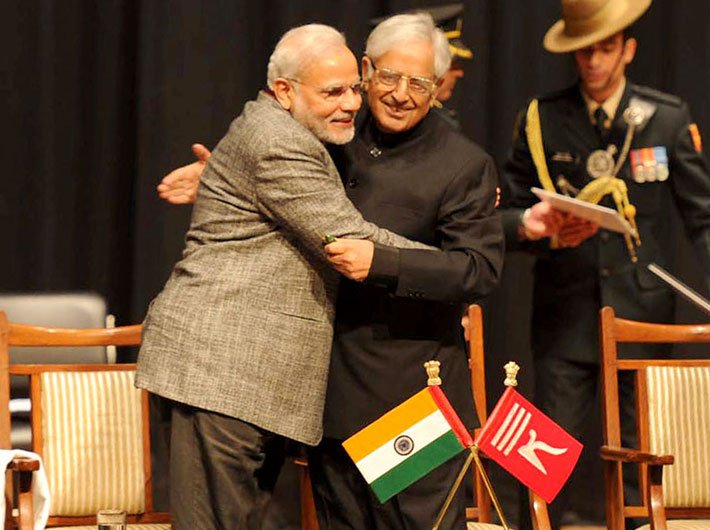
As the saying goes, politics is the art of the possible. A political drama on the same lines is unfolding in Jammu and Kashmir where the foes, Peoples Democratic Party (PDP) and Bharatiya Janata Party (BJP), are at the cusp of turning friends; promising to handhold each other for sharing power for six years.
The two parties have clinched a deal after two months of negotiations, haggling and working out the optics of the final act meticulously so that neither of them appears to be a loser in the eyes of the people. Looking at the history of coalition politics in India, the PDP-BJP government should be the most adventurist venture so far.
With 79-year-old Mufti Mohammad Sayeed as the chief minister and BJP’s Dr Nirmal Singh his deputy for the full six-year term, the coalition did not go for a repeat of the rotational chief minister formula in view of the failure of this model in the past (the PDP-Congress government had collapsed as the PDP withdrew its support in 2008).
For Mufti, who takes pride in being considered an efficient administrator and largely owes his success to the charisma of his daughter Mehbooba Mufti, has become the chief minister a second time. For the BJP, however, this is a historic moment, for the saffron party has never ruled the state that is at the core of its political ideology.
Looking into the not so remote history one can figure out why the BJP should be ecstatic and the PDP cautious in this marriage of convenience. The BJP’s unease with India’s only Muslim-majority state began soon after the constitution bestowed a special status on J&K entitling it to have its separate flag, constitution and other frills of authority. Syama Prasad Mookerjee, the leader of the Jana Sangh (BJP’s precursor), was the first to question the state-within-state status of J&K. In 1953, Mookerjee entered J&K without a permit – Indians were required to have one at that time. He was jailed for breaking the law of the land and he died in prison under rather suspicious circumstances.
His death gave grist to the Sangh Parivar’s nationalistic fervour which gradually evolved and culminated into the demolition of Babri Masjid. Soon, however, the BJP, a face of Hindu nationalistic forces, came into reckoning as India’s mainstream party and came to power in Delhi. However, for some reasons, the BJP has never come close to even thinking of becoming a ruling party in J&K, till the advent of Narendra Modi as a national leader in 2014.
So, sharing power in J&K is a dream come true for the Sangh Parivar and a vindication of its political stand. This is why the BJP did not mind playing a minor partner in the proposed coalition government with the PDP, after targeting it as ‘Baap-beti party’ during the election campaign.
However, for Mufti Sayeed, joining hands with the BJP remains a calculated risk fraught with challenges. In popular perception in Kashmir, from where the party has got the bulk of its 28 seats in the assembly elections, is that the PDP has joined hands with a party that seeks to end the special status of Kashmir. Social media is already abuzz with criticism of the Muftis joining hands with ‘Hindutva’ (read anti-Muslim) forces to come to power. Some analysts wanted Mufti Sayeed to take lessons from Aam Aadmi Party (AAP) and remain uncompromising like Arvind Kejriwal. In fact, Mufti did not want to be seen as rushing through a power-sharing deal with the BJP. He deliberately created the scenes of intense consultations and negotiations over government formation for two months.
On a pragmatic note, the leaders of the two parties maintained a not-so secret link right from the day results were announced. While the BJP was led by the BJP general secretary Ram Madhav, for the PDP its chief Mehbooba Mufti was dealing with it. Much of their time was spent on picking the politically ambiguous language for an all-pleasing common minimum programme (CMP) document. The PDP was keen to focus on some emotive issues like Article 370 and Armed Forces Special Powers Act (AFSPA) while the BJP was keen to have a clause on the West Pakistan refugees and equitable share of funds to Jammu and Ladakh region inserted in it.
On the ground level, however, the PDP-BJP government would be run on the slogan of good governance and all contentious issues will be embargoed.
Sources say that while the BJP is in no position to scrap Article 370 and AFSPA lifting will have to be linked to the security scenario in South Asia, it has allowed the PDP to get its wishlist inserted in the CMP. However, the saffron party put its foot down on the issue of the settlement of West Pakistan refugees before the PDP.
J&K is a unique place in the subcontinent where some 3,00,000 people are citizens and yet destined to live without any citizenship rights. These people, called West Pakistan refugees, had migrated from what is now Pakistan to Jammu and Kashmir during the partition and subsequent Indo-Pak wars. Since they did not hail from the erstwhile state of J&K, they were treated as citizens of India but not of J&K. Likewise, they are entitled to vote in the Lok Sabha elections but not in the state and local elections. These people, mostly living in Jammu region, are in abject poverty as most of them have no jobs or property in J&K.
The Narendra Modi government in its early days announced land allotment to these people in J&K. This is a red rag to the PDP, which sees the move as the BJP’s attempts to dilute Article 370. While the BJP sees the refugee resettlement as a humanitarian issue, the PDP and other parties like the National Conference accuse it of trying to settle Hindus in the state to change its Muslim-majority character. The PDP is finally believed to have yielded to this demand.
Mufti Sayeed, on the other hand, sees this arrangement as an opportunity to expand his party’s base in Jammu region and to have a role in national politics.
He has defended it openly by admitting that since the BJP had emerged as a dominant political force from the Hindu majority Jammu region, treating it as untouchable would lead to further differences between the two regions of the state. He is also hoping the Narendra Modi government to be liberal with allocation of funds for J&K’s development.
However, on the flip side, both the BJP and PDP are facing criticism of entering into a marriage of convenience. The RSS has warned the BJP against getting cosy with those who are out to help separatists.
One thing is sure: if the coalition succeeds, it would become a test case for Indian politics.
[email protected]
(Original article appeared in March 1-15, 2015, issue)